


“The trees are starting to die.” That was the thought that crossed the mind of Eli Shashua, 38, a resident of the community of Sansana and a licensed tour guide, as he walked through the Sansana Forest in the Yatir region in recent months. “When you step outside the community and look out, you see that most of the tree cover is simply gray,” he said.
At this time of year, the forest should be entirely green, with anemones and irises soon in bloom. Sansana Forest lies in the southern Hebron Hills, between Lahav Forest and Yatir Forest. Its trees were planted in the 1960s, alongside the plantings in Lahav and Dvira forests. “As children, we went out to plant trees on Tu Bishvat, and as a tour guide, I take visitors from all over the world to plant trees in the Land of Israel. JNF forests defined the Israeli landscape,” Shashua said.
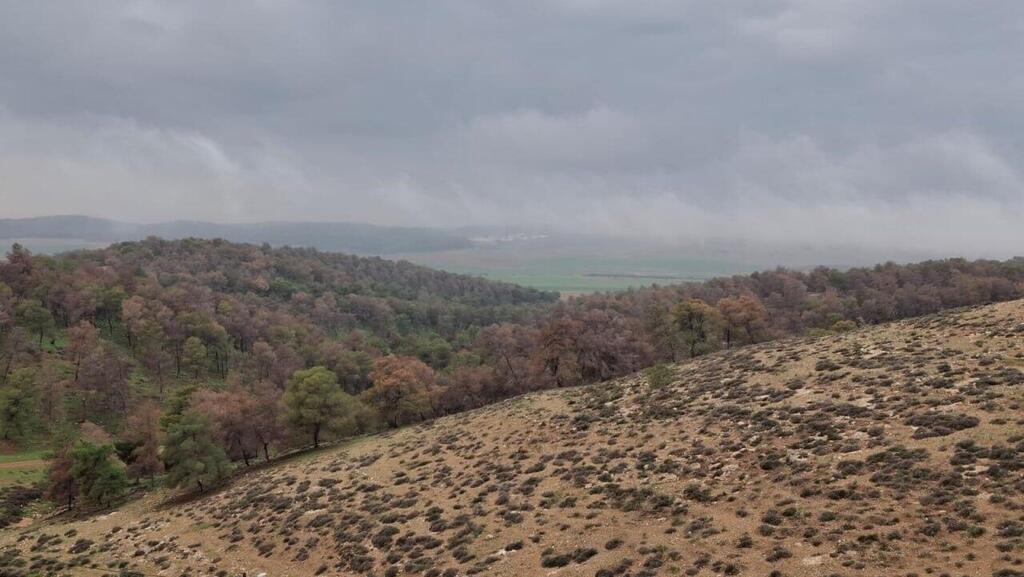
In addition to dead trees, he has also noticed felled ones. “You see clearings where there used to be trees. More and more residents are noticing it. We always took pride in being a country where the number of trees keeps growing because we plant, and quietly, these forests are disappearing. And it’s as if no one is bothered.”
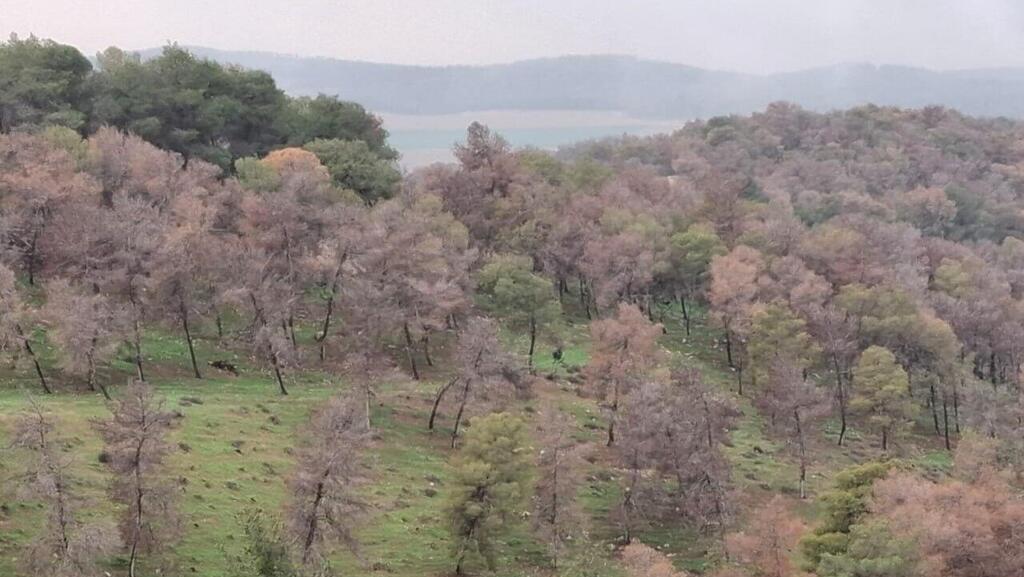
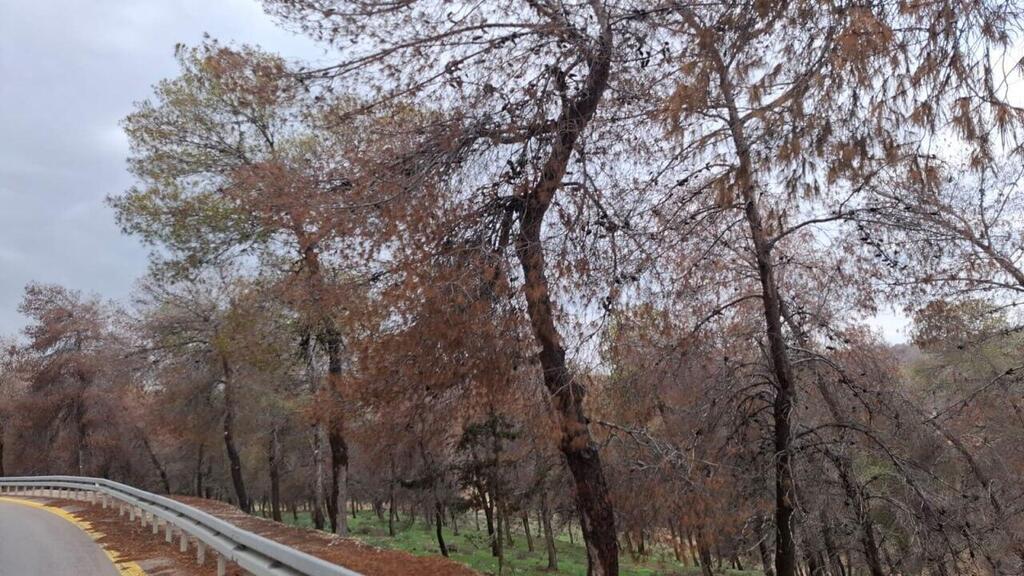
Dr. Shili Dor-Haim, head of the Forest Management and Information Department at the Jewish National Fund’s Forestry Division, confirms Shashua’s impressions: JNF forests in southern Israel are indeed in slow decline. Prolonged droughts and a sharp drop in rainfall in recent years — particularly in 2025, when only 50% to 67% of the annual average precipitation fell — have caused severe drying among conifer trees in the south. “The phenomenon has led to widespread damage to forests, with unprecedented tree mortality rates,” she said.
Damage in Sansana Forest, which lies about 500 meters (1,640 feet) above sea level, has been relatively limited compared with other forests. In Carmim Forest, which covers about 9,500 dunams (roughly 2,350 acres) and is largely made up of Jerusalem pine, massive tree die-off has been observed. Damage has also been recorded in the Shikma, Meitar, Lachish, Yatir, Dudaim and Gerar forests. In an initial remote-sensing survey of about 100,000 dunams of southern forests, spanning from the Be’eri area to Yatir Forest, more than 50% mortality was observed among conifers, mainly cypress trees.
(Photo: Eli Shashua)
JNF has begun mapping and assessing the condition of the forests while planning renewal and rehabilitation efforts. All actions, officials say, will be carried out in accordance with principles outlined in a climate-change forest management preparedness document and an updated policy for forest establishment and renewal. These are based on a changing climate reality already familiar to Israelis: rising temperatures, declining rainfall intensity and frequency, and prolonged dry periods. Average annual rainfall typically stands at about 250 millimeters (nearly 10 inches), but in recent years, less than 150 millimeters (about 6 inches) have fallen annually.
The policy aims to ensure the long-term resilience of forests by adapting tree species, management methods and ecological planning to high-risk areas. JNF will have to adjust forest conservation practices to climate change, match vegetation to habitats and encourage natural processes and native species, while preserving the continuity and size of forested areas.
Some have long warned about afforestation policy in the Negev. Alon Rothschild, director of biodiversity policy at the Society for the Protection of Nature in Israel, has written about the environmental damage caused by afforestation, noting that in the 1950s, trees were planted to assert sovereignty in disputed areas. Today, JNF plantings have also led to tensions with the Bedouin population in the Negev. “Israel’s potential for afforestation on a scale that would make a meaningful contribution to mitigating climate change is negligible,” Rothschild wrote in one article. Studies have also found that in bright areas with high solar reflectivity, forests can have a warming effect. “It takes decades to achieve a net positive contribution — about 80 years in the Yatir region, for example.”
“We are seeing extensive tree mortality in recent months in the northern and western Negev,” Dor-Haim said. “We need to map and thoroughly examine the scope of the phenomenon in order to know how to deal with it. This past winter, we saw high-intensity rainfall, and we need to see how rainfall can be retained within forest areas, which act as buffers for the extreme events we are experiencing. We want to support our forests in desert regions.”
(Photo: Eli Shashua)
The fact that such widespread tree mortality is occurring virtually under the foresters’ noses is troubling. “We are still in the mapping process,” Dor-Haim explained. “First, we want to understand which species are most affected. Why are we seeing this specifically now? In recent years, Israel has experienced very severe droughts, which have had a physiological impact on trees. At the Shaked Patrol Park,” — a roughly 6,000-dunam park that includes a research station working to prevent desertification — “there was a massive die-off of shrubs. Many years of drought cause plants to become extremely vulnerable due to water shortages and temperature stress. Eventually, they reach a point of no return and collapse and die.”
“Why did you wait until now?” Shashua asked. “This is a symbol of the Zionist enterprise, and damage to the brand known as JNF. We are not going to give up on our forest so quickly.”