

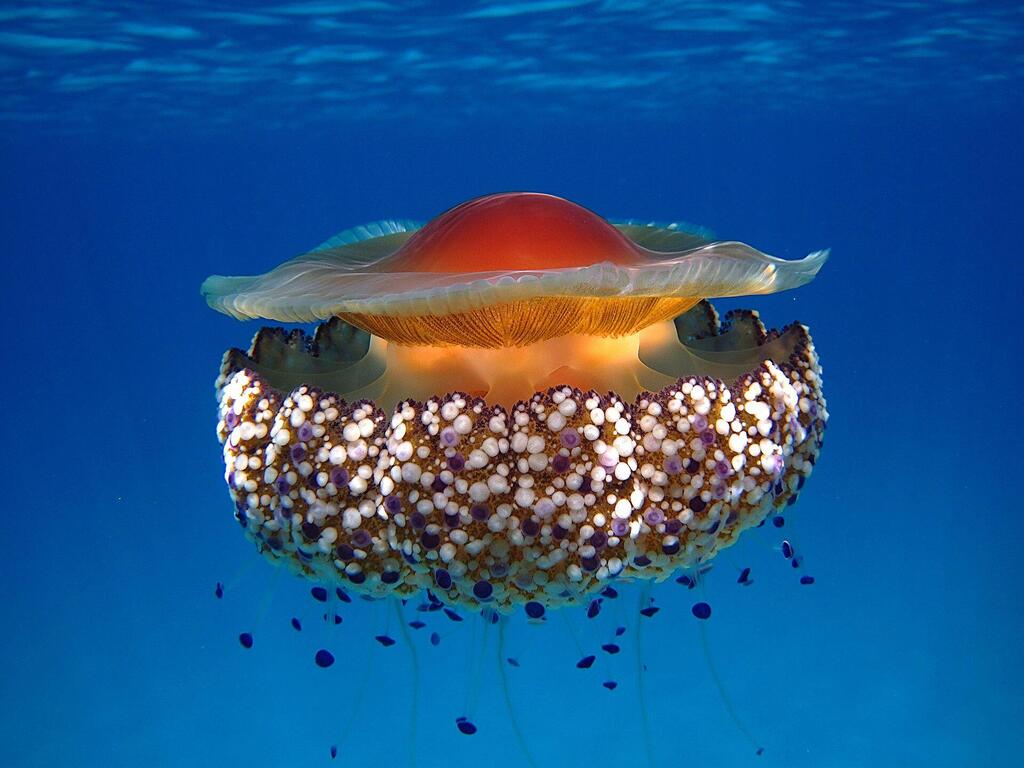
Among the many jellyfish found in the Mediterranean, one stands out for a reason that is immediately obvious: it looks remarkably like a fried egg.
The so-called fried egg jellyfish is one of the most striking and photogenic gelatinous creatures in the region. It lives in partnership with symbiotic algae, has an unusual life cycle and, scientists now understand, a digestive system more complex than once thought.
Mediterranean fried egg jellyfish off Palmachim Beach
(Video: Shlomi Yitzhaki, Israel Nature and Parks Authority)


To better understand the species, we spoke with Prof. Dror Angel of the Recanati Institute for Maritime Studies and the Department of Maritime Civilizations at the University of Haifa, who also serves as director general of the Meduzot Ba’am association and has studied jellyfish for decades.
Why is it called the fried egg jellyfish?
“The common name ‘fried egg jellyfish’ comes from its unique appearance,” Angel said. “When you look at it from above, there is a dark yellow-orange bulge in the center that looks exactly like a yolk, surrounded by white edges that complete the appearance of egg white.”
Its scientific name is Cotylorhiza tuberculata, a species common in the central and western Mediterranean. In the eastern Mediterranean, including waters off Israel, a related species called Cotylorhiza erythraea is found and tends to be less colorful.
Does it sting?
“All jellyfish belong to the phylum Cnidaria and have stinging cells designed to immobilize their prey,” Angel said. “But not every jellyfish stings us with the same degree of pain.” The fried egg jellyfish’s venom is intended for small organisms, and most people are not particularly sensitive to it. “The sting we feel when we encounter a jellyfish in the sea is not because the jellyfish wants to sting us, but because we come into contact with its hunting arms,” he explained.
Unlike the nomad jellyfish, which can appear in enormous swarms along Israeli beaches, fried egg jellyfish are generally seen alone or in small groups and are considered far less troublesome for swimmers.
What eats them, and what do they eat?
Fried egg jellyfish themselves provide food for many animals, including sea turtles, fish and birds. “Jellyfish in general are an integral part of the marine food web,” Angel said, adding that in some parts of the world people also eat certain jellyfish species.
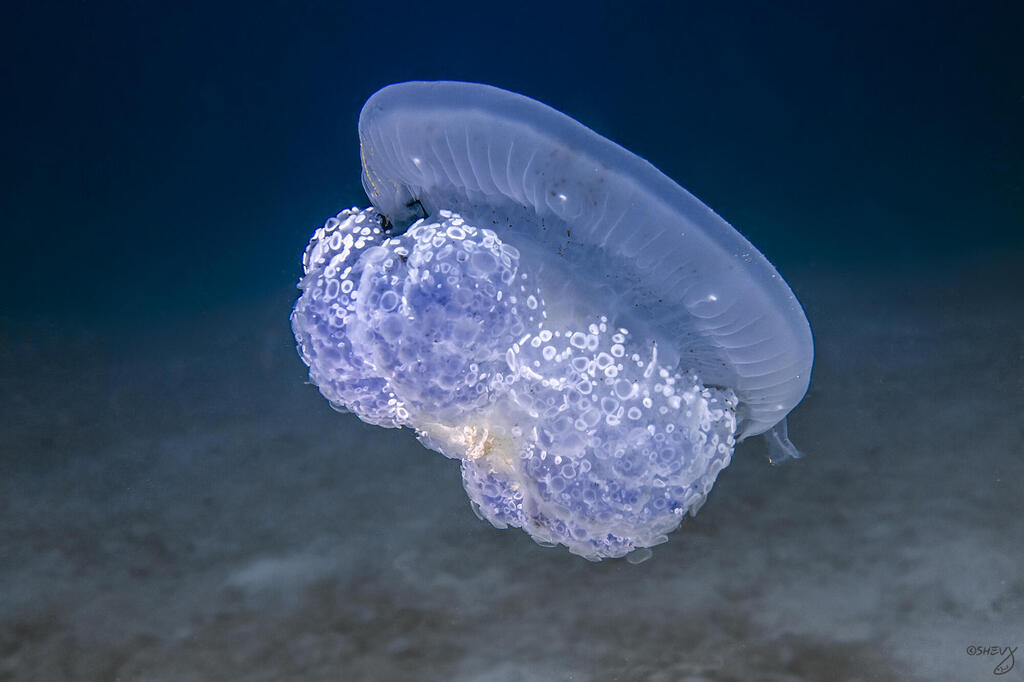
The fried egg jellyfish feeds on different types of plankton, including tiny crustaceans, putting it in competition for food with young fish. But hunting is only part of its nutritional strategy. “One of its most fascinating characteristics is that, much like corals, symbiotic algae live inside its tissues,” Angel said.
The jellyfish gives the algae shelter and protection, while the algae use photosynthesis to produce organic matter that helps feed their host. Because photosynthesis depends on sunlight, the jellyfish is found mainly in shallow waters. “This is critical for them,” Angel said. “Without the symbiotic algae, these jellyfish cannot complete their life cycle and produce new jellyfish.”
(Photo: Dr. Shevy Rothman)
How are jellyfish born?
Adult jellyfish release reproductive cells into the water. After fertilization, tiny larvae form and search for a surface on the seabed where they can attach themselves. There they develop into polyps, stationary organisms resembling tiny sea anemones that can survive for months or even years.
Each polyp must acquire symbiotic algae from the surrounding water before it can move on to the next stage of its life cycle. “When environmental conditions are suitable, polyps containing algae undergo a process called strobilation,” Angel explained.
During this process, they produce numerous tiny discs that detach into the water as miniature jellyfish and gradually grow into adults.
What does climate change mean for the fried egg jellyfish?
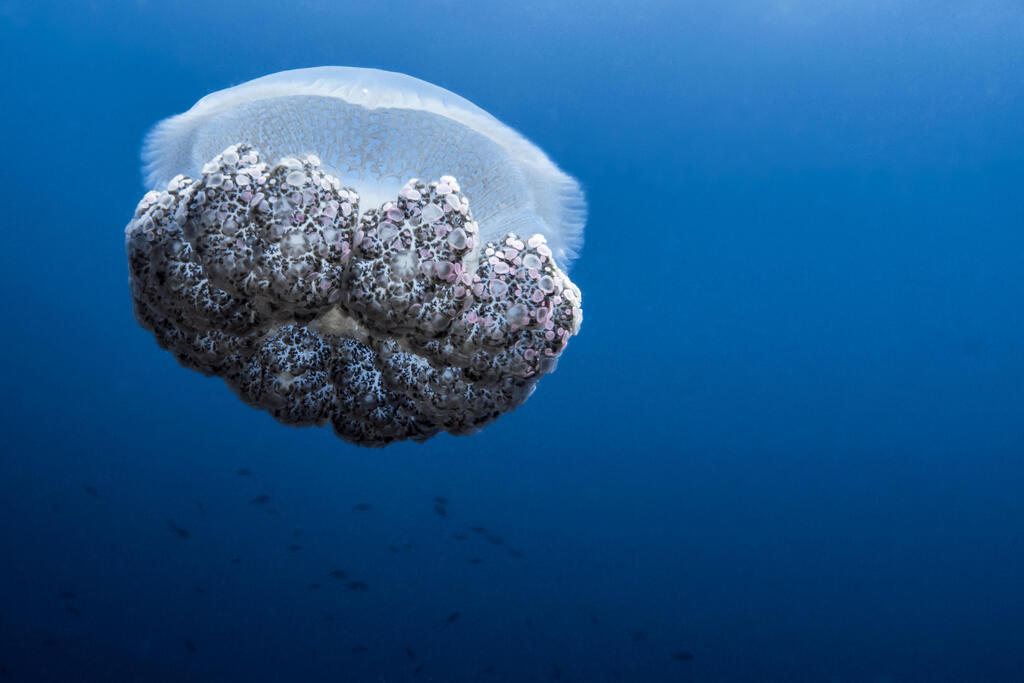
Fried egg jellyfish generally favor warm, salty water, meaning moderate warming could potentially benefit them. But there is a limit. “If temperatures remain extreme for a prolonged period, that could harm their symbiotic algae,” Angel said.
The process resembles coral bleaching. When seawater becomes excessively warm, the jellyfish may lose the algae on which it depends. That can halt its growth and could ultimately kill it. “So moderate warming may help them, but extreme marine heat waves are a real threat,” he said.
(Photo: Dr. Shevy Rothman)
What should swimmers do when they encounter one?
“The most important message is to respect them,” Angel said. “Don’t treat them as a nuisance or as something negative.”
“If you see a jellyfish, simply give it space and enjoy its beauty and hypnotic movement,” he added. Swimming or diving alongside jellyfish, he said, can be a remarkable experience. “The sea is an amazing world of shapes and colors, and the fried egg jellyfish is one of its most charming ambassadors.”