

For centuries, “fairy rings,” circles of mushrooms that appear in lawns and forests, have inspired folklore and superstition. Stories claimed they were created by fairies and other mysterious beings dancing at night, and that anyone who stepped inside risked being transported to the fairy realm.
It is easy to understand why the phenomenon fascinated people in the Middle Ages. A lawn might appear completely ordinary one evening, only for a neat circle of mushrooms to seem to appear from nowhere the next morning.

A new study from Sweden offers a possible explanation for why fungi form expanding rings instead of spreading evenly across the entire area: the growth pattern may be a response to changing conditions beneath the soil.
The mushroom circles do not actually form overnight. What appears above ground is only the fruiting body, the reproductive structure of the fungus.
Seen as an entire organism, the mushroom above ground is comparable to an apple on a tree. The “tree” is the mycelium, a branching network of thin fungal filaments that lives in the soil and can remain there for many years, breaking down organic material and absorbing nutrients.
The mushrooms that emerge above the surface are the “apples,” responsible for reproduction and the dispersal of spores, the reproductive units of fungi.
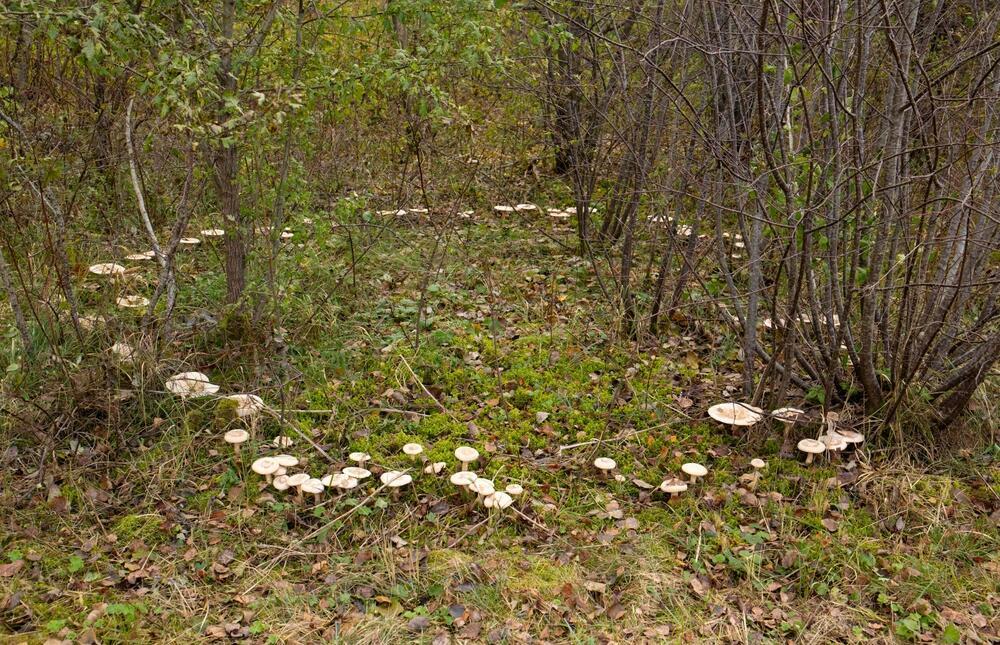
A fairy ring in nature
(Photo: FotoHelin, shutterstock)
An entire experiment inside one organism
Dr. Hanna Johannesson of Stockholm University, the senior researcher on the study, has previously described fairy rings as “an entire evolutionary experiment within a single organism.”
A ring begins when spores land on the ground and germinate. Fine fungal filaments grow from the spores, and when two meet they can form a mycelial network that expands in all directions.
If soil conditions are similar throughout the area and there are no obstacles, the growth takes on a circular shape. Eventually, if humidity and temperature are suitable, the mushrooms’ reproductive bodies appear above the advancing growth front, revealing the fairy ring to the human eye.
To investigate what was happening underground, the researchers examined two fairy rings formed by Marasmius oreades in a cemetery in Uppsala, Sweden.
They collected soil samples from the center of the rings, their edges and areas outside them, then sequenced all the DNA found in the soil. They searched the sequences for DNA belonging to the fungus.
The results showed that most of the fungal DNA was concentrated along the edge of the ring, particularly its outer section. Only tiny amounts were detected in the center and outside it. The researchers concluded that the mycelium does not grow like a carpet covering the entire area. Instead, it forms a living ring that gradually advances outward.
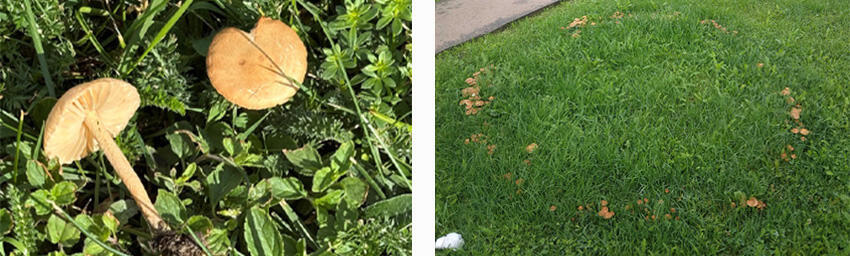
One of two fairy rings studied in a cemetery in Uppsala, Sweden
(Photo: From Olsson et al. 2026)
Escaping a hostile zone
The researchers then sought to understand why the ring keeps expanding outward. One hypothesis was that the area behind the growth front becomes unfavorable to the fungus, perhaps because nutrients have already been depleted or because the fungus leaves behind a substance that inhibits its own growth.
The researchers conducted transplantation experiments, digging up sections of the expanding growth front and moving them to different locations. Some were planted in the center of the ring, some outside it, while others were simply rotated in place.
When the researchers returned 14 months later, they examined the direction in which the mycelium had grown.
The sections moved to the center successfully resumed growing, suggesting that the center does not remain hostile to the fungus indefinitely. Sections moved outside the original ring also continued to grow.
Most of the findings supported what the researchers called a “temporary escape” explanation.
Under this model, conditions just behind the expanding growth front temporarily become less favorable, forcing the fungus to move into fresh soil. After some time, conditions in the center improve and the fungus can grow there again.
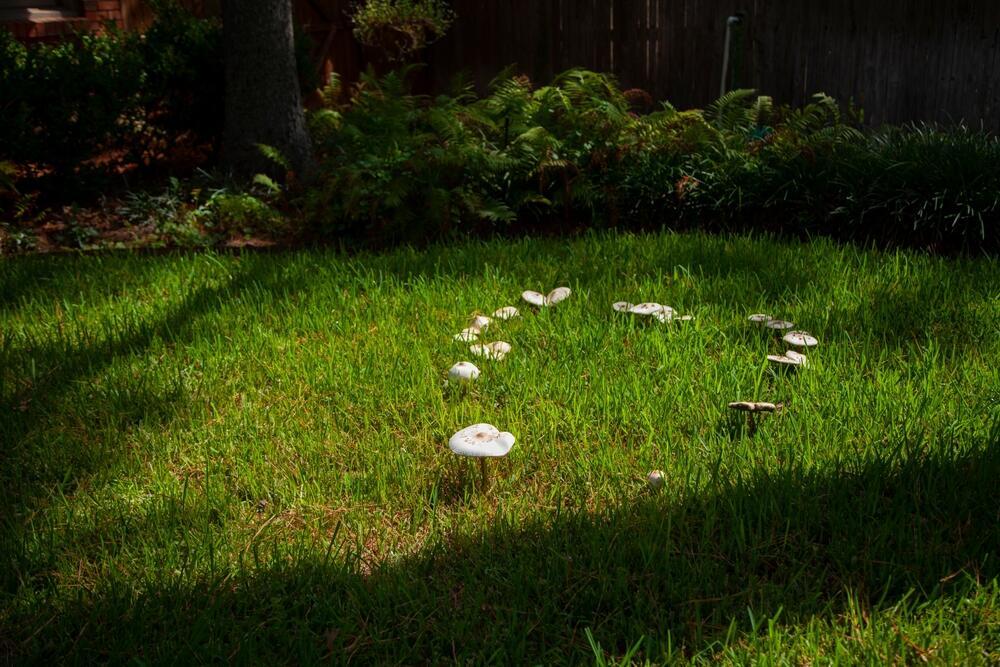
A fairy ring in nature
(Photo: MMCRP, shutterstock)
Scientists still do not know exactly what creates the unfavorable conditions in the soil. The fungus may be using up nutrients, releasing a substance that inhibits its own growth or altering the population of microscopic organisms living around it. The study does not completely solve the mystery, but it narrows the range of possible explanations and shows that a fairy ring is an active, changing structure.
Mycelium can remain underground for many years and expand a little farther with each season. Mushroom hunters may therefore find mushrooms in the same general area the following year, though not necessarily in exactly the same spot.
So perhaps fairies are not really dancing there. But beneath the soil, the fungus is certainly not standing still.
Ilana Kuzminsky, Davidson Institute of Science Education, the educational arm of the Weizmann Institute of Science