

Saul Hudson, better known as Slash, is best known as the guitarist for Guns N’ Roses. But beyond the music, his electric guitar performances, famous mane of hair and iconic top hat, Slash is also an avid reptile enthusiast and a strong supporter of zoos and natural history museums. Now, he has been honored with a newly discovered snake species from New Guinea named after him: Lielaphis slashi.
“As a long-time herpephile, I am extremely honored and humbled to have Lielaphis slashi from New Guinea named after me. It is really exciting, I never would have imagined this moment would arrive,” Slash said.
Gallery
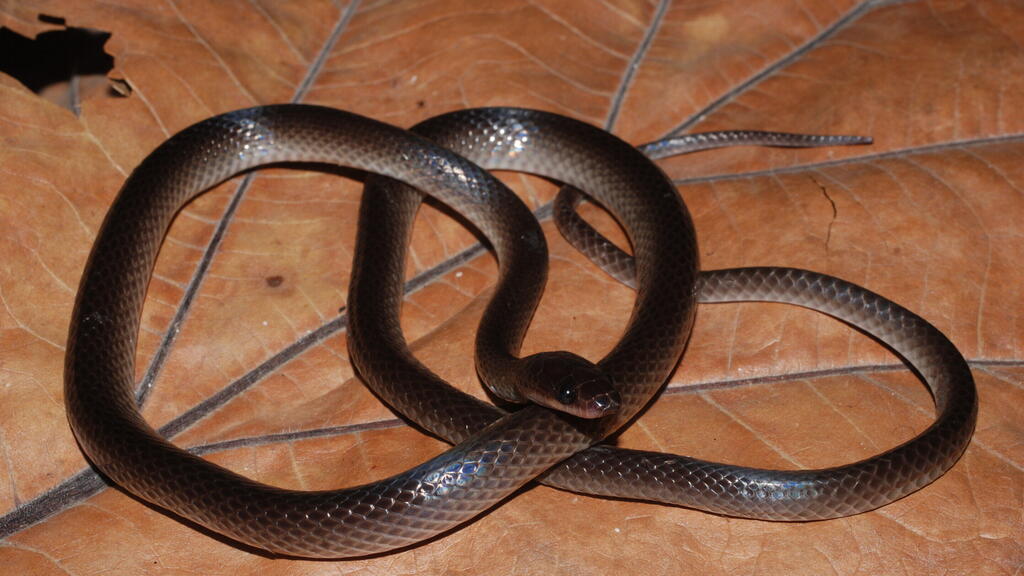
The news snake species Lielaphis slashi, is named for Guns N Roses guitarist Slash
(Photo: Chris Austin)
“Guns N’ Roses has been one of my favorite bands since I was in first grade, and by fifth grade, I had already told my teacher that I wanted to be a herpetologist-- a scientist who studies reptiles-- when I grew up,” said Dr. Sara Ruane, curator at the Field Museum of Natural History in Chicago and lead author of the study published in the journal Zootaxa describing the new species. “So when I was twelve years old and got my copy of Reptiles Magazine in the mail, and it had a picture of Slash holding his pet reticulated python on the cover, I thought, ‘This guy is so cool.’”
When she grew up and became a scientist who occasionally gets to assign official scientific names to newly discovered reptile species, Ruane remembered that magazine article.
“I reread the interview in which Slash talked about his great love of museums, zoos and natural history, and about how as a child he would go outside looking for snakes — all things I identified with very strongly — and I thought he would be a fitting person to name a new species after,” Ruane said.

Slash and Dr. Sara Ruane, holding the journal in which her study of the new snake species was published
(Photo: Sara Ruane)
That opportunity eventually came in the form of a reddish-brown snake measuring about 71 centimeters -or 28 inches, discovered in the forests of New Guinea, the world’s second-largest island after Greenland. It lies in the southwestern Pacific Ocean, north of Australia, and is divided between Indonesia and Papua New Guinea. The island’s dense rainforests contain enormous biodiversity, much of which has still not been thoroughly studied by scientists.
One night in 2006, while conducting field research in New Guinea, Professor Chris Austin, curator of herpetology at the Louisiana State University Museum of Natural Science, encountered a snake he did not recognize.
“New Guinea ground snakes are active at night, so the best way to find them is after dark. They can usually be found shortly after sunset at the base of large trees while searching for food,” said Austin, who was part of the research team. “When working at night in New Guinea, you have to be especially careful because there are several highly venomous species that closely resemble the nonvenomous ground snakes.”
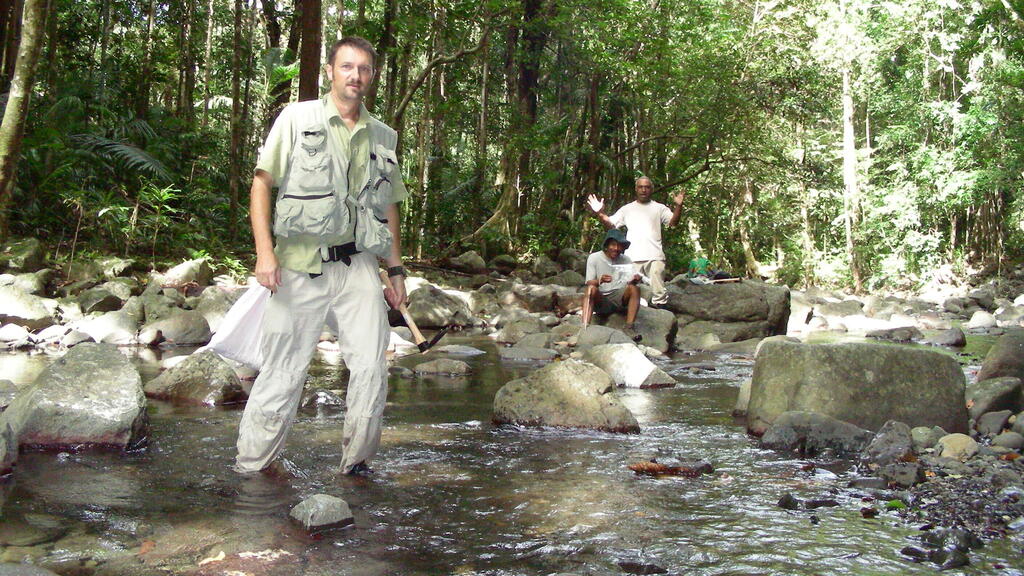
Professor Chris Austin conducting field research in New Guinea
(Photo: Chris Austin)
In 2016, after completing her doctorate, Ruane began working with Austin to better study the snakes of New Guinea, a field in which relatively little was known, and they have collaborated on the subject ever since.
Based on appearance alone, it was not obvious that the snake belonged to a new species. Laboratory testing, however, made clear that it was something distinct.
“Using several advanced methods of genetic analysis, we found that Lielaphis slashi is genetically distinct from other similar snakes in the same genus,” said Dr. Tianchi Huang, a researcher at the Field Museum of Natural History and a member of the study team. “The combination of physical characteristics — such as differences in scale counts compared with other species — and the genetic evidence is what led us to understand that this is an entirely new species. We also used ecological models to show that this new species prefers a different habitat from similar snakes.”
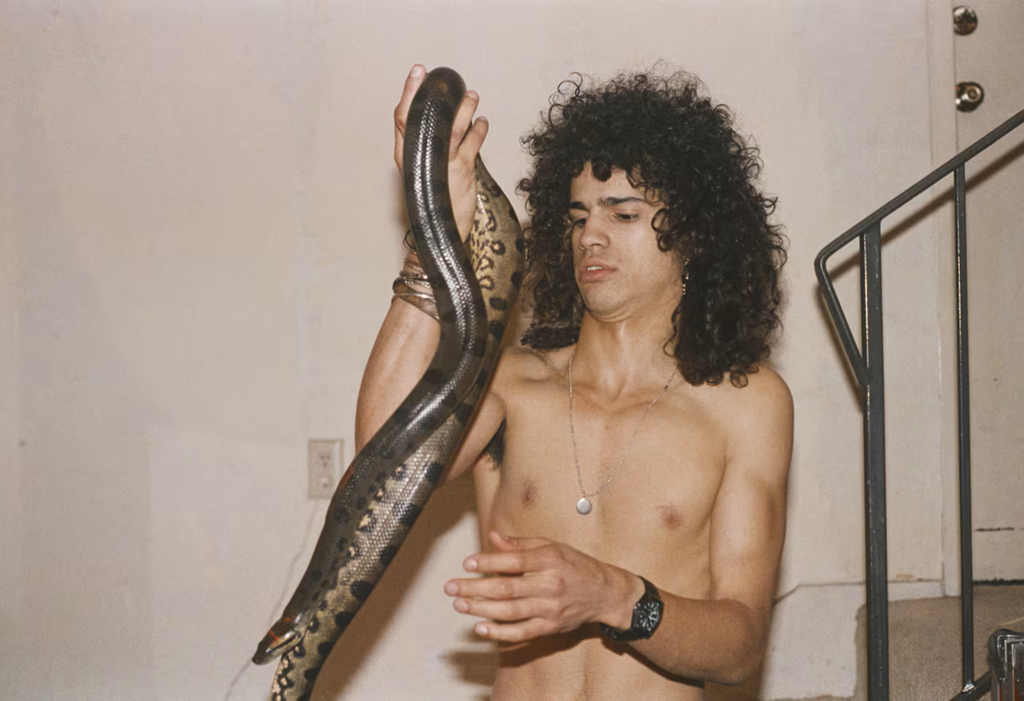
photo from 1984, showing Slash holding a Reticulated Python
(Photo: Marc S Canter/Michael Ochs Archives/Getty Images)
Much about the ground snake remains unknown. Ruane explained that snakes are extremely difficult to observe in the wild before they disappear from view, so knowledge about Lielaphis slashi remains limited. Still, some of the snake’s anatomical features offer clues.
“Snakes of this kind often have large teeth at the back of the mouth. It is possible that New Guinea ground snakes use them to grip and eat small lizards and the eggs of other reptiles — this snake does not seize and constrict its prey the way a common boa does,” Ruane explained.
“However, it should be noted that Lielaphis slashi poses no threat to humans. Human activity, on the other hand, could spell disaster for this snake and for the other creatures living in New Guinea’s forests.
“The habitats where this snake lives are threatened by industries such as coffee cultivation and mining. That is one of the reasons why it is important to identify every species, so we can better understand how ecosystems function and how each component fits into the environment. We cannot conserve animals or other living organisms if we do not know they exist.”