

In 1904, engineer George Bennett introduced a small, deceptively simple mechanical device that appeared to defy the rules: four arms connected by hinges. According to the engineering principles known at the time, and still used today, the mechanism should not have moved at all. Yet it does. For more than a century, it has been regarded as an anomaly, earning the label “paradoxical mechanism.”
Now, researchers at Ariel University say they have found a clear and simple explanation. In a study published in the journal Mechanism and Machine Theory, they present a geometric solution to the long-standing puzzle and identify a fundamental limitation in one of mechanical engineering’s most basic analytical tools.
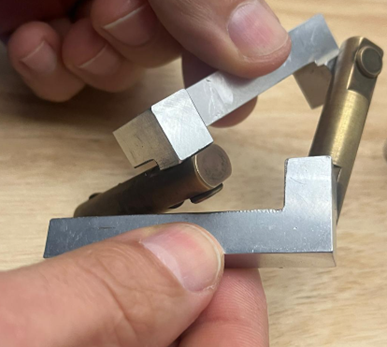
For more than 100 years, engineers have relied on the classical Chebychev-Grübler-Kutzbach formula to determine whether a mechanism can move and how many actuators are required to drive it. The formula counts the number of links and joints and has been a cornerstone of machine and robot design. But according to the researchers, that approach captures only the surface of the problem.
“The classical Chebychev-Grübler-Kutzbach formula checks how many joints there are, but it does not truly see the shape,” said Prof. Nir Shvalb of the Department of Industrial Engineering and Management at Ariel University. “We show that there are situations where the calculation says there is motion, but the geometry itself simply does not allow it.”
In their study, the team identifies a broad family of closed spatial mechanisms that, according to the classical count, should be mobile. On paper, some would even require an infinite number of actuators to control. In practice, however, they are completely rigid.
The researchers stress that these mechanisms are not stuck because of friction or malfunction. Rather, their hinge axes are arranged in space in a way that eliminates any possibility of movement. The team refers to such systems as “hypo-paradoxical” mechanisms, the inverse of Bennett’s paradox.
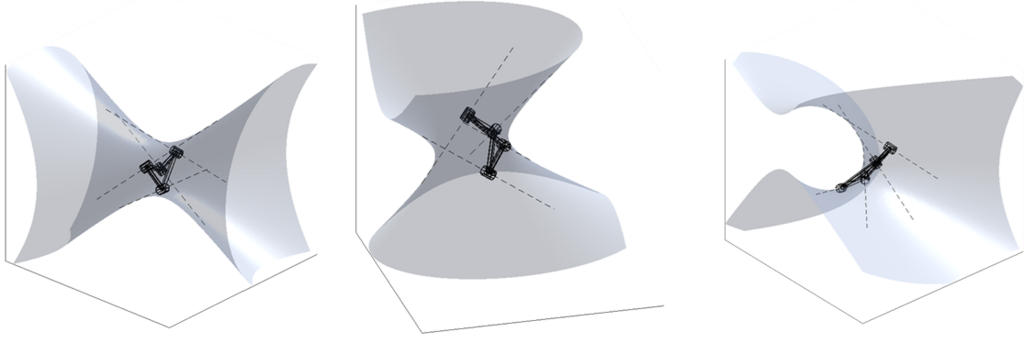
Geometric structure of the Bennett mechanism
(Illustration: Prof.Nir Shvalb, Dr. Oded Medina)
Using a geometric and mathematical argument, the researchers explain that when all the hinge axes of a mechanism are arranged within a shared spatial structure that preserves their order of appearance, motion collapses. The mechanism effectively becomes fully constrained, and the freedom predicted by the mathematical count disappears.
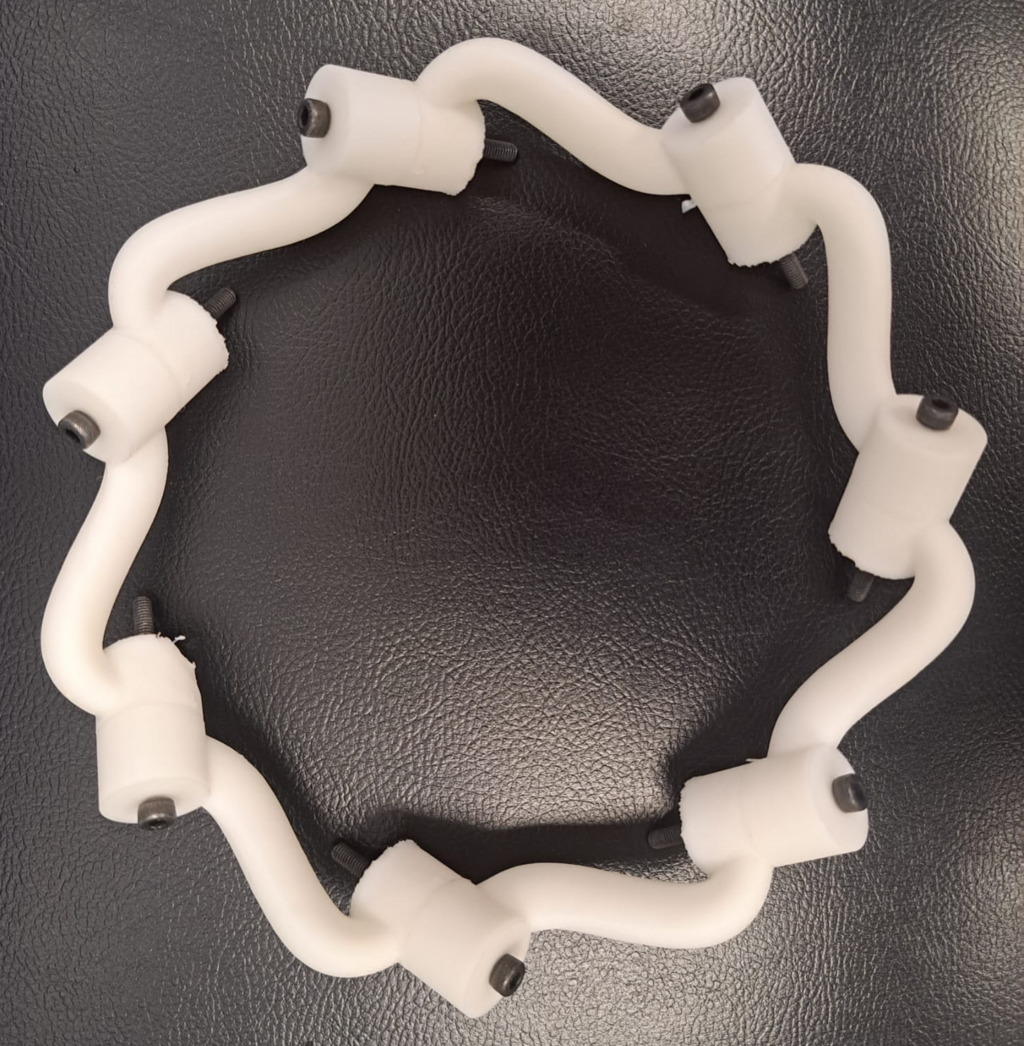
Hyper-paradoxical mechanism that remains motionless despite infinite degrees of freedom
(Photo: Prof. Nir Shvalb, Dr. Oded Medina)
From the same geometric perspective, the team revisits Bennett’s mechanism. Surprisingly, its axes also lie on a common geometric structure. However, unlike the rigid systems, the order of the axes never matches the order of the mechanical connections. That mismatch, the researchers argue, guarantees motion and prevents collapse.
 Prof. Nir ShvalbPhoto: Courtesy of Ariel University
“In a sense, Bennett’s mechanism always remains slightly folded onto itself,” said Dr. Oded Medina of the Department of Mechanical Engineering at Ariel University. “That folding preserves a dependency among all the axes throughout the motion, which allows exactly one degree of freedom. It is not magic. It is very precise geometry.”
The findings resolve a puzzle that has stood for more than 120 years. Bennett’s mechanism is neither anomalous nor a violation of engineering laws, the researchers say, but rather a boundary case in which structural geometry outweighs a simple count of parts.
 Dr. Oded MedinaPhoto: Courtesy of Ariel University
The implications extend beyond theory. In robotics and advanced engineering, even small geometric changes, such as a slight deviation in angle or a minor shift in distance between axes, can turn a mobile mechanism into a rigid one, or vice versa.
The study serves as a reminder that formulas alone are not enough. To understand motion, engineers must also understand shape.