

Ancient wild date palms cling tightly to the soil of the Ein Shaviv oasis in the Arava (located south of the Dead Sea), and to one another. These are not the elegant, domesticated palms familiar from neatly kept plantations, standing in orderly rows and waiting for harvest. Here, the trees form untamed clusters packed tightly along the streambed, dozens at a time, intertwined in dense braids of branches, crowns, offshoots and shoots, until it is impossible to tell where one tree ends and another begins, which was born and which is dying. The flowing spring water carries a pleasant scent, and the ground is layered with a tough carpet of fronds and leaves shed over thousands of years we call history.
This is no exaggeration. A single date palm lives for about 90 years, but the palm colony as a whole is thousands of years old and, according to new research, deserves to be called the ‘mother of the date palm’, a nod to the ‘mother of wheat’ discovered by Aaron Aaronsohn in Rosh Pina some 120 years ago.
The palms growing here belong to a rare species never before documented in this region. They are the original Land of Israel date palms, as they existed before humans domesticated them about 6,000 years ago. Just as traces of Neanderthal DNA can be found in all of us, part of the genetics of this wild palm appears in every cultivated date. At the heart of every Medjool date we eat is an ancient palm.
"These are living fossils, breathing finds that are remnants of something very ancient", said archaeologist and farmer Dr. Roi Galili, one of the study’s editors, as he moved with infectious excitement into the heart of the thicket. "Everything here is teeming with life. These trees live in communities and have strong relationships with one another. You can actually feel it."
Galili estimates the colony is between 4,000 and 6,000 years old. "But we are looking at palms that carry a memory of the Pleistocene era, which ended about 12,000 years ago", he said. I paused to take a deep breath, inhaling all those years. Were it not for the Eilat-Ashkelon oil pipeline running nearby, it would be easy to believe nothing here had ever changed.
We are accustomed to learning history through inanimate remains, such as stone, bone, tools, clothing and documents. But the history of this region, perhaps more than anywhere else, can and should also be told through plants and agriculture, the true roots that enabled and still enable life in this harsh environment.
"The date palm is humanity’s most loyal companion in the desert", Galili said. "It provides shade, trunks and fronds for construction, fibers, and of course food. It is a resilient tree that survives extreme conditions. Until now, we thought the date palm was brought here by humans from Mesopotamia, from the Iraq-Iran region. It now appears these palms were here first."
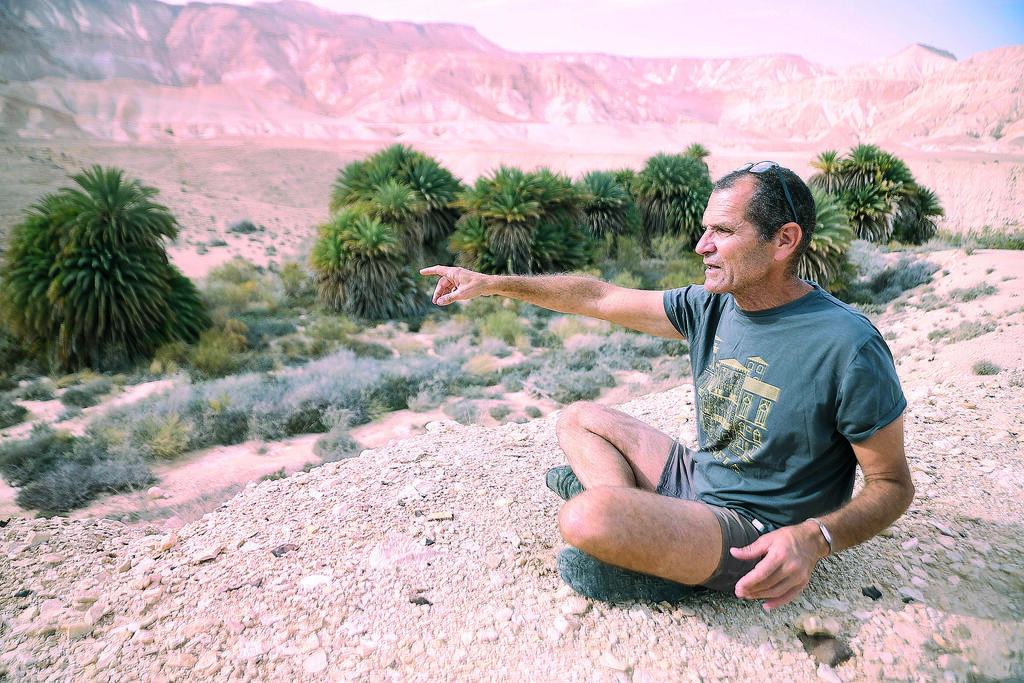
Near the oasis lies the archaeological site of Ein Ziq. Reaching it is no simple task. We met Galili near Sde Boker, climbed into his battered but sturdy pickup truck and bounced along rough tracks for about 40 minutes through the striking landscape of the Zin Valley. Ein Ziq is an archaeological and historical mystery. When it was first discovered, it was predictably declared a site traversed by the Israelites. Today we know that was not the case. The remains belong to a settlement from the Intermediate Bronze Age, about 4,500 years ago.
The settlement was surrounded by a wall and housed approximately 300 families in round stone dwellings with walls dug into the ground, indicating a large and central community. Yet we know almost nothing about the people who lived here, their language, culture, origins or motives. "That is archaeology", Galili said, slipping briefly into poetry. "Searching the landscape for what has been lost to time."
Even in antiquity, the Zin Valley was remote and sparsely populated. "Who were the people who came to live here in the desert, and why?" Galili asked. "Some come looking for minerals, some are fleeing the law, and some come out of an inner calling, a desire for isolation. We don't know who these people were or what they felt. Emotions do not survive in archaeology. We know they were outsiders, different from the Canaanites. It was a mysterious period. But they had a reason to be here. Many of my colleagues think it was connected to copper mining. I believe the date palms were part of that story."
The ancient inhabitants left behind almost nothing except piles of date pits, which intrigued researchers because they differed from familiar date seeds. They are smaller and more deeply grooved. "We had a sense there was something special about them", Galili said. "We just did not expect something so dramatic."
The discovery of the ‘mother of the date palm’ emerged from a legal struggle against the ICL group, (Israel Chemicals) over pollution in the Zin stream. In 2020, four citizens, including Galili, filed a class action lawsuit against the company and its subsidiary Rotem Amfert, alleging ongoing pollution of desert oases, including Ein Zin, Ein Akrabim and Gevei Shayish (marble pools).
The pollution was caused by industrial effluent from a phosphate plant that flowed and seeped into the stream, the soil and groundwater, inflicting severe and irreversible damage on wildlife and vegetation, including two ancient date palm colonies at Ein Akrabim and Ein Zin that were almost destroyed.
As part of the proceedings, ICL committed to funding the rehabilitation of the dying palms with an initial sum of 2.7 million shekels. The case is still in mediation.
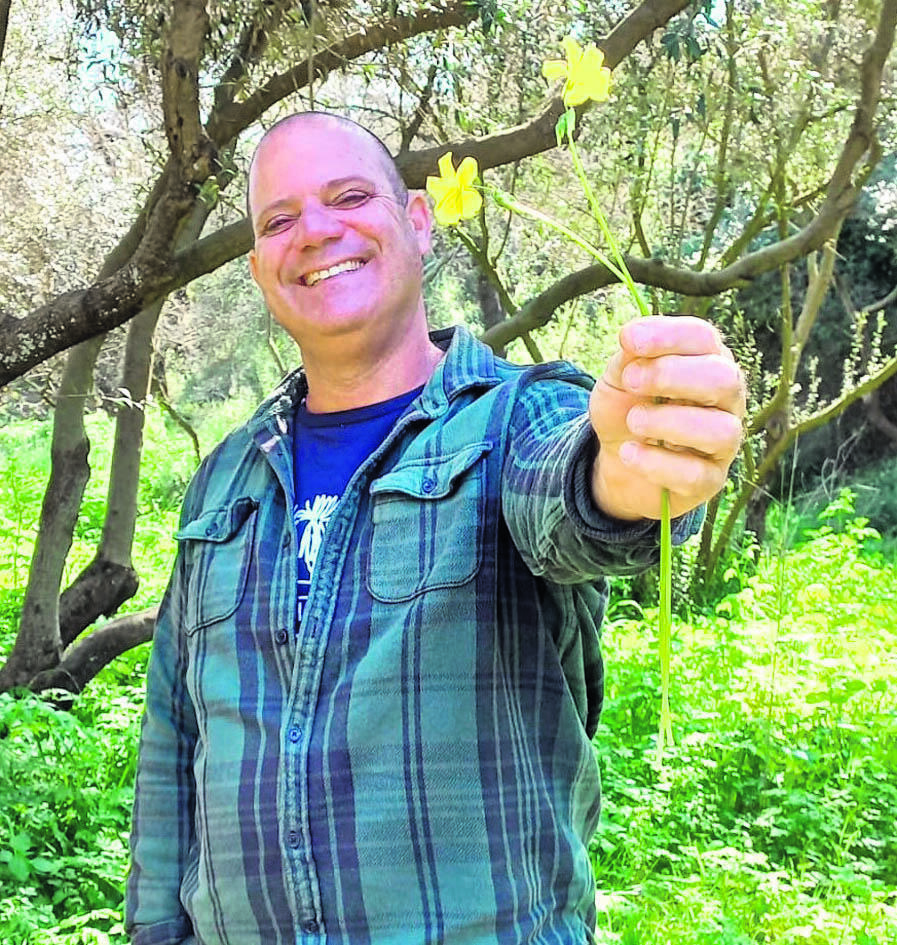
Prof. Guy Bar-Oz
(Photo: Anat Desberg)
"When discussions with ICL turned to damage done to the palm colonies, professionals and lawyers tried to minimize it", Galili said. "They said, 'So what? It is just a common date palm, we can bring others'. But we felt that not all the colonies were made up of ordinary palms. That is what led us to begin a process of examining and mapping palm groves."
Galili and Prof. Guy Bar-Oz, both from the University of Haifa’s School of Archaeology, examined 30 palm colonies, most of them in the Arava. "The survey showed wild date palms are endangered throughout the region because the springs are polluted and drying up", Galili said. "They are strong, resilient trees, but there is a limit to what they can endure. In most colonies we did find only common date palms, but in three, Ein Akrabim, Ein Zin and here at Ein Shaviv, we found palms that looked different."
Genetic sequencing of the seeds revealed that the ancient wild palm belongs to a species known as Phoenix theophrast, or the Cretan date palm, a rare and endangered species previously thought to reach its southernmost limit on Crete. "At first we thought the palm arrived here from Crete", Galili said. "But it now seems the opposite may be true."
So what makes this discovery so significant?
"This is the last place on Earth with such a palm grove", Galili said. "At Ein Zin and Ein Akrabim there were once hundreds and thousands of palms. Fewer than 30 remain, and they too are at risk. Here, the core is still stable. Our responsibility to the cultural heritage of this region, to our environment and to the universe as a whole is to preserve them. Not to destroy everything and then say nothing was ever here. We are one link in a chain. If our legacy is the destruction of oases and irreversible damage to this landscape, no one will be absolved."
The discovery also holds promise for repair. The ancient wild palm is strong and resistant to disease and salinity, traits that could help improve domesticated varieties that have become more vulnerable through cultivation. "But that is not my responsibility", Galili said. "We are researchers."
The finding is still fresh, but history suggests its impact will endure. Aaronsohn’s discovery of the ‘mother of wheat’ continues to inform scientific research and agricultural applications more than a century later. Its genetic reservoir contains critical traits lost through domestication, including disease resistance, resilience to environmental stress, stronger root systems and adaptation to extreme climates.
It is not a wild gamble to assume the wild ‘mother of the date palm’ will one day pass on important traits to its cultivated descendants. It will not bear a grudge against the humans who nearly wiped it out.
Every tree has a story
The study is part of a broader project known as ‘Bustan’, led by Bar-Oz, which explores the agricultural history and archaeology of the Middle East. The project, the only one of its kind in the world, is funded by the EU and is now in its second year. "The amount of knowledge being accumulated is enormous", Bar-Oz said. "We have documented more than 12,000 heritage trees."
What are heritage trees?
Heritage trees are those that predate us, remnants of agricultural systems that existed here 2,000 years ago and more. Hundreds are ancient trees. Researchers are studying their history and genetics, dating them and examining the archaeology around them. "Every tree tells the story of its environment", Bar-Oz said. "If we learn to read trees, we can uncover unknown chapters in the history of our agriculture."
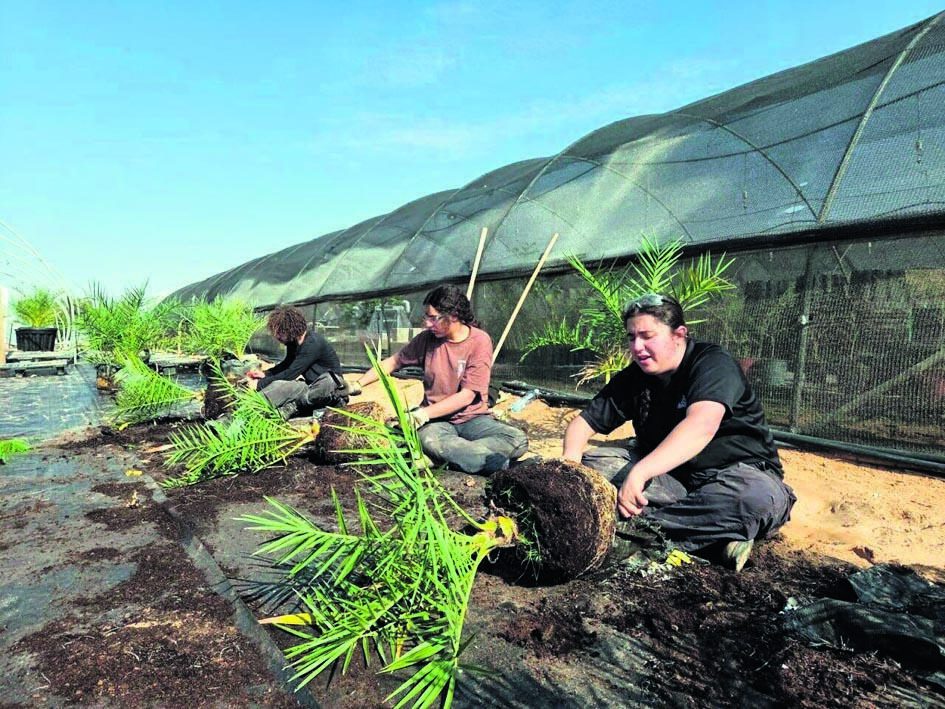
The date palm research station at the Arava Greenhouse
(Photo: Arava greenhouse)
The Bustan project, involving the University of Haifa, Tel Aviv University, the Volcani Institute, the Arava Research and Development Center and the University of Montpellier, focuses on three ancient local species: the olive, the grapevine and the date palm. In all three, it has produced striking discoveries.
The grapevine was the first studied. Ancient grape seeds found in excavations were split, half sent for genetic sequencing and half for precise dating. In the sands of Nitzanim, researchers found a vine whose genetics had not changed in 1,500 years.
The same technique was applied to olives. Near Nitzana, in Zitans stream by Shivta, a living olive tree of the same age was found with unchanged genetics. Now, the date palm. Researchers hint that surprises may soon follow with sycamore and fig trees as well.
Despite this deep history, most grapevines and date palms grown in Israel today are relatively recent arrivals brought by modern settlers. Date palms were introduced from Iraq in the 1930s, and most grapevines arrived from Europe during the Rothschild era. "This is a pattern repeated across the world", Bar-Oz said. "The conqueror or settler arrives with their own agriculture. They do not learn from the locals."
Ancient grape, olive and date seeds are now being germinated at the Central Arava research station, with the hope of bringing them back to life. "People talk today about reviving mammoths or wolves", Bar-Oz said. "Bringing back the date palm or grapevine is far simpler. It is a romantic possibility."
On the drive back from the Ein Shaviv oasis, Galili and I passed once more by the enigmatic site at Ein Ziq. "There is not much here", he said, looking out at the empty desert. "Mostly date palms, pits and stone remains. As an archaeologist, I am awed by what has been discovered in Egypt and in Arab countries.
"We do not have mummies or monumental structures. Israel is not the richest place in terms of archaeological finds, or even botanical ones. We do not have millennia-old sequoias. But it is one of the most interesting places there is. We are standing at a crucial crossroads in human history. And as someone born in the desert, living in it, growing things and studying it, people forget it can also be a generous place."