

The Theban Necropolis, located across the Nile from modern-day Luxor, contains more than 400 tombs. In a new study published in Frontiers in Environmental Archaeology, researchers from Spain examined Burial Chamber 3 in tomb TT 209 to reconstruct how the space was used and repeatedly reused over hundreds of years.
The tomb was built during Egypt’s 25th Dynasty, which lasted from 754 to 656 BCE, and remained in use until the Ptolemaic period, from 305 to 30 BCE, when it was eventually abandoned.
Gallery
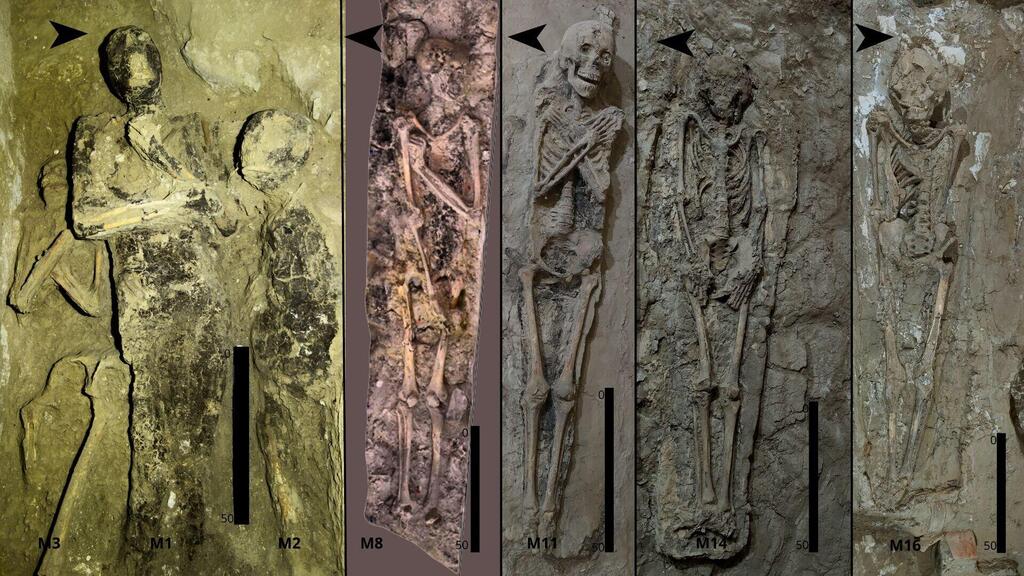
Mummified remains from the Theban Necropolis, showing variations in body orientation and arm position
(Photo: Proyecto Dos Cero Nueve, Universidad de La Laguna/DR. Jared Carballo-Pérez)
“We found 16 mummified human bodies, a mummified dog, and a burial deposit containing the remains of at least four additional people,” said Dr. Jared Carballo-Pérez of the University of La Laguna, one of the researchers involved in the study.
“This was not a random accumulation, nor did the original ritual lose its meaning over time. On the contrary, each new burial appears to have been adapted to the presence of the bodies that were already there, creating a kind of funerary ritual memory as the site was reused.”
To better understand how the bodies were positioned and how the burial space changed over time, the researchers excavated the chamber, photographed the mummies and documented their location, orientation and relationship to the tomb’s architecture. The chamber contains nine burial groupings, including both individual and collective burials, as well as associated funerary objects.
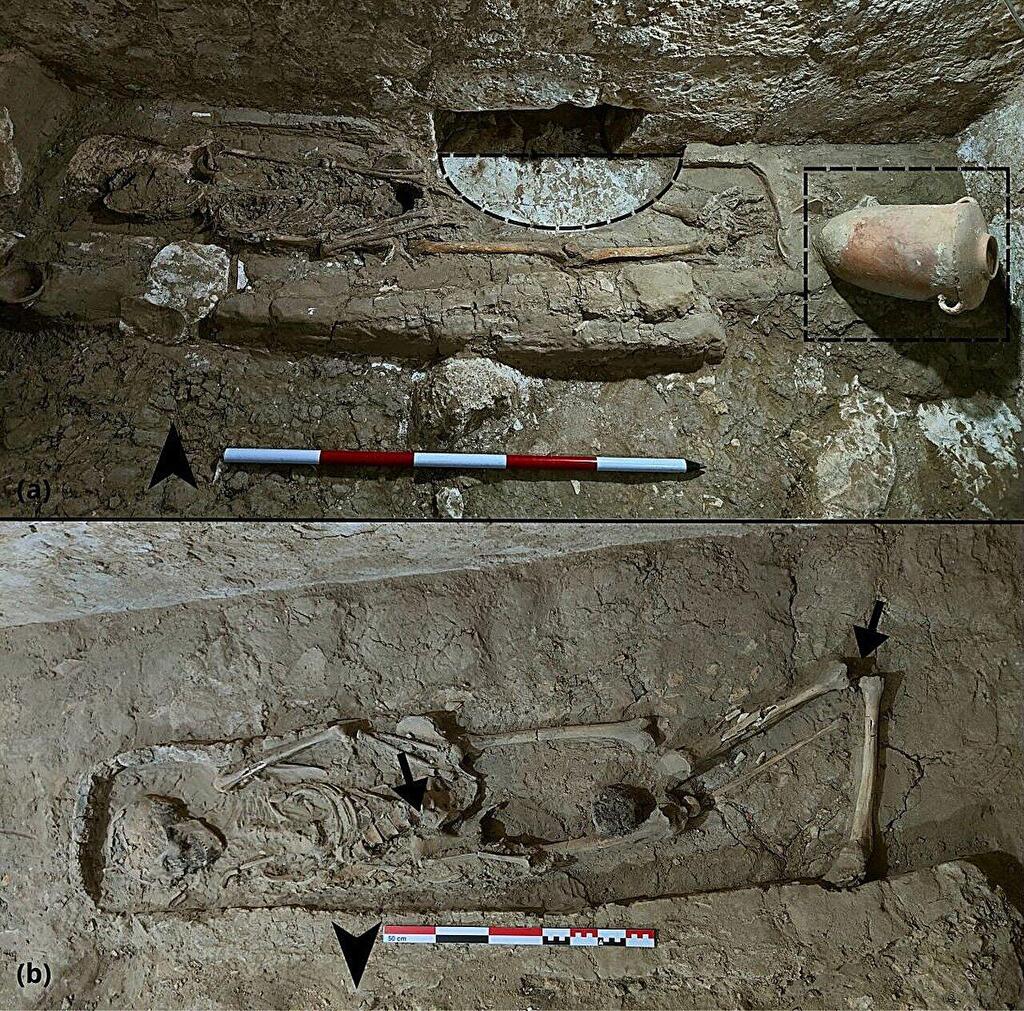
Evidence of disturbance and displacement affecting two mummified individuals in a burial chamber in the Theban Necropolis
(Photo: Proyecto Dos Cero Nueve, Universidad de La Laguna/DR. Jared Carballo-Pérez)
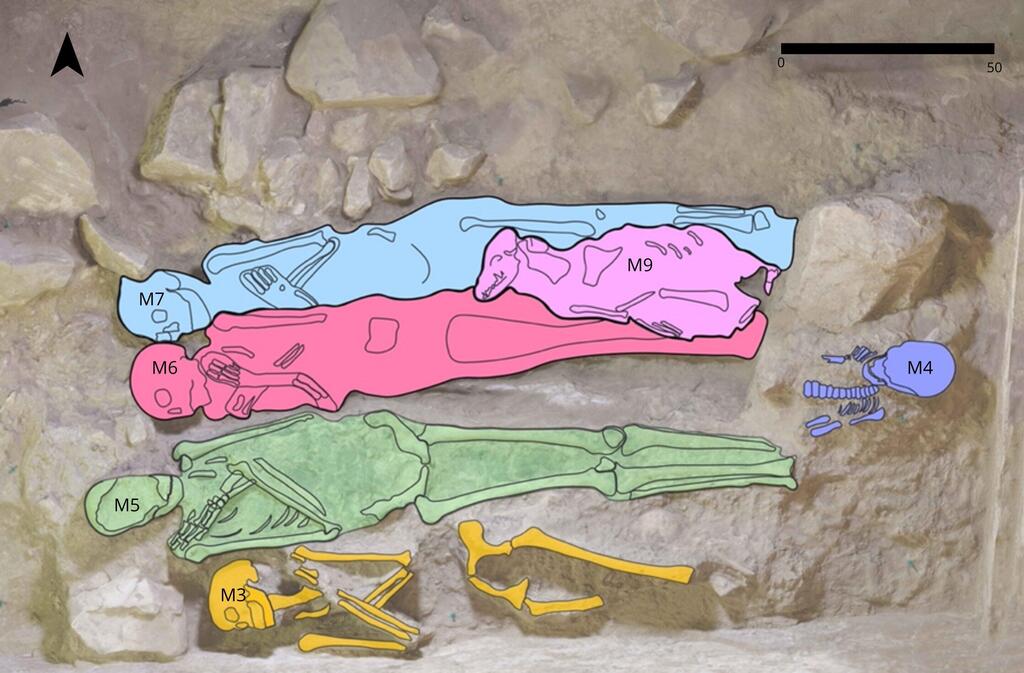
Individuals M6 and M7 lie closely stacked on top of one another, with the dog (M9) positioned above their lower limbs
(Photo: Dr. Jared Carballo-Pérez)
Researchers found that the earliest dead were generally placed individually inside coffins. Later, toward the end of the 25th Dynasty and during the Persian period, roughly 680 to 404 BCE, bodies began to be placed wherever space remained available, leading to a much denser use of the chamber.
In some cases, the position of the limbs also changed. One arm, for example, might be folded inward, unlike earlier burials in which the arms were generally extended.
During the Persian period, the researchers also identified a shift from placing bodies separately to arranging them vertically, one above another. Stacked bodies were found in about two-thirds of the burial groupings in the chamber.
“The earliest individuals buried here appear to have been of high social status, since they were buried in coffins accompanied by funerary nets and amulets, as well as valuable goods, including contents found inside Phoenician amphorae, many of which were discovered beside them,” said Dr. Miguel Ángel Molinero Polo, an Egyptologist at the University of La Laguna and a member of the research team.
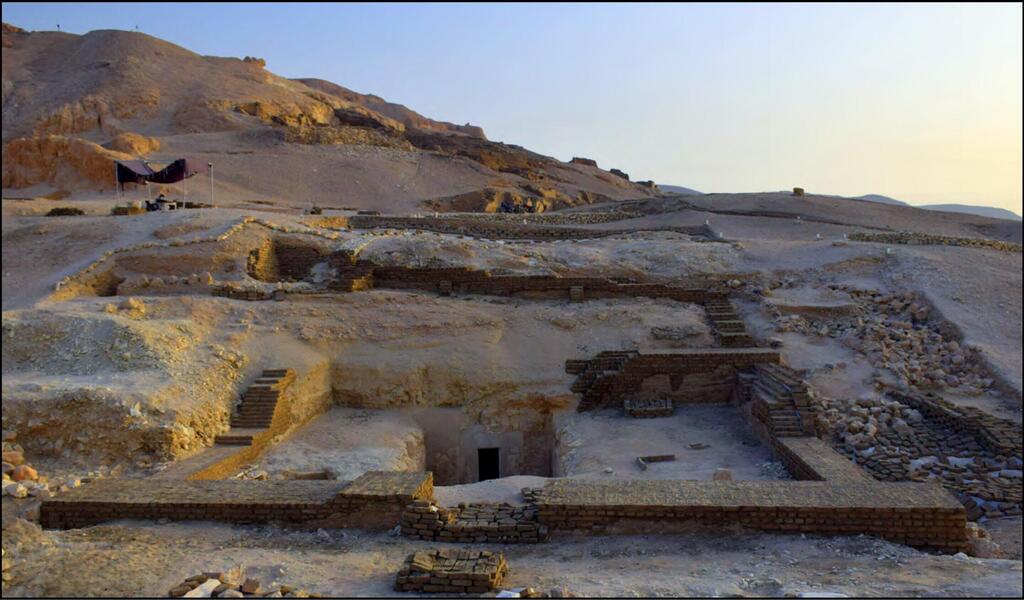
Burial Chamber 3 of tomb TT 209 in the Theban Necropolis
(Photo: Proyecto Dos Cero Nueve/José Miguel Barrios Mufrege)
In the southeastern part of the chamber, four mummies and a mummified dog were buried one above another during the Ptolemaic period.
“The bodies placed one above another vertically were not buried in coffins, but they underwent careful mummification,” Molinero Polo said. “They can also be linked to jars placed upright, indicating a distinctive ritual that did not appear during the earlier phases of the tomb’s use.”
One discovery in particular stood out to the researchers. “One detail I find especially beautiful is the presence of a mummified dog placed directly on top of the mummies of a man and a woman,” Carballo-Pérez said.
“This may indicate a close relationship between these people and the animal. However, it could also reflect another change in ritual practice, in which an animal assumes the role of a psychopomp, a symbolic guide on the journey to the afterlife.” That discovery, together with other changes in the arrangement of the bodies, suggests that the tomb did not simply descend into disorder as more burials were added.
In later burial layers, for example, individuals were placed with both arms crossed over the chest in what Egyptologists call the “Osiris position.” The researchers say these changes show that the chamber retained ritual meaning even as it was repeatedly reorganized.
Rather than abandoning earlier traditions, those using the tomb adapted the burial space again and again. New burials changed both its physical arrangement and its symbolic meaning without erasing what had come before.
“The findings we uncovered help us better understand the social behaviors underlying funerary practices in ancient Egypt,” Carballo-Pérez said.