


As record-breaking heatwaves strike the Middle East and the wider Mediterranean with increasing frequency, scientists are confronting a critical question: Can the climate models used to forecast climate change identify the processes that lead to dangerous heat events before they occur?
A new study led by researchers at the Hebrew University of Jerusalem offers a complicated answer. The world’s most advanced climate models can reproduce heatwaves relatively well once they are underway, but often struggle to identify the atmospheric warning signs that precede them.

The study, led by Andre Klif, Prof. Chaim Y. Garfinkel, Prof. Dorita Rostkier-Edelstein, and Dr. Assaf Hochman, was published in the scientific journal Weather and Climate Extremes.
The researchers examined 11 advanced climate models used in scientific assessments by the Intergovernmental Panel on Climate Change (IPCC). They compared their simulations with atmospheric observations across the eastern Mediterranean and the Middle East.
Their findings revealed a significant gap. Although the models were generally able to reproduce the heat conditions themselves, they did not always accurately represent the complex processes that caused those conditions to develop.
Global warming in recent decades
(Video: UN Climate Change)


According to the researchers, eastern Mediterranean heatwaves are not isolated weather events, but the result of a broad chain of atmospheric processes that can begin several days, or even a week, before temperatures peak.
Shifts in airflow and high-pressure systems over Europe, Turkey, India and parts of Africa can create an atmospheric pathway that funnels hot air toward the eastern Mediterranean, setting the stage for an extreme heatwave.
However, the study found that the models frequently delayed the appearance of those warning signals, weakened them or failed to reproduce them altogether.
The ridge over Turkey and India’s monsoon
One of the central mechanisms identified in the study was the strengthening of a high-pressure ridge over Turkey. The researchers found that models that more accurately represented this phenomenon were also more successful in reproducing the intensity of heatwaves recorded in real-world observations.
Another major finding involved the connection between the South Asian monsoon and heatwaves in the eastern Mediterranean. Observational data indicated that atmospheric changes over India may help create the conditions that allow extreme heat to develop in the region. Yet none of the climate models examined in the study successfully reproduced that connection.
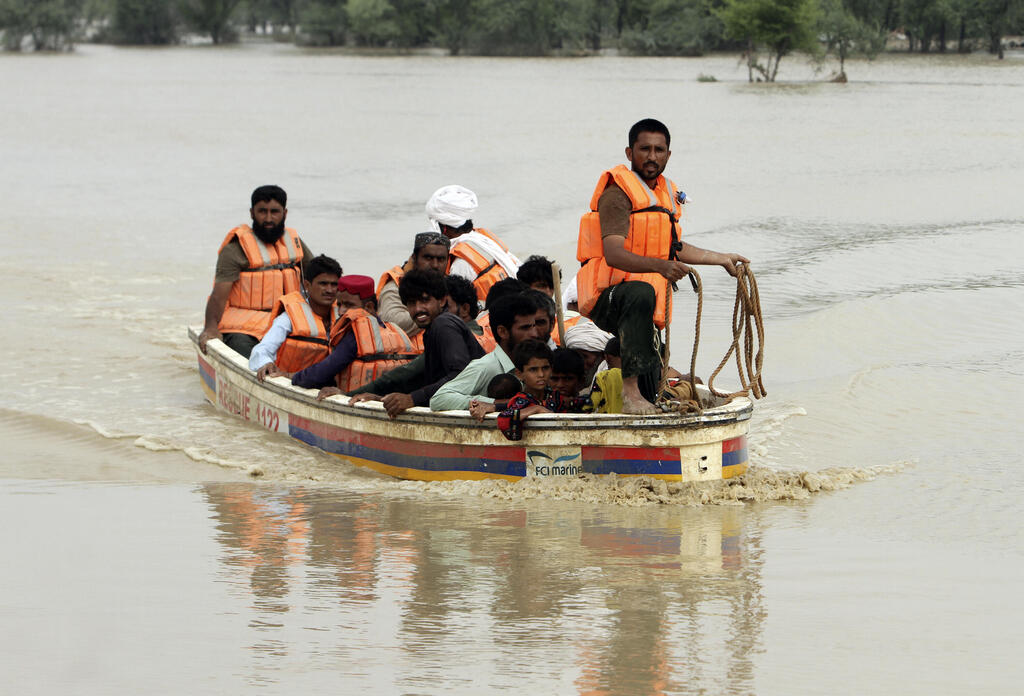
Monsoon flooding in Pakistan
(Photo: AP)
According to the researchers, the failure may point to a broader weakness in the way climate models represent interactions between tropical weather systems and atmospheric systems in more temperate regions.
The researchers concluded that the models can produce realistic heatwave statistics, but they still misrepresent the atmospheric processes that lead to those events. The findings could have significant consequences for efforts to prepare for future heatwaves.
Extreme heat is considered one of the world’s deadliest natural hazards and already places heavy pressure on electricity grids, water resources, agriculture and health systems across the Middle East and the Mediterranean basin.
As climate change increases the frequency and intensity of extreme heat events, the researchers said the ability to identify atmospheric warning signs as early as possible will become a central tool in preparing for and adapting to a hotter world.