

Deep beneath the ocean surface, sperm whales move through darkness by sound, sending powerful clicks across the water as they hunt, navigate and communicate. Now, scientists say they have taken a major step toward following those exchanges as they happen, using an autonomous underwater robot that can hear the whales and change course toward their voices.
The system, described in a study published this week in Scientific Reports, was developed by Project CETI and tested with a SeaExplorer underwater glider equipped with a four-hydrophone acoustic array. The goal is to move beyond brief glimpses of whale behavior and toward long-term monitoring that could track sperm whales over weeks or months, without attaching tags to their bodies or waiting for them to pass fixed sensors.
Gallery
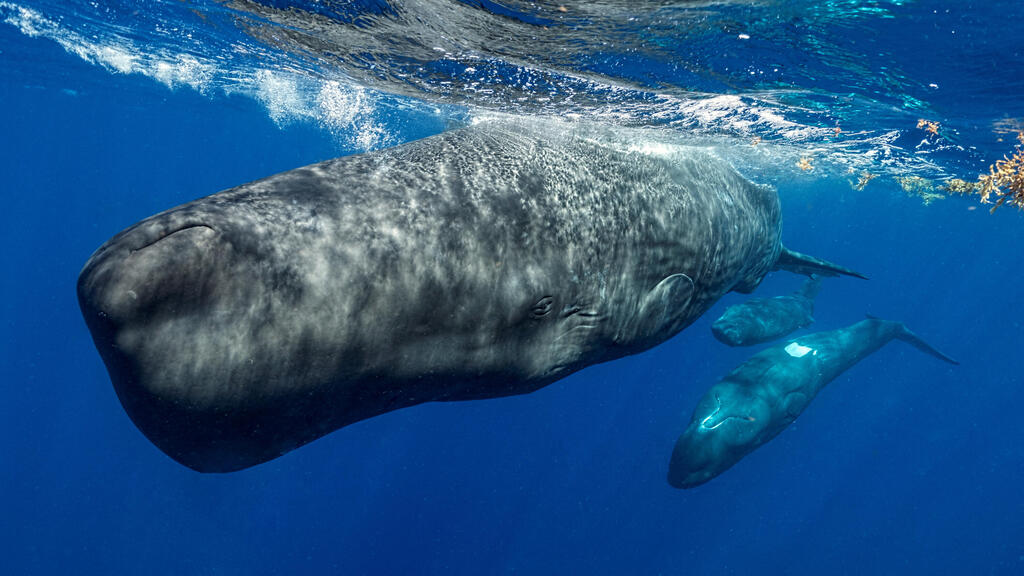
Three sperm whales swim near the surface of the Caribbean Sea off Dominica
(Photo: NOAAAmanda Cotton/Project CETI/Handout/Reuters)
Sperm whales use clicks to navigate and hunt, and also produce patterned sequences of clicks, known as “codas,” that scientists believe play a role in communication. Researchers first identified sperm whale vocalizations in 1957, but decoding them has remained difficult because the animals can dive more than 1.6 kilometers, about one mile, and spend around 50 minutes of each hour underwater.
“The underwater glider is listening for whales via four hydrophones and then steering itself toward them using a feature called backseat driver,” said David Gruber, founder and CEO of Project CETI, professor of biology and environmental sciences at Baruch College at the City University of New York and a co-author of the study.
“When the glider detects the distinctive vocalizations of sperm whales, the software on board identifies where that sound is coming from and automatically communicates with the glider's navigation system to change directions and follow the whale,” Gruber added.
Tracking the communication patterns of sperm whales
(Video: David Gruber/CETI/Reuters)


The glider is not a fast, propeller-driven submarine. It is a slow, quiet robot that moves by changing its buoyancy, becoming slightly heavier to sink and lighter to rise. Steering is achieved by shifting its internal battery to alter its center of mass, allowing it to glide through the water while using little energy.
“You can think of it as a quiet, long-distance explorer, more like a soaring albatross than a motorized vehicle, steadily travelling through the ocean while listening and gathering information as it goes,” Gruber said.
That quietness is central to the system’s appeal. Traditional autonomous underwater vehicles can generate enough self-noise to interfere with whale-click localization, while suction-cup tags attached to whales usually fall off after a few days and fixed hydrophones lose contact once the animals move away. The study says the glider’s passive listening system emits no signal, operates with negligible noise most of the time and can detect sperm whale vocalizations from several kilometers away.
What makes the new system different, Gruber said, is that it “can make decisions in real time while it's still underwater,” rather than simply recording sounds for later analysis.
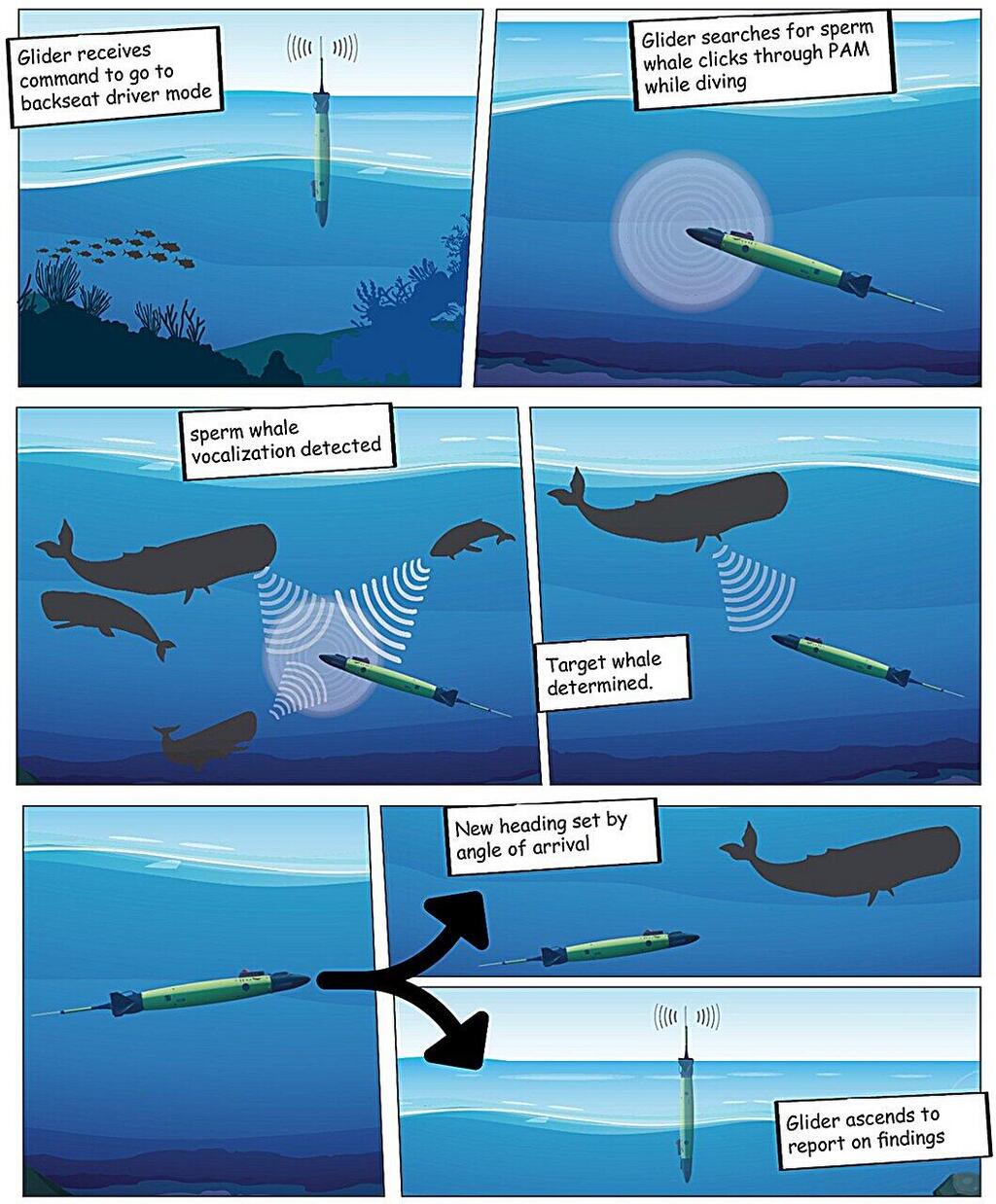
How the underwater robot tracks the communication patterns of sperm whales
(Photo: Scientific Reports)
The robot’s onboard acoustic system first identifies sperm whale echolocation clicks, then estimates the direction from which each click arrived. It groups clicks into sequences, separates them into different whale sources and selects a target, such as the whale producing the strongest signal, before sending a command that changes the glider’s heading. The system then pauses briefly before listening again, with the pause shortening when the signal grows stronger, allowing finer tracking as the glider gets closer.
Previous methods could help scientists reconstruct where a whale had been. This system is designed to keep adjusting the robot’s route while the animal is still moving. Gruber said the approach could allow researchers to stay with a single whale for “extended periods - potentially months.”
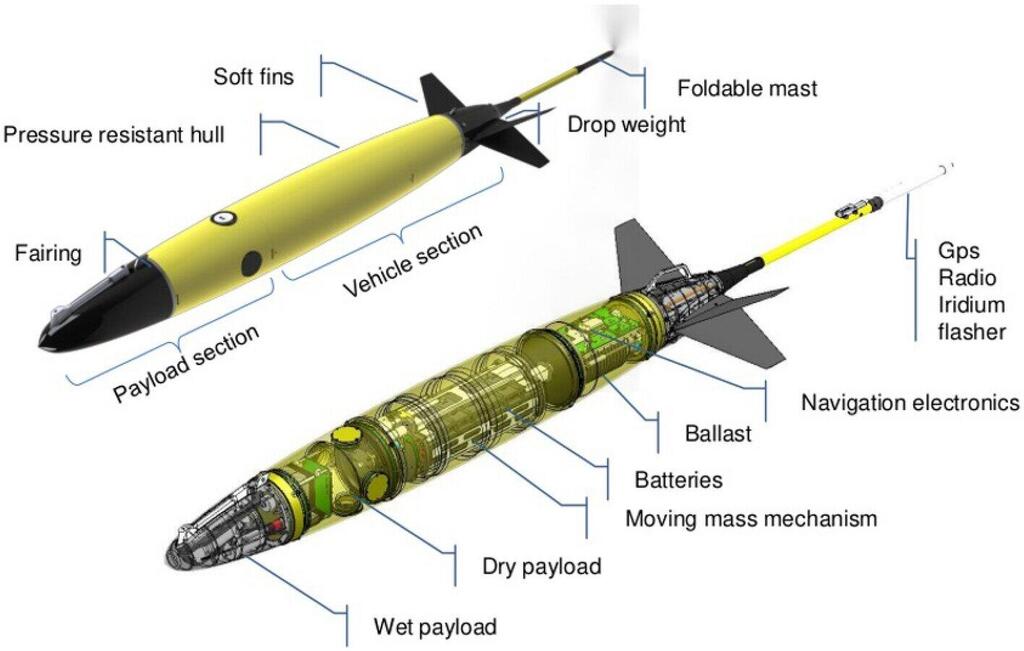
The structure of the underwater robot designed to track the communication patterns of sperm whales
(Photo: Scientific Reports)
The study’s sea trials show both the promise and the limits of the technology. In a controlled experiment in southern France in July 2025, researchers played recorded sperm whale clicks from a boat while the glider performed dives to 50, 100 and 150 meters. Once it detected the sounds, the robot changed direction in response. The study found that the glider began responding immediately to heading commands, though it took several minutes, between 2.6 and 4.6 minutes, to converge on the new heading.
In a second demonstration off Dominica, where Project CETI studies sperm whales in the Caribbean, the glider showed it could separate the sounds of multiple whales at once. In one three-second recording window, it identified 37 echolocation clicks and separated them into seven whale sources, even though that test did not involve actually following the whales.
For scientists trying to understand sperm whale society, source separation may be especially important. The study says a glider able to follow whales while distinguishing individual click streams could help researchers link vocalizations with movement, diving behavior, interactions and environmental events. In mother-calf pairs, for example, it may help reveal how young whales pick up vocal patterns from their mothers.
“By following mother-calf pairs over time, we can begin to see how calves pick up vocal patterns from their mothers,” Gruber said.
(Photo: NOAA/AP)
The system could also help researchers study how whales respond to human-made noise from shipping, offshore construction and fishing. By connecting changes in whale behavior and communication to environmental pressures, the researchers said the data could support more precise conservation measures, such as reducing ship speeds, rerouting traffic or imposing fishing restrictions in sensitive areas.
The technology is still not a whale translator, and the study is careful about what has and has not yet been proven. The researchers say long-term whale following remains future work, and the robot still faces significant challenges. It can detect a whale’s direction but not always its exact range, and because it is slow, maintaining contact with a moving animal remains difficult. It also must surface every few hours to communicate by satellite and recalibrate its sensors, and some internal movements, such as shifting its battery or changing ascent and descent modes, can create noise or interfere with measurements.
Still, the system marks a shift from short encounters to something closer to continuous observation.
“We're beginning to build systems that can operate independently and respond to the natural world as it unfolds,” Gruber said.
For Gruber, the broader promise goes beyond conservation alone.
Developing the system “brings us closer to understanding another form of intelligence on Earth, which has implications not just for conservation, but for how we think about communication and life beyond our own species,” he added.