

Although this is not the first time the phenomenon has occurred, in recent days residents of Indonesia looked up at the sky and saw a rainbow of colors near the clouds. The phenomenon, known as cloud iridescence, looks magical, but it has an explanation rooted in physics.
All clouds are made up of tiny particles suspended in the air. These particles can be water droplets, ice crystals or both.
Cloud iridescence phenomenon in Indonesia
(Video: The Weather Channel)


According to Prof. Yuval Reuveni of Ariel University’s Department of Physics, a senior researcher at Eastern R&D, strong colors require particles that are relatively small, uniform in size and in a thin cloud layer. That is why most clouds appear white or gray, while only a small share show clear iridescence.
“Unlike a rainbow, which forms through refraction and internal reflection in relatively large raindrops, and usually appears opposite the sun, when sunlight passes through tiny water droplets or ice crystals in a thin cloud, it scatters around the droplets in a process called diffraction,” Reuveni said.
In clouds, light passes around tiny water droplets. Each droplet creates a small disturbance in the light wave, causing the light to scatter at small angles rather than continue in a straight line.
Another physical phenomenon, interference, determines which colors intensify in each direction. “When two light waves reach the same point, they can strengthen or weaken each other,” Reuveni said. “In an iridescent cloud, different wavelengths of light — red, green or blue — travel slightly different paths and strengthen at different angles. That is why observers see colorful patches resembling a rainbow, though it is not a regular rainbow.”
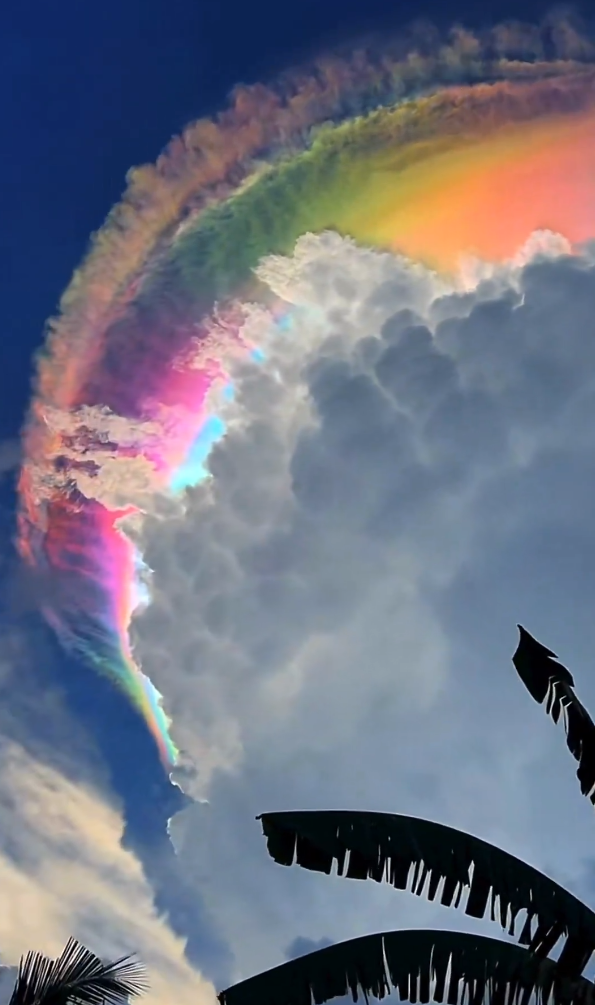
So why don’t we see it every day? Several conditions are almost essential. The sun must be relatively close to the cloud from the viewer’s angle, the cloud must be thin and the droplets must be small and uniform in size. If the cloud is too thick, the light scatters repeatedly and the colors become blurred, appearing white or gray.
In the case of the event in Indonesia, the cloud was likely young or dynamically renewing, meaning droplets formed and evaporated quickly before growing or merging. That preserved a population of small droplets suited to iridescence. A relatively dark background or partial blockage of the sun by the cloud also helps make the colors visible without direct glare.
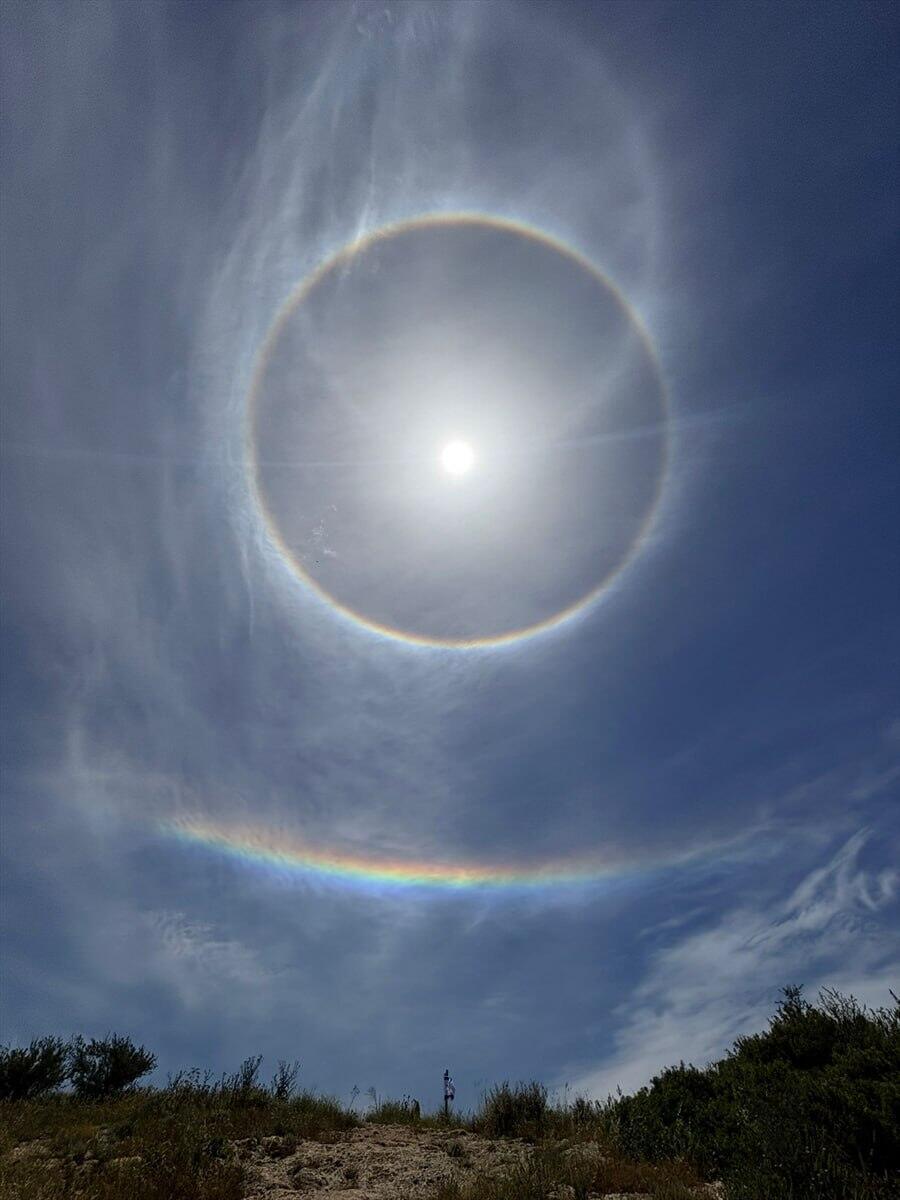
Halo around the sun, as documented in the Gilboa region
(Photo: Benny Gabai)
The phenomenon is most common in relatively thin midlevel or high clouds, including altocumulus, cirrocumulus, cirrus, lenticular clouds and pileus clouds above developing cumulus or cumulonimbus clouds.
Reuveni said the phenomenon is not unique to tropical areas, though in Israel it is usually brief and elusive. “Cloud iridescence may be seen in Israel mainly in spring and fall, when there is developed midlevel to high cloud cover, rapid changes in humidity and thin altocumulus or cirrocumulus clouds,” he said. “It can also occur in winter, on the edges of developing storm clouds or in high, thin clouds before or after a rain system, and in summer, though more rarely, when cirrus or cirrocumulus clouds appear.”