

Over the past decade, there has been a growing understanding that we need to rethink not just how we build the structures of the future, but from what materials we build them. The main reason is that the construction industry is one of the world’s leading sources of environmental pollution. Cement production—the most widely used building material—alone accounts for roughly 8% of global carbon emissions.
In response, science and technology are advancing to develop alternative, sustainable building materials with lower carbon footprints, often based on recycled resources while preserving strength and quality. As part of a joint initiative by researchers and students from the Hebrew University and the Technion, a new innovative building material has recently been developed with exceptional environmental potential—made entirely from recycled salt. Could we one day build entire structures from salt?

Working with what we have
Today, construction is a major environmental burden. According to data from the UK Green Building Council, the industry uses more than 400 million tons of raw materials annually, many of which are tied to ecosystem damage, pollution and high energy consumption. A 2017 United Nations Environment Program study also found that construction accounts for 23% of global air pollution, uses about 36% of all energy produced, and contributes roughly 39% of carbon dioxide emissions.
Construction clearly demands vast energy. In Israel, apart from natural gas, traditional natural resources like oil are scarce. One notable resource is the Dead Sea, one of the world’s largest sources of potassium and salt, where mineral extraction has become a distinctive national asset.
Each year in the southern Dead Sea, millions of tons of excess salt are deposited as a byproduct of decades of industrial production. Over time, enormous quantities have accumulated in evaporation ponds with no practical use. This buildup presents an environmental and logistical challenge, raising the lakebed and shifting shorelines. For years, this surplus salt was viewed as worthless waste.
Since 2015, Professor Danny Mendler of the Chemistry Department at Hebrew University has led research aimed at turning the accumulating Dead Sea salt from waste into a usable raw material. The guiding principle is simple but far‑reaching: treat the salt not as a nuisance to remove, but as a resource that can be refined and used.
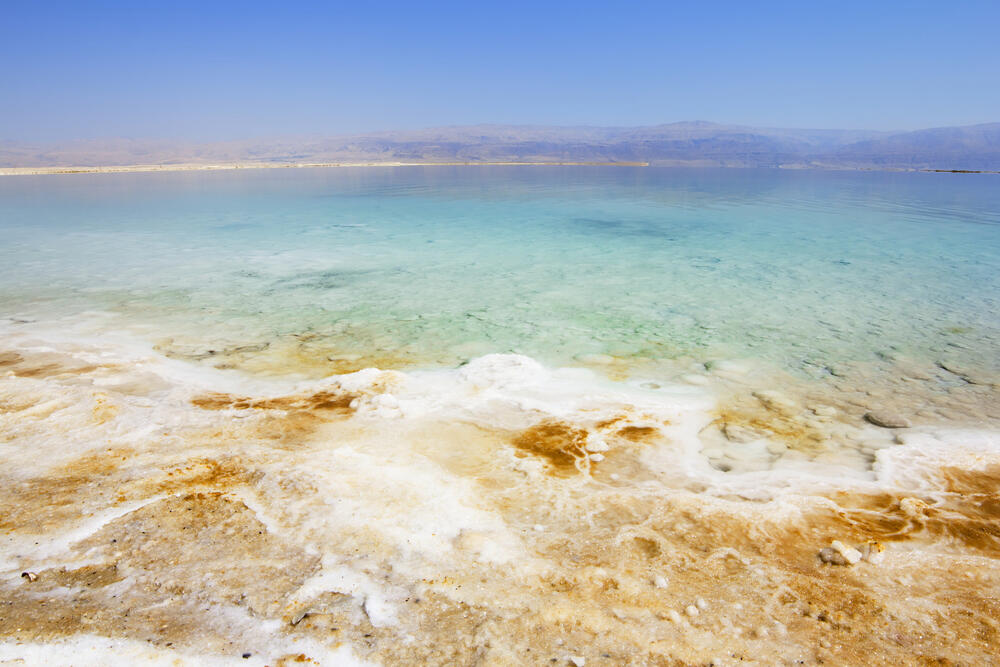
Salt deposits on the edges of the Dead Sea
(Photo: Shutterstock)
Mendler developed a chemical process that compresses and processes the salt into solid bricks with strength nearly equivalent to concrete. “About 5% additional materials are added to the salt, compressed under high pressure, and you get strong bricks that can be shaped in various forms and sizes,” he explains. “If we can replace even a small portion of cement with salt, the environmental impact would be dramatic. It could significantly reduce the industry’s carbon emissions.”
From lab to architectural studio
This year saw the first collaboration between Mendler and a group of Technion architecture students. As part of the Studio 1:1 program in the Faculty of Architecture and Town Planning, under Michal Bleicher and Dan Price, the students applied architectural thinking to the technology. They translated the new material into a practical building system—defining the brick’s dimensions, understanding its strength requirements and examining its potential for use in the Israeli construction industry.
“What’s interesting here is the connection between chemistry and architecture,” Bleicher says. “The students designed an example structure called the ‘Mediterranean Igloo’ and studied the qualities of salt—translucency, mass, strength. From there we developed the structure and derived the brick itself in proportions of 8 cm x 8 cm x 24 cm. That 1:3 ratio allows flexibility in compositions and building forms.”
The studio, which annually explores alternative materials and develops real‑scale projects, served as an experimental platform linking research, design, and implementation. Based on Mendler’s patent, the students developed the first building brick made entirely from Dead Sea salt, suited to contemporary construction needs and opening the door to reusing a material once deemed worthless. The final product is uniform, producible in series, and adaptable to various shapes, thicknesses and textures. Beyond recycling an existing resource, this material is less polluting and more sustainable compared with conventional building materials.
A direct flight to the Biennale
The initiative was presented in October at Change: The Shape of Transformation, part of the Venice Architecture Biennale—one of the most important global architecture events. The project was selected from 55 academic institutions, with only 10 groups invited to present—a distinction that places the local academic work alongside leading worldwide programs.

Will we soon see salt bricks on construction sites in Israel?
(Photo: Shutterstock)
At the Biennale, the students showcased their research, development and material model. Bleicher says their participation represents international recognition of the importance of material research and the potential to turn this waste into a future building resource.
“We took bricks with us to Venice and presented the project, and it created incredible buzz,” she says. “This material is both natural and engineered. Our intention, together with Professor Mendler next semester, is to build a real structure in Israel using these bricks. We believe in this technology; it can solve a significant environmental problem and turn waste into something valuable. There is a real breakthrough here for the future of construction and the environment.”
The challenges ahead
Despite progress in sustainable building solutions, researchers emphasize that improvements are not keeping pace with accelerated construction and rising energy demands. The implications are clear: without new, more environmentally friendly materials and building processes, construction will remain a key driver of the climate crisis.
So, will we soon see salt bricks on Israeli construction sites? The answer for now is complex. The path from the Technion lab to widespread industry use is long—especially in construction, an industry known for conservatism.
“Introducing a new material into construction takes time and resources,” Bleicher notes. “Every material must undergo prolonged standardization, strength and durability testing—and that takes many years and significant investment. Moreover, there is a lack of regulation and legislative support that complicates the development of new solutions.”
Yet the salt that has accumulated for decades as a problematic surplus may yet become a cornerstone of cleaner, more thoughtful architecture—one that views crisis not just as a threat, but as an opportunity for innovation.
This article was prepared by Zavit – the news agency of the Israeli Society for Ecology and Environmental Sciences