


Police on Monday evening closed all entrances to the southern resort city of Eilat after flooding inundated key roads leading to the city.
Earlier in the evening, Routes 12, 40 and 13 were shut down due to flooding. Police later expanded the closures to include Route 90 from Ein Gedi to Eilat, as well as Route 25 from the Zefit Junction to the Arava Junction.
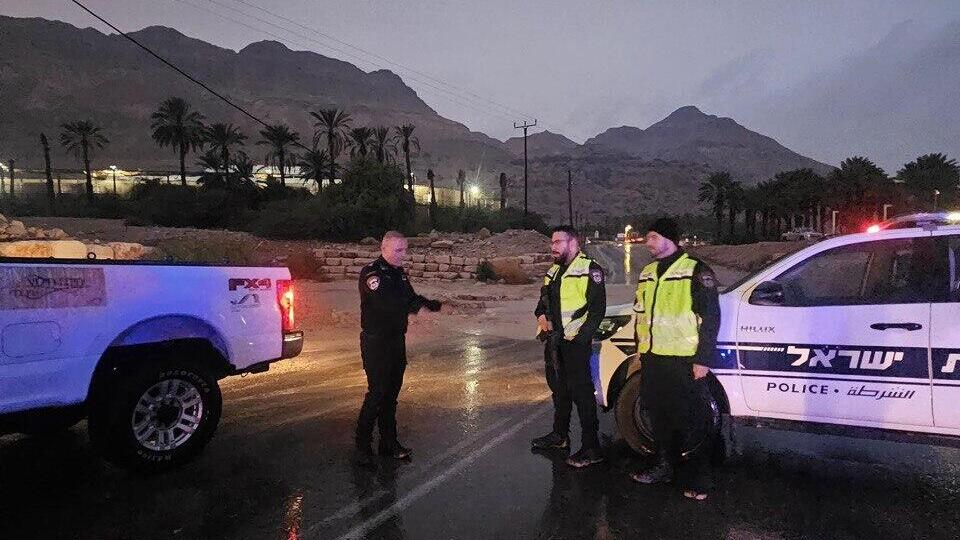
Israel Police on Route 90
(Photo: Israel Police)
“Exit from Eilat will be permitted only for residents of the Eilot Regional Council communities and for those traveling to Ramon Airport,” police said in a statement.
The closures come just three days after Storm Byron swept through the region, bringing heavy rainfall that caused flooding and flash floods across southern Israel. Earlier Monday, the Israel Meteorological Service issued orange-level warnings for significant rainfall in multiple areas and warned of flooding in the Negev.
During the evening hours, police confirmed the closure of Route 90 and later announced additional shutdowns, including Route 40 from the Zipporim Junction through Mitzpe Ramon to the Tzihor Junction, and Route 25 from the Zefit Junction to the Arava Junction.
Motorists were urged to drive with caution and follow instructions based on weather and road conditions.
The Meteorological Service said rainfall totals of 50 to 75 millimeters were expected in the central and southern coastal plain, the Shephelah, northwestern Negev and western Negev. In the Judean Desert and Dead Sea area, northeastern Negev, Negev Highlands, eastern Negev and northern Arava, rainfall of 15 to 25 millimeters was forecast within less than 24 hours.
Officials warned of a high risk of flooding, particularly in the Shephelah and the central and southern coastal plain. Due to those concerns, police began preemptive road closures in southern Israel even before Route 90 was shut down.
According to a summary released by the Israel Meteorological Service following Storm Byron, the heavy rainfall erased precipitation deficits in many parts of southern Israel and along the coast, and even produced a significant surplus in some areas. In the Tel Aviv metropolitan area, the rainfall deficit was sharply reduced, while in the northern mountains it narrowed more moderately.