

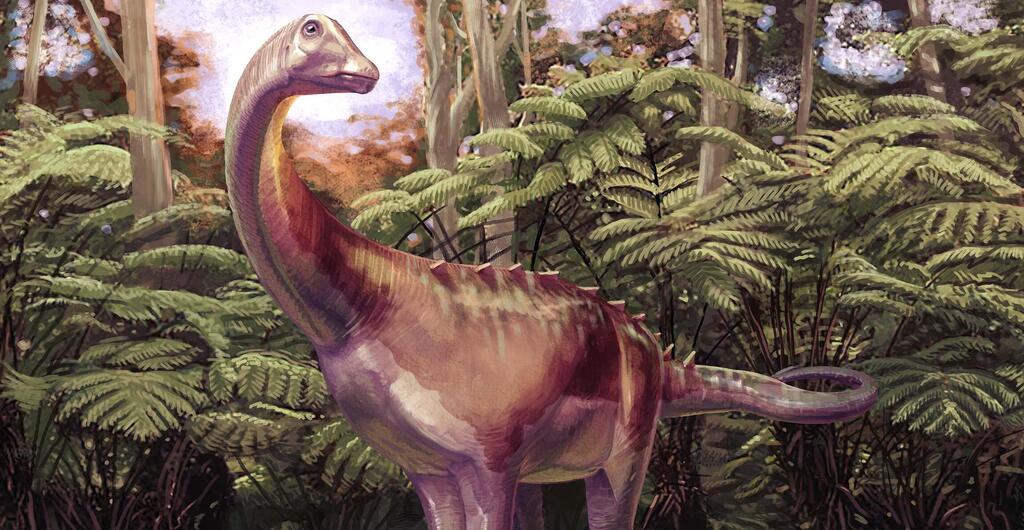
Antarctica is known today for the largest ice sheet on Earth, covering about 14 million square kilometers and holding roughly 90% of the planet’s ice. But tens of millions of years ago, the frozen continent looked entirely different: a forested, living landscape where dinosaurs roamed.
Now, a fossil found there four decades ago has confirmed that some of those dinosaurs were titanosaurs, the group that included the largest land animals ever to walk the Earth.
The fossil, a vertebra, was discovered in 1985 by geologist Dr. Mike Thomson of the British Antarctic Survey on James Ross Island, near the Antarctic Peninsula. At the time, researchers found many marine fossils in the same formation, helping date the rock to the Late Cretaceous period, between 100 million and 66 million years ago. The bone itself was initially thought to belong to a marine reptile.
A new study published in Acta Palaeontologica Polonica has now identified the fossil as part of a giant herbivorous sauropod that lived about 82 million years ago. Prof. Paul Barrett of London’s Natural History Museum, an expert on sauropods, helped identify the bone based on its structure.
“This is the first dinosaur fossil ever found in Antarctica,” Barrett said.
The bone is too incomplete to determine the exact species, but its shape and size suggest it belonged to a titanosaur. Researchers estimate the animal was probably about six to seven meters long.
At the end of the Cretaceous period, Antarctica was still connected to the southern tip of South America. Instead of ice, it had lush temperate forests, similar in some ways to those found today in Tasmania, off Australia’s southeastern coast. Because of its southern location, the continent still experienced dramatic swings in daylight, but life flourished there.
So far, about six dinosaur species have been described from Antarctica, though scientists believe the true number was certainly higher. The forest floor was home to small herbivores such as Morrosaurus, ankylosaurs and Antarctopelta, as well as two-legged predators such as Imperobator. Flying dinosaurs and early birds were also present, including Vegavis, an ancient relative of ducks and geese.
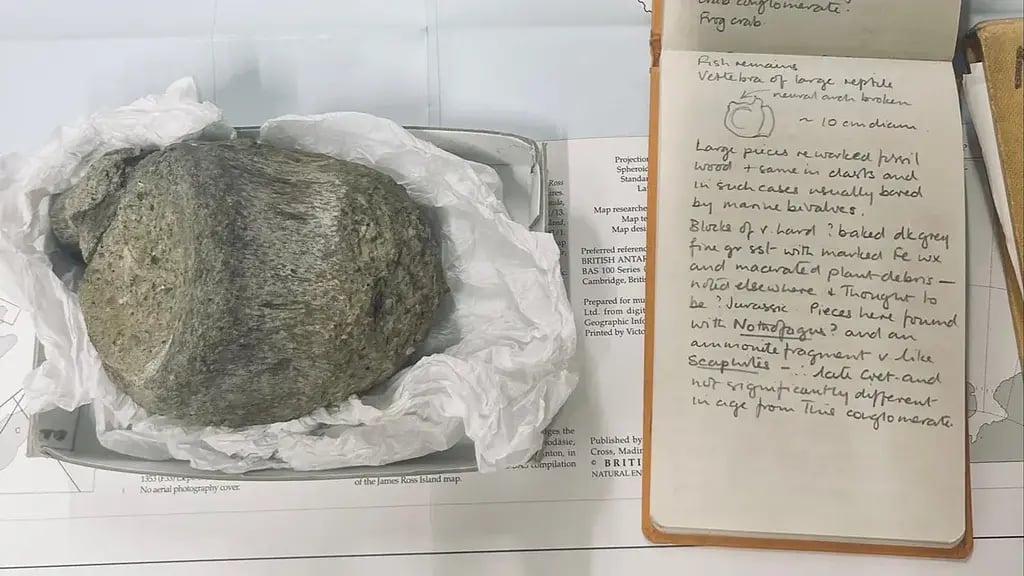
Dr. Mike Thomson’s journal, from the British Antarctic Survey, beside the first fossilized dinosaur vertebra found in Antarctica in 1985
(Photo: British Antarctic Survey)
The newly identified vertebra is especially valuable because only one other sauropod bone has ever been found in Antarctica. Researchers believe the dinosaur may have resembled Muyelensaurus, a sauropod known from South America, though it is impossible to say whether it belonged to the same species or a close relative.
The fossil may also help solve another puzzle. Sauropods have been found in Australia, but titanosaurs have not yet been discovered there, even though titanosaur fossils have been found in nearby New Zealand.
According to Barrett, New Zealand was, at the time, “quite far from Australia” and closer to southern South America and the Antarctic Peninsula because of the way the continents had shifted.
That raises the possibility that the Antarctic Peninsula served as a route that allowed titanosaurs to move from South America toward New Zealand while bypassing Australia altogether. Researchers stress that more fossils will be needed to confirm that theory.
Still, a bone once mistaken for a marine reptile is now helping scientists reconstruct a lost Antarctic world, one where forests grew, giant plant-eaters moved between continents and the coldest place on Earth was once full of life.