

The pom-pom, or perhaps the long-legged hedgehog, in the photograph is not a hedgehog at all. It is the adorable raccoon known as Jimothy.
Jimothy became an almost overnight viral sensation after Seattle resident Kiana Hall, who also gave him his name, posted a video of him on July 14. The clip attracted millions of viewers, and social media was soon flooded with memes, comics, tattoo photographs, illustrations and countless posts celebrating him. Even Google joined in.
Jimothy, the raccoon who became a star
(Video: From social media)


Jimothy does not look like an ordinary raccoon. He has no long, bushy tail marked with black rings, almost no visible neck and, instead of the elongated, plump body typical of a raccoon, resembles a furry ball perched on unusually long legs. He looks more like an enormous harvestman, or a giant hairy spider that has lost four of its legs.
After Hall’s video went viral, earlier footage emerged showing Jimothy as a cub alongside his conventionally shaped family.
“He was so small and clumsy, but his mother and siblings were always so patient and caring, keeping him from falling and sometimes just carrying him,” wrote Ben Trammell, who filmed the cub on June 28, 2025. "I honestly never had high hopes for his longevity but every time we saw him it brought so much joy and a fair amount of amusement."
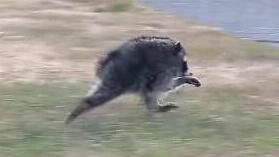
Jimothy’s extremely unraccoon-like appearance appears to result from short spine syndrome, a term describing a group of exceptionally rare congenital disorders that, unsurprisingly, cause a significant shortening of the spine.
Although Jimothy has not been formally diagnosed, the disorder affecting him appears to be spondylocostal dysostosis. The condition is caused by a mutation in one of several genes involved in embryonic development, including the development of the vertebrae and ribs.
Because of the mutation, the vertebrae and ribs develop abnormally in the embryo. They may be compressed, deformed or fused, and some may be missing entirely.
As a result of the abnormal spinal development, humans and other animals with the disorder have short necks with limited flexibility, crooked torsos and bodies that appear more compressed than usual. Their limbs, however, are generally normal in length or even slightly longer. In animals that normally have tails, the tail may be absent or extremely short.
In animals, short spine syndrome is best known in dogs, which can look like they were drawn by an untalented young child or unsuccessfully generated by artificial intelligence. Only a few dozen dogs worldwide are known to have the syndrome, and some have gained hundreds of thousands of social media followers.
The earliest known documentation of the condition appears in 17th-century paintings of dogs by artist David Klöcker Ehrenstrahl. Some dogs with more severe forms of the syndrome die shortly after birth. Those that survive, however, generally live full lives and, as far as is known, do not suffer from chronic pain. In many cases, they do require assistance because their movement is partially restricted, and some need additional medical treatment.
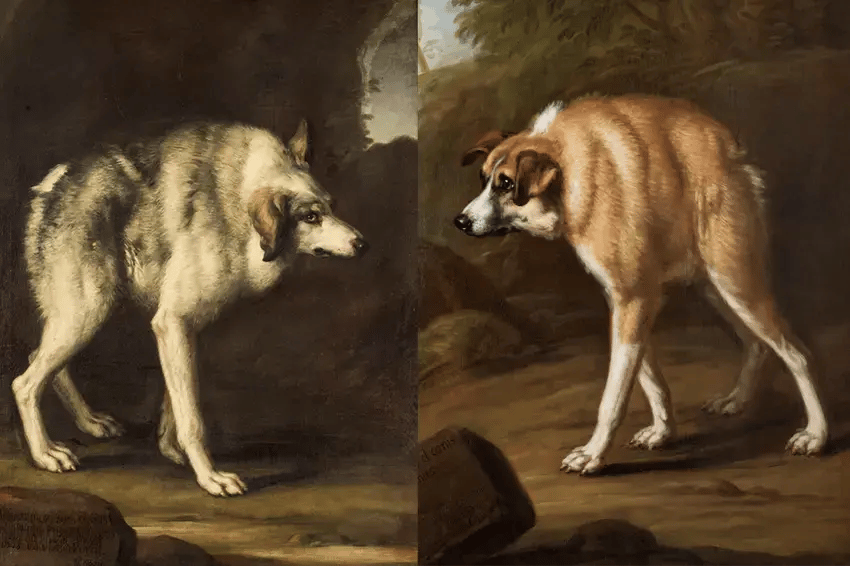
Two 17th-century paintings by David Klöcker Ehrenstrahl provide the earliest known documentation of the syndrome in dogs
(Photo: Linn Ahlgren, CC BY-SA 4.0, Nationalmuseum)
Jimothy clearly survived infancy, and although animals are skilled at concealing pain, he does not appear to be suffering. "He looked lively and active," Marcie Logsdon of Washington State University’s Veterinary Teaching Hospital told The Seattle Times. “The fact that he’s made it to this age tells me that he’s managing and that he’s adapting,” Logsdon added. “I was surprised and honestly a little bit inspired that he’s that resilient.”
Jimothy’s best chance of survival is for people to leave him alone. They should not attempt to capture or feed him. Food could harm him or cause him to become accustomed to humans, increasing the risk that the raccoon, whose movement is already more limited than that of an ordinary raccoon, could be struck by a vehicle or attacked by a dog.
Anyone in the Seattle area who happens to see him should photograph him only from a distance and avoid approaching him. People in Seattle, or anywhere else in the world, can celebrate his existence in other ways, including sharing book recommendations in his honor, humorously awarding an honorary degree to Dr. Jimothy or devising any other creative tribute.
Hall told Today that she had spotted Jimothy while out for a walk and said she hoped others would explore their own neighborhoods and pay closer attention to their surroundings, because they could never know what they might encounter.
“I saw Jimothy just out on a walk." Hall told Today. "I hope that more people will go out in their neighborhoods, wherever they are, and just look at what’s around them. You just never know what you might see.”
Noam Levitan is with the Davidson Institute of Science Education, the educational arm of the Weizmann Institute of Science.