

More than five decades after completing his studies at the Technion, Ami Nadir has added another degree to his name - a doctorate in archaeology from Ben-Gurion University of the Negev. For him, exploring the past has turned out to be a pursuit with a future.
At 81, Nadir lives in Haifa with his wife, close to his three children and eight grandchildren. He remains active, curious, and full of energy. While many of his age are slowing down, he continues to press forward, uncovering new insights in fields he is passionate about.
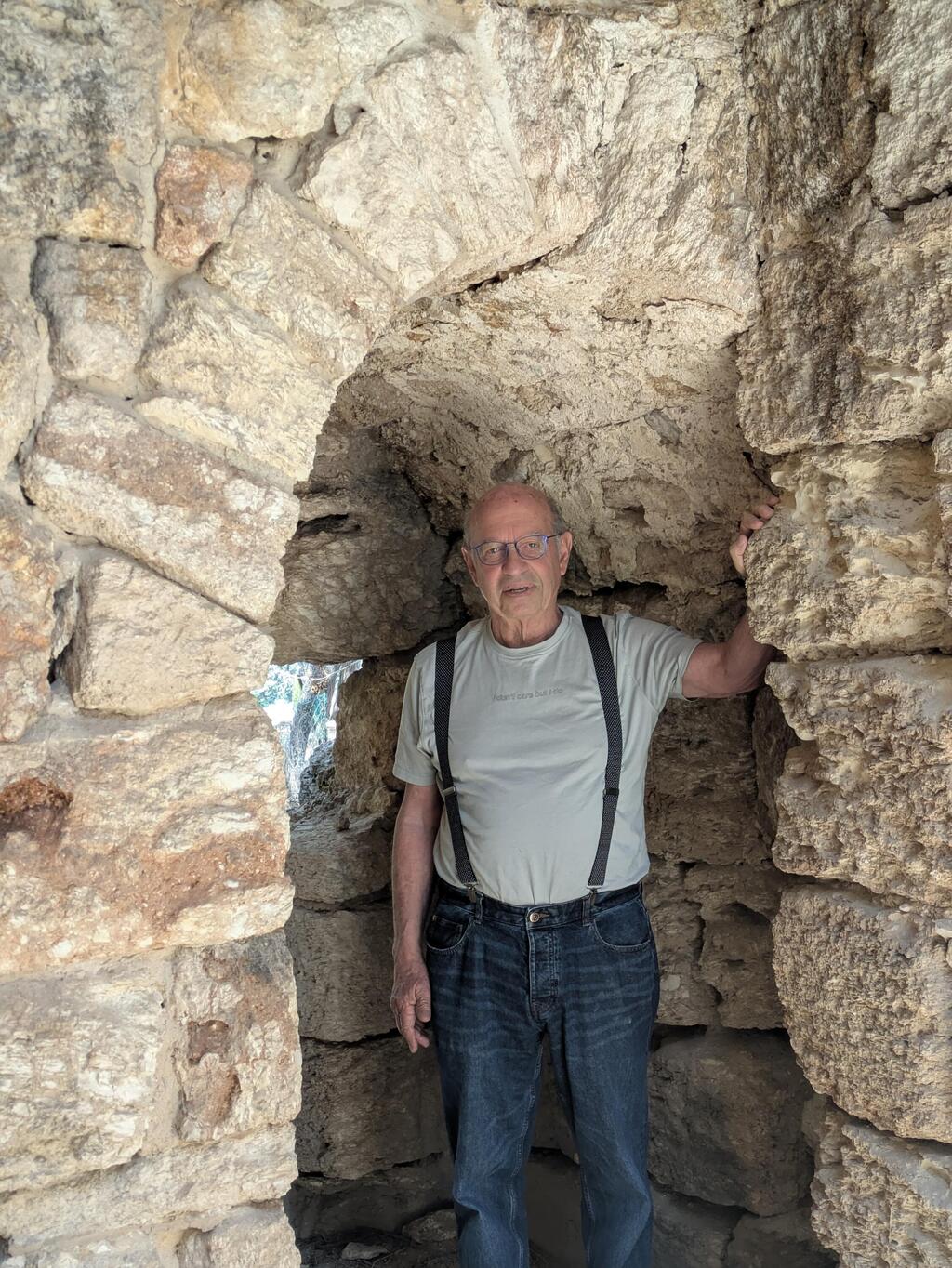
Dr. Ami Nadir at the ruins of Rosh Mia Fortress
(Photo: Shahar Nadir, taken from Ben-Gurion University magazine)
His thirst for knowledge has fueled his journey, making him a role model of perseverance and hard work. They say 'experience is the best teacher', and Nadir has shared his with classmates, many of whom weren’t born when he first studied engineering at the Technion.
Nadir was born in 1944. He served in the Israeli Navy from 1962 to 1969, concluding his military career as a torpedo boat commander.
Then, he studied industrial engineering and management at the Technion and went on to work in engineering and economics until his retirement.
His decision to shift from engineering to the humanities stemmed from a desire "to broaden my perspective on the world around me", as he described it.
His initial studies as an auditing student at the University of Haifa only deepened his curiosity. His academic passion soon centered on the fourth-century settlers of Sde Boker in the Negev, particularly what brought them to settle in the region. "Based on my background in economics, I concluded that these settlers arrived in Sde Boker for economic reasons and left for the same reasons," he explained.
In 2022, Nadir joined Ben-Gurion University as a doctoral student in archaeology through the Kreitman School of Advanced Graduate Studies. Drawn to the institution named after Israel's first prime minister, he quickly adapted to the new environment and, above all, was taken with the people he met there.
While searching for a doctoral advisor, exploring options at Haifa and Tel Aviv universities, he met Prof. Haim Goldfus, who agreed to supervise a dissertation that combined archaeology and economics.
"Eventually, Prof. Isaac Meir joined the advisory team and closely accompanied the research," Nadir said. "Both of them, along with the rest of the faculty, welcomed me warmly. Without them, I wouldn't have succeeded in accomplishing the doctorate."
Nadir made the weekly journey from Haifa to Be'er Sheva by train. "It was a pleasant trip for me. As soon as I boarded the train in Haifa, I had time to review material. Two and a half hours later, I would arrive at the university gates, filled with joy," he recalled.
He also has a message for retirees looking to fill their free time: what you choose to do after retirement matters. "It’s important to discover a new world you haven’t yet explored.
"In my case, I can say unequivocally that pursuing higher education has given my life new depth," said Nadir. "You accumulate new experiences and have plenty of time to dive into topics that haven’t been fully explored. Everyone should pick a subject that interests them for an enjoyable experience."
Now, Nadir isn’t resting on his laurels. He’s already at work on his next research project. Given the pressures and deadlines of formal academia, he chose to pursue what he calls a 'self-directed post-doctorate', researching economic development in ancient Mesopotamia and Egypt.
"I’m conducting the research from my home in Haifa, occasionally visiting the University of Haifa library. I want to work at my own pace, free of the pressure that comes with academic institutions," he said. "With the experience I’ve gained over the years, I hope this project will reach academic publication in the future."