

Imagine being able to turn transparent. How many embarrassing, unpleasant, or even dangerous moments could we avoid if no one could see us? What if, like Harry Potter beneath his Invisibility Cloak, you could simply vanish from sight?
Humans, of course, cannot make themselves disappear. But in nature, many animals have evolved varying degrees of transparency. For many of them, transparency functions primarily as a form of camouflage. Some animals are almost entirely transparent, such as certain planktonic organisms, tiny marine creatures that drift with the current. Others have only transparent body parts, including certain species of butterflies, frogs, and fish. A few can even switch between opaque and transparent states as needed.
Gallery
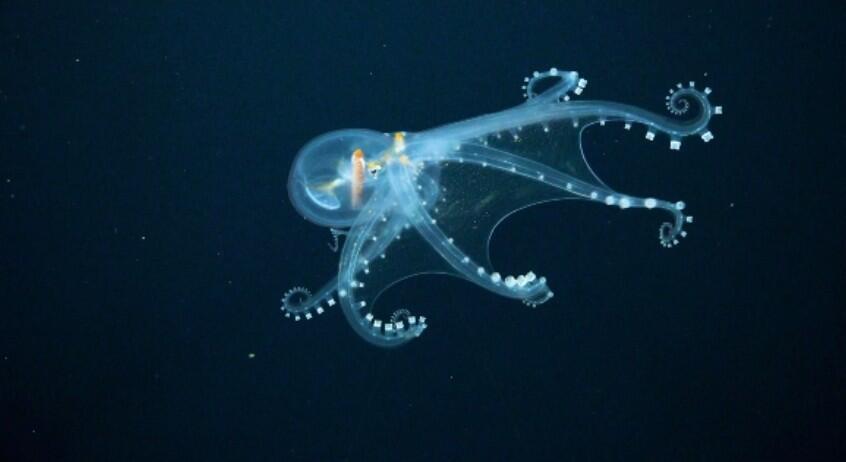
Transparency helps the glass octopus adapt to life across a range of ocean depths and environments. The glass octopus
(Photo: Schmidt Ocean Institute)
But transparency comes at a cost. It requires complex anatomical adaptations, such as narrowing certain organs or restricting blood flow to specific parts of the body. So how and why did transparency evolve in some animals?
The physics of transparency
When particles of light, called photons, hit a surface, several things can happen. Some may bounce off it. If they are reflected at the same angle at which they arrive, the surface acts like a mirror. Other photons may be absorbed or scattered, allowing us to see the object in a particular color, depending on which wavelengths are reflected to our eyes. Finally, if light passes through the material rather than being reflected, absorbed, or scattered, the material appears transparent — as glass does.
One way to describe and measure transparency is through a material’s refractive index: a physical property that compares how fast light travels through a material with how fast it travels through a vacuum. In a vacuum, light travels at about 300,000 kilometers per second. In water, for example, it slows to about 225,000 kilometers per second. The closer a material’s refractive index is to that of its surroundings, the more transparent it appears.
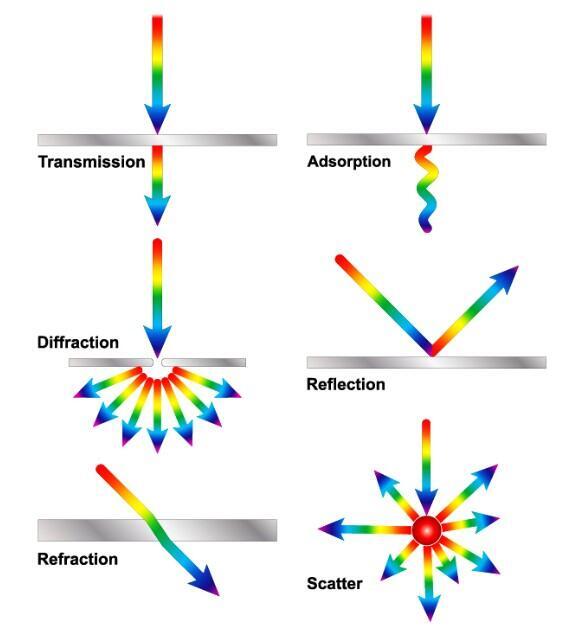
When light interacts with matter, its behavior depends mainly on the nature of the surface it encounters
(Illustration: Fouad A. Saad, Shutterstock)
The transparent wing of the glasswing butterfly
The glasswing butterfly (Greta oto) is a remarkably delicate insect. As its name suggests, its wings are mostly transparent, edged with black borders, and span about six centimeters. In a study conducted at the University of California, Berkeley, researchers examined the structure of the butterfly’s wings to understand how this transparency is produced. By comparing transparent and opaque regions, they investigated what allows the clear areas to transmit light, and what prevents even the darker regions from reflecting more of it.
Using an electron microscope, the researchers found that the wings are covered with tiny scale-like structures. In opaque regions, the scales are large and thick, preventing light from passing through. In transparent regions, however, the scales are much smaller and resemble fine hairs rather than flat plates.
These transparent regions consist of two main layers. The inner layer is a highly ordered, bumpy surface made of chitin — a strong, flexible polysaccharide that forms the exoskeleton of many insects. Structurally, it resembles other transparent biological tissues, such as moth eyes, which also feature an orderly, bumpy surface.
Above the chitin is a waxy layer containing nanopillars arranged less regularly than the structures beneath it. When researchers chemically removed this wax layer, they found that it helps reduce light reflection. An intact glasswing butterfly wing reflects only about two percent of incoming light. Without the wax layer, the wing remains transparent but reflects roughly twice as much light.
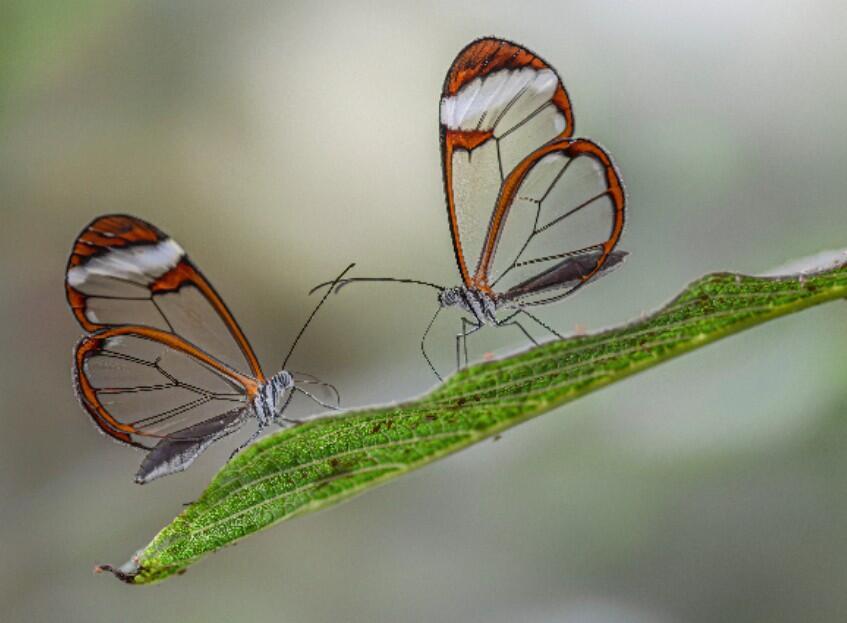
Complex chemistry helps make the wings more transparent. Glasswing butterflies on a branch.
(Photo: Albert Beukhof, Shutterstock)
An earlier study showed that the wing’s microscopic structure helps match its refractive index as closely as possible to that of air. The nanopillars and surface bumps create a gradual transition in refractive index, allowing light to pass through with minimal reflection. At the outer layer, the effective refractive index is a combination of air and nanopillar material. Deeper within the wing, the spacing between structures decreases, gradually increasing the refractive index. A similar gradient exists in the inner layer as well.
But do transparent wings actually help glasswing butterflies avoid predators? A study conducted in Finland tested whether great tits, used as model predators, and humans could detect glasswing butterflies more easily than opaque species. Although glasswing butterflies are naturally preyed upon by motmots (Momotus momota) in the Amazon, great tits were used due to their similar visual capabilities and availability for experimentation. The birds were captured for the study and later released. The results showed that both birds and humans had more difficulty detecting butterflies with transparent wings, suggesting that transparency does indeed improve survival.
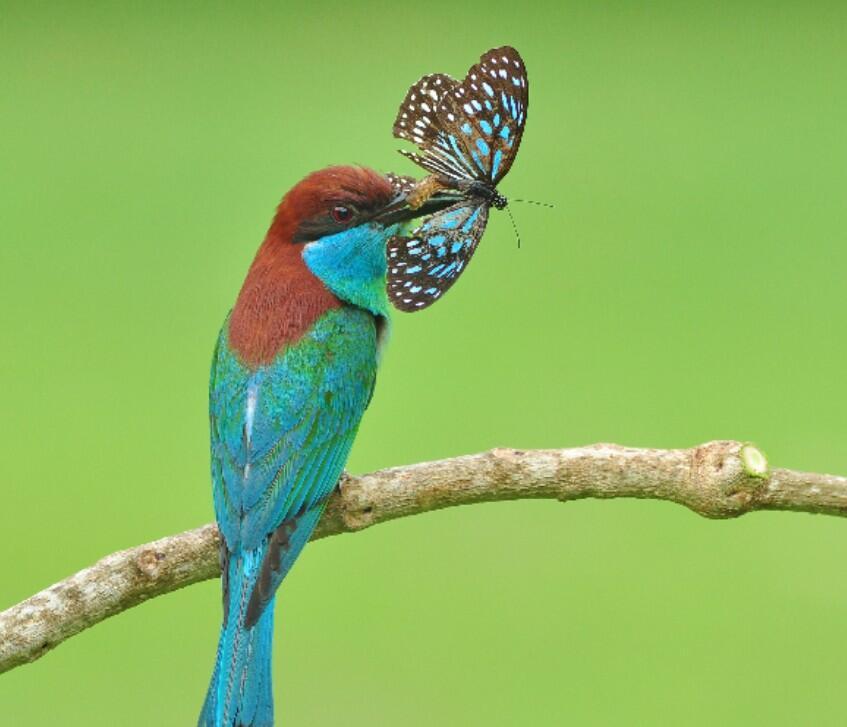
Transparent wings probably help glasswing butterflies evade predators. A bird preying on a butterfly with ordinary, nontransparent wings
(Photo: Butterfly Hunter, Shutterstock)
Partial transparency is better than none
Frogs also use transparency as a camouflage strategy. Glass frogs, belonging to the family Centrolenidae, have green backs and transparent bellies that reveal their internal organs. At first glance, this may seem ineffective: from above, the back is visible, and from below, the internal organs are exposed.
However, a study led by researchers at the University of Bristol found that even partial transparency can be advantageous. Glass frogs spend most of their time on leaves. From above, the transparent edges of the belly help them blend into the shifting shades of the leaf surface. The study found that this significantly reduced their detectability compared to other frog species.
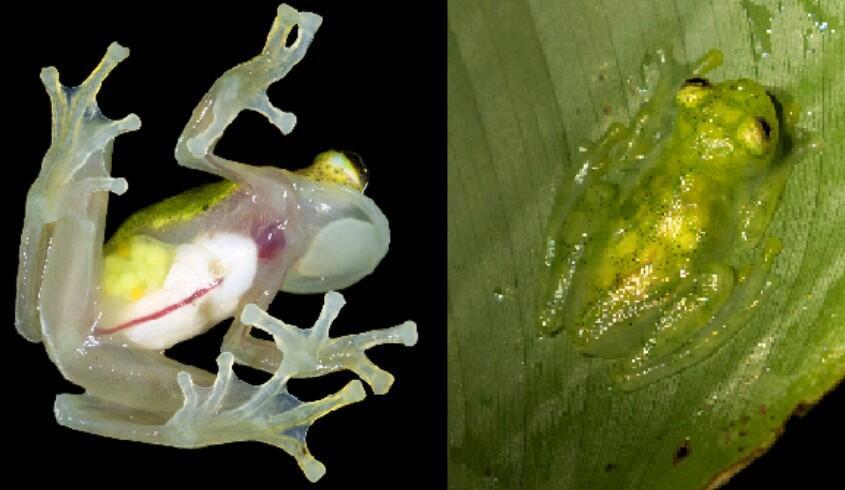
A transparent belly makes the frog harder to spot with the naked eye. A glass frog photographed from below and camouflaged on a leaf when viewed from above
(Photos: Dr Morley Read Rob Jansen, Shutterstock)
The squid that can detect transparent prey
Transparency is not always enough to hide from predators. The longfin inshore squid (Loligo pealei), studied by Prof. Nadav Shashar (Ben-Gurion University of the Negev, Eilat Campus), has evolved a mechanism to detect transparent plankton. The squid relies primarily on vision to hunt plankton. But if the prey are transparent, how can they be seen?
The answer lies in polarized light. Natural light vibrates in many directions, but polarized light vibrates predominantly in a single plane. When light interacts with certain transparent organisms, it becomes polarized in a specific direction.
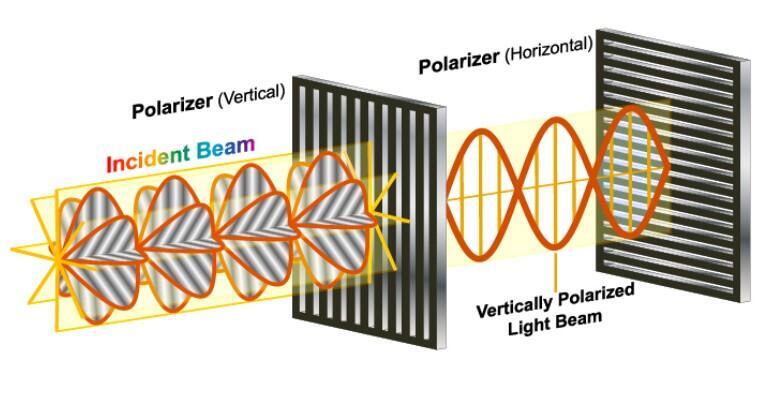
A polarizer filters out light waves that do not vibrate in its transmission plane, allowing only waves in that specific plane to pass through. Here, the first polarizer produces vertically polarized light, which is then blocked by a second, horizontal polarizer
(Illustration: Fouad A. Saad, Shutterstock)
Humans can detect polarized light only with special lenses. Squid, however, possess specialized retinal structures that allow them to perceive it directly. Experiments using glass beads that either polarized or did not polarize light showed that squid preferentially targeted the polarizing beads, suggesting they use polarization to detect otherwise invisible prey.
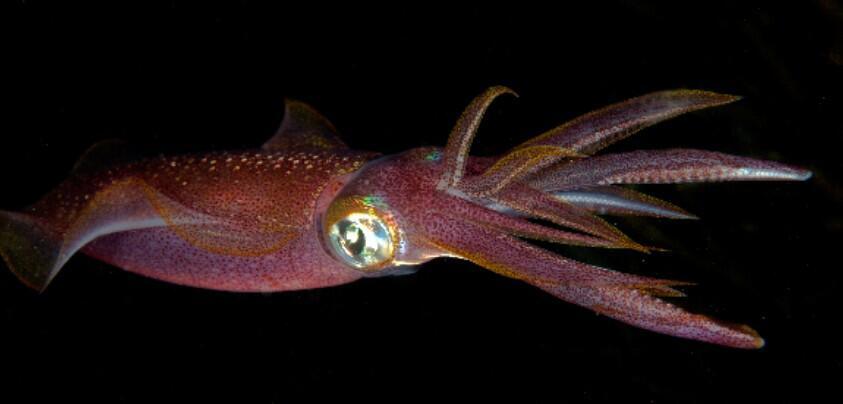
The squid’s large eyes allow it not only to see well in dim light, but also to detect polarized light and identify transparent plankton
(Photo: Konstantin Novikov, Shutterstock)
A transparent bite from a black fish
The dragonfish (Aristostomias scintillans) inhabits the deep ocean, where it hunts crustaceans and fish. Its black body helps it remain invisible in near-total darkness. It can also produce bioluminescent light to detect prey, including transparent plankton that reflect this glow.
Its teeth, however, are transparent, an adaptation that prevents them from revealing their presence. The nanocrystalline structure of hydroxyapatite in its teeth is far smaller than the wavelength of visible light, preventing scattering. Unlike typical teeth, they also lack dentinal tubules, which would otherwise scatter light and carry nutrients.
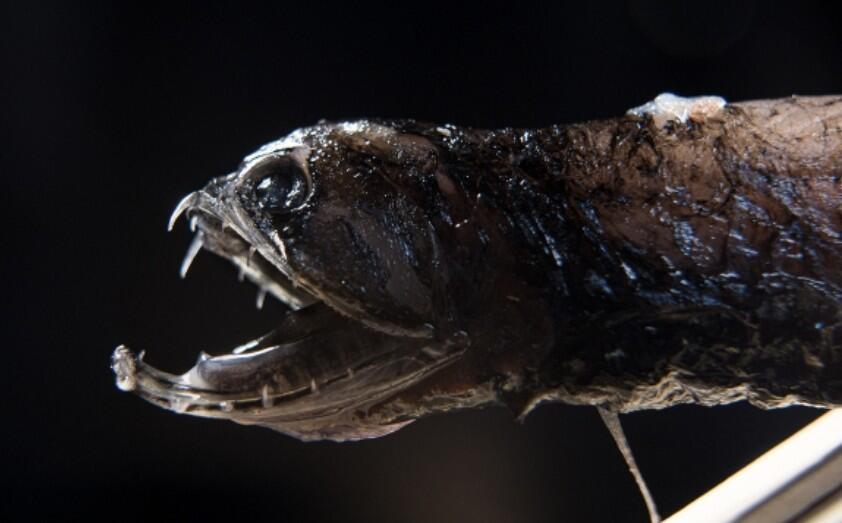
Tiny crystals reduce light scattering, helping keep the teeth transparent. Dragonfish teeth
(Photo: David Baillot/UC San Diego Jacobs School of Engineering)
The fish that can see through its head
Macropinna microstoma, known as the barreleye fish, has a transparent, dome-shaped head resembling a helmet. This structure protects its eyes while allowing it to look upward through its own skull.
Living at depths of 600–800 meters, it was long known only from dead specimens. In 2004, a live individual was observed for the first time using a remotely operated vehicle.
Its real eyes are the glowing green spheres inside the dome, while what appear to be frontal eyes are actually its nostrils. The fish typically scans upward for plankton but can rotate its eyes forward, made possible by its transparent head.
(Seeing through a transparent head. Barreleye fish’s unusual vision)
Depths of life, depths of transparency
The glass octopus (Vitreledonella richardi), filmed in the central Pacific Ocean, is nearly completely transparent except for its eyes, digestive system and nervous tissue.
Females carry fertilized eggs beneath the mantle until hatching, after which they die. The species migrates across a wide depth range throughout its life, facing varying light conditions and predator pressures. Transparency likely helps it remain concealed in these shifting environments.
However, this adaptation comes at a cost: reduced eye size limits its field of vision.
Nature’s Invisibility Cloak
The transparent cleaner shrimp (Ancylomenes pedersoni) can switch between transparency and opacity. While resting, it is nearly invisible. When startled or under stress, it turns white due to changes in hemolymph distribution, then gradually returns to transparency over time.
Researchers suggest that increased hemolymph flow during exertion causes light scattering, making the shrimp appear opaque. When injured, affected areas also remain white, supporting this hypothesis.
While transparency helps it avoid predators, it may come at a physiological cost, including reduced oxygen delivery to muscles.
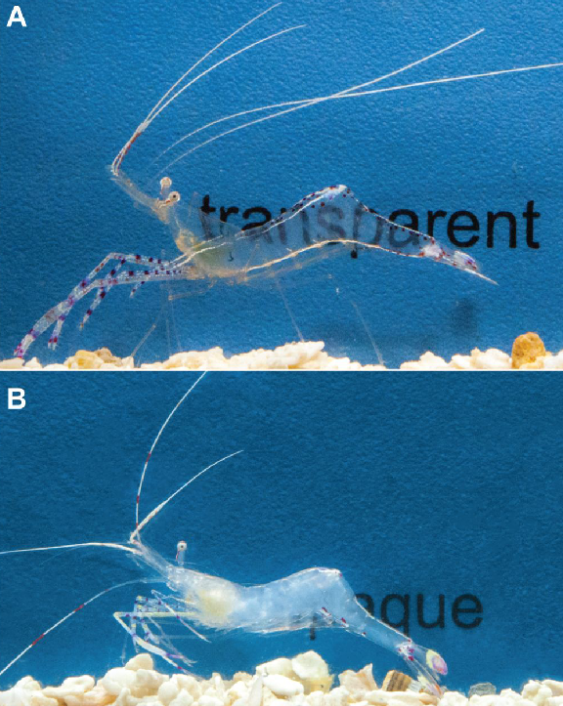
The transparent shrimp loses its transparency during exertion or distress. The shrimp is shown in its transparent and white states
(Photos: From the research article)
Now you see them, now you don’t
Some crustaceans in the Sapphirinidae family use structural coloration instead of transparency. Their crystalline guanine structures reflect different wavelengths depending on the angle of light, allowing them to appear vividly colored or nearly invisible.
Researchers found that at certain angles, reflected light shifts into the ultraviolet range, effectively rendering the animals invisible to many predators.
Different species adapt their reflectance based on depth and available light, shifting between blue, red, and UV reflection depending on environmental conditions.
( From purple to transparent. Sapphirinids changing color and disappearing)
Transparency in nature is a widespread and highly versatile adaptation used for camouflage, predation and even communication. In some species, it is reversible and dynamically controlled.
However, it comes at a cost. It requires specialized structures and physiological trade-offs. Glasswing butterflies have fragile wings, cleaner shrimp may suffer reduced oxygen flow, and other transparent animals often sacrifice aspects of vision or mobility.
Even so, the repeated evolution of transparency across the animal kingdom suggests its advantages often outweigh its costs — otherwise, it would not have emerged independently so many times.