

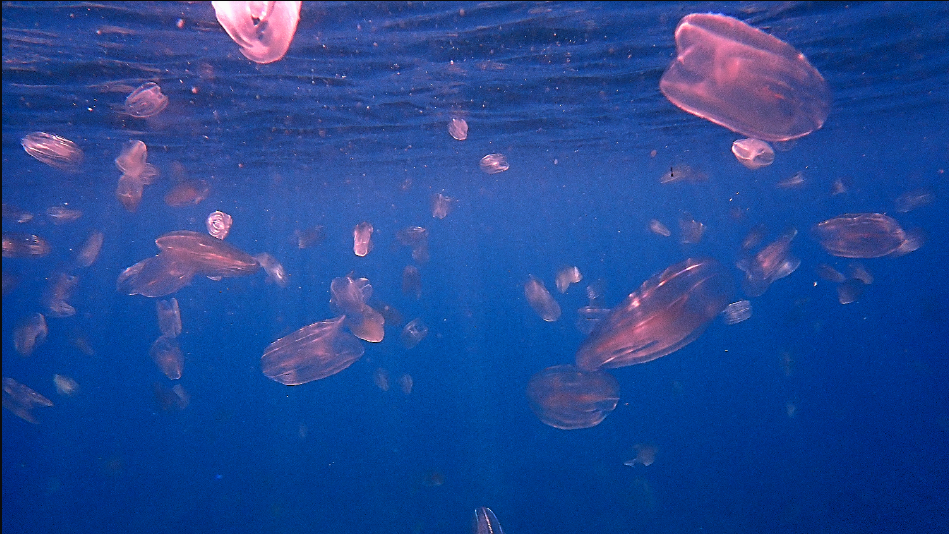
If you have ever swum in the Mediterranean, you may have passed through clouds of transparent, glowing creatures without ever knowing they were there.
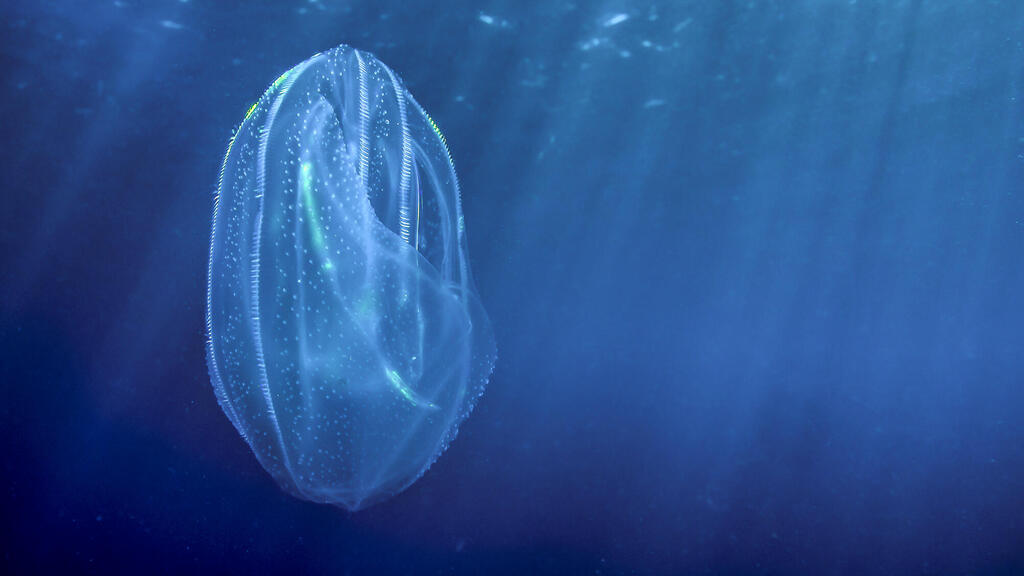
They move through the water with rows of tiny, shimmering cilia that catch the sunlight. They do not sting, and unlike jellyfish, most beachgoers neither see nor feel them. But the delicate-looking sea walnut, or Mnemiopsis leidyi, is considered one of the most successful and destructive invasive species in the world.
To understand how the species became such a formidable invader, Zavit, the news agency of the Israeli Society of Ecology and Environmental Sciences, spoke with Prof. Dror Angel of the Recanati Institute for Maritime Studies and the Department of Maritime Civilizations at the University of Haifa, who also heads the Israeli Jellyfish Association.
According to Angel, the fragile-looking comb jelly can survive in extreme conditions, reproduce at extraordinary speed, outmaneuver marine food webs and even activate a rare biological mechanism that appears to turn its developmental clock backward.
The species originated in the western Atlantic Ocean but has since invaded the Mediterranean, Black Sea, Baltic Sea, Caspian Sea and waters across Asia.
“Its adaptability is enormous,” Angel said. “It can survive in an extreme salinity range of 2 to 38 psu and in temperatures of 2 to 32 degrees Celsius. In Israel, we first documented huge swarms in 2009, and since then they have been seen along the coast for many months of the year, regularly and not seasonally. When there is abundant food, they respond immediately and create huge population explosions.”
Comb jellies are predators in the marine system, but unlike jellyfish, they do not use stinging cells. Most species are completely transparent, meaning that even when they appear in dense populations, swimmers often have no idea they are surrounded by them.
At the same time, they have a distinct glittering appearance underwater. Many species can also produce bioluminescence, creating their own biological light and glowing in the dark. They appear in a wide range of forms, and some groups of comb jellies live on the seafloor and display highly effective camouflage.
(Photo: Shlomi Katzin)
Their ecological impact can be severe. Sea walnuts feed voraciously on plankton, fish eggs and fish larvae, and can wipe out populations and seriously disrupt marine food chains.
In the mid-1980s, they caused a major collapse of sardine and anchovy populations in the Black Sea and crippled the local fishing industry, Angel said. The system only began to recover after the arrival of their natural predator, a comb jelly of the genus Beroe, which helped restore balance.
In Israel, Angel said, the system is more balanced because Beroe is present. The two species follow a regular cycle, and in a unique local phenomenon, Beroe individuals in Israel can grow to the size of a human palm, apparently because of the abundance of available food.
Despite their delicate appearance, sea walnuts are not considered threatened. Angel said the usual conservation questions, such as whether the species is endangered, are less relevant in this case because the species is exceptionally adaptable and continues to expand worldwide.
“The only factor that may perhaps threaten them in the future is severe marine pollution,” he said. “Like most marine organisms, substances such as oils or heavy metals would affect them negatively. At the same time, because of their unique characteristics and their ability to respond quickly, even if all marine populations in a certain place were harmed by pollution, comb jellies would likely be among the first species to recover.”

Prof. Dror Angel of the Recanati Institute for Maritime Studies and the Department of Maritime Civilizations at the University of Haifa, who also heads the Israeli Jellyfish Association
Human activity played a central role in spreading the species around the world. The main mechanism is ballast water, the large volumes of seawater cargo ships take into their hulls to maintain balance and stability during voyages.
The sea walnut can survive in ballast water because it can endure conditions with very little food. When ships reach their destination and discharge that water, the comb jellies are released into a new environment. If there is enough food, they exploit the opportunity, reproduce rapidly and can cause major damage to local species.
Climate change is expected to help them expand further.
“As the sea warms, it can be safely predicted that the comb jelly will expand its range and establish populations in areas where it did not previously exist,” Angel said. “It is expected to damage local food webs through increased predation on plankton, creating a domino effect that will harm both the organisms it preys on and the local predators that will be left without food.”
One of the sea walnut’s most remarkable abilities is reproduction. The species is hermaphroditic, meaning each individual carries both male and female reproductive organs and can self-fertilize.
“They do everything on their own,” Angel said. “Their phenomenal reproductive ability is mainly influenced by food availability. When conditions are right and there is abundant food, one individual can release about 10,000 eggs into the water.”
Those eggs develop extremely quickly. The offspring grow and reach sexual maturity within a very short time, sometimes within only a few weeks or less. Without natural predators to balance the system, Angel said, they “celebrate” and rapidly create population explosions.
The sea walnut also presents scientists with unusual biological mysteries. One of the most striking is its rare ability to revert to younger developmental stages after injury or physical damage.
In most species, development is linear. But in this case, Angel said, when the comb jelly is harmed, it can go into reverse. Instead of dying, it returns from a mature or adult state to its youngest developmental stages.
“It is like a child who grows up and then suddenly experiences severe distress, simply turns back into an embryo and waits for the storm to pass before continuing to grow,” he said.
Scientists still do not fully understand what gives the species such extraordinary flexibility in the face of changes in temperature, salinity and food availability, especially compared with other species that cannot do the same.
Another unresolved mystery lies in the Red Sea. Despite its remarkable success in the Mediterranean and many other seas around the world, the sea walnut has never been observed in the Eilat area, and the reason remains unknown.
For now, Angel said, there is no reason to devote conservation efforts to protecting it.
“This is a species that is currently defined as an ecological nuisance,” he said. “We have no need or reason to invest energy and effort in protecting it.”
- Content distributed by Zavit, the news agency of the Israeli Society of Ecology and Environmental Sciences.