


The world’s largest fish was first identified through binoculars by municipal lifeguards Bryan Lieberman and Yigal Molner at the city’s northern beach. The two immediately set out on a rescue board to confirm that it was indeed a whale shark, a species that poses no danger to humans.
Whale shark in the Gulf of Eilat
(Video: Bryan Lieberman, Eilat municipality lifeguard)


The Eilat Municipality said whale sharks are occasionally seen in the Gulf of Eilat, mainly during transitional seasons when sea conditions and food availability are suitable. Their arrival indicates a healthy and thriving marine ecosystem in the gulf.
Despite its impressive size, which can reach up to about 14 meters (about 46 ft), the whale shark is considered a gentle giant and is not dangerous to people. It feeds primarily on plankton, small fish and tiny crustaceans, filtering them from the water as it swims slowly and calmly.
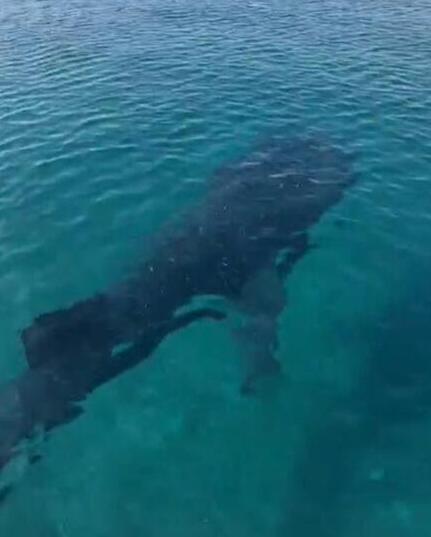
Whale shark spotted in Gulf of Eilat
(Photo: Bryan Lieberman, Eilat municipality lifeguard)
The whale shark species, which has been documented several times in the Gulf of Eilat, was first identified in April 1828 after a 4.6-meter specimen was harpooned in Table Bay, South Africa. It was later described by zoologist Andrew Smith, a military physician attached to British troops stationed in Cape Town. In 1849, Smith published a more detailed account of the same specimen.
The name “whale shark” derives from its physiology. Although it is a shark, it reaches the size of a whale and uses a similar feeding technique, filtering food from the water. The species is classified as Endangered by the International Union for Conservation of Nature (IUCN). It typically measures between 12 and 14 meters (39.37 to 45.93 ft) in length and can live for around 100 years or more.