

Egyptian authorities said Wednesday they have launched a large-scale search for a 3,000-year-old gold bracelet that disappeared from the Egyptian Museum in Cairo. The Ministry of Antiquities said the bracelet, which once belonged to Pharaoh Amenemope, vanished from the museum’s restoration lab, located in Cairo’s Tahrir Square.
According to the ministry, the bracelet, made of gold and inlaid with lapis lazuli, a blue gemstone, went missing several days ago. Officials delayed making the incident public to give investigators “a proper working environment.” After the covert investigation failed to produce results, the disappearance was announced. Photos of the artifact were distributed to Egyptian media and sent to officials at airports, seaports and land crossings to prevent attempts to smuggle it out of the country.
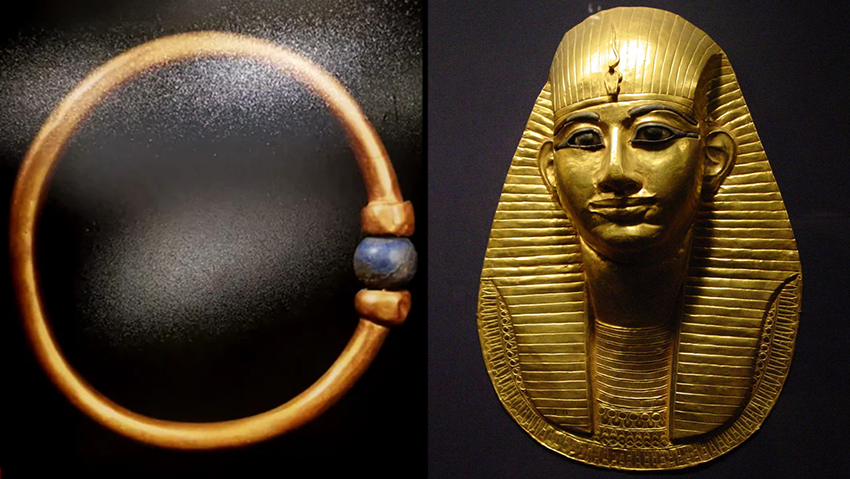
(Photo: John Campana / Wikimedia)
A special committee has been formed to review all other artifacts handled recently at the museum’s restoration lab. The Egyptian daily Al-Masry Al-Youm reported that staff discovered the bracelet was missing as they prepared to transfer dozens of items to an archaeological exhibition scheduled next month in Rome.
Christos Tsirogiannis, an archaeologist at the University of Cambridge who specializes in the illicit antiquities trade, told CNN he was not surprised by the disappearance, saying there is “a huge market” for such valuable items. He said several scenarios are possible: if the bracelet was smuggled abroad, it could appear sooner or later in an auction or on an online platform under forged documents. Another possibility, he said, is that smugglers may melt it down to sell the gold. That would yield less profit since the gold would lose its historical value, but it would make tracking the artifact much harder, perhaps impossible. Tsirogiannis added that the bracelet could also end up in a private collector’s gallery, hidden from public view, or eventually be returned to the museum. “In the past, especially in Egypt during the Arab Spring, there were cases where items taken from museums were later found in public gardens or left outside museums,” he said.
Egypt has long struggled against the illicit antiquities trade. Just last year, authorities arrested two men suspected of trying to smuggle hundreds of historical artifacts they had recovered from the seabed near Alexandria.
The missing bracelet belonged to Amenemope, a pharaoh of Egypt’s 21st dynasty who reigned from 993 to 984 B.C. According to the museum’s website, Amenemope was not a particularly prominent ruler. He was first buried in a simple tomb at the necropolis of Tanis in the Nile Delta, but years later his body was reinterred in the tomb of Psusennes I, one of the most powerful pharaohs of the era. That tomb, also in Tanis, was discovered in 1940.