


Israel’s most venomous snake has a new official Hebrew name, the Academy of the Hebrew Language announced Tuesday. The snake formerly known as Tzifa’on Shachor (Atractaspis engaddensis, or Israeli Mole Viper) will now be called Saraf Ein Gedi.
The change, approved by the academy’s plenum following scientific review, reflects concerns that the previous name was misleading and could pose serious health risks. Dr. Barak Dan, the academy’s scientific secretary, said such renaming is rare but necessary in this case because “an inaccurate or misleading name could mean the difference between life and death.”
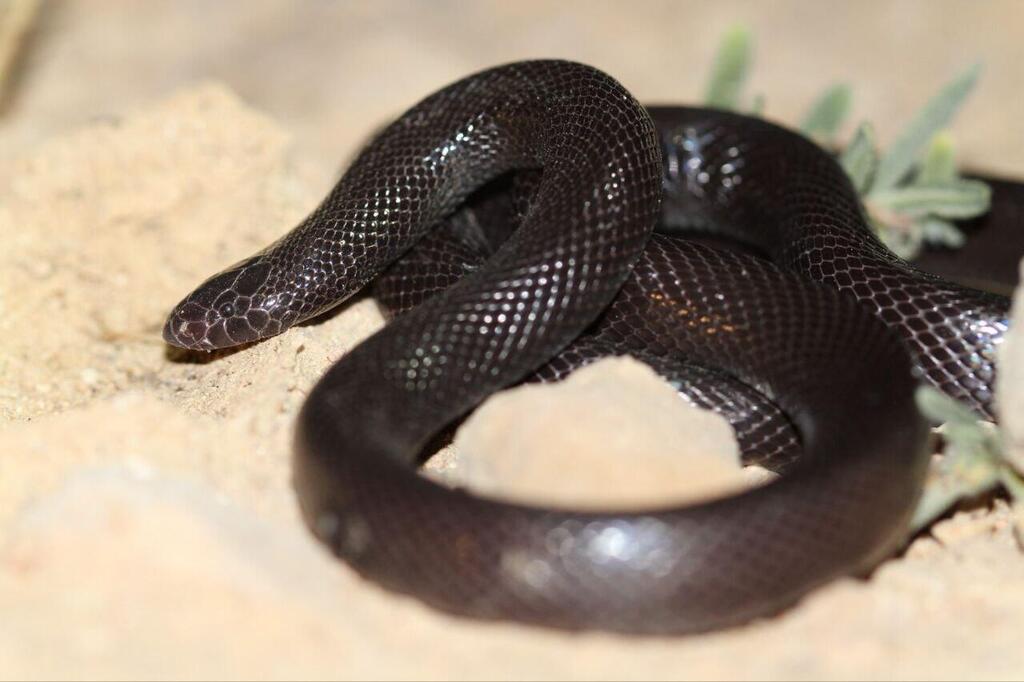
(Photo: Israel Nature and Parks Authority)
Dr. Boaz Shacham, a reptile expert at Hebrew University of Jerusalem, explained that Saraf Ein Gedi is a nocturnal snake whose venom requires immediate medical attention. “There is currently no antivenom for a Saraf Ein Gedi bite,” he said, adding that misidentification and incorrect treatment — such as administering antivenom meant for vipers — can cause fatal complications.
For decades, the snake was known by two competing Hebrew names: the official Tzifa’on Shachor and the widely used Saraf Ein Gedi. The original name suggested a close relation to vipers, which is scientifically inaccurate. Following requests from emergency room doctors, the academy has now officially adopted the name Saraf Ein Gedi and designated the snake’s family as Sarafiyim (Atractaspididae).
The term saraf, meaning a burning or venomous serpent, appears in the Bible’s Book of Numbers, where venomous serpents punish the Israelites in the wilderness. The passage recounts: “Then the Lord sent venomous serpents among the people, and they bit the people; and many of the Israelites died... Make a fiery serpent and put it on a pole; everyone who is bitten shall look at it and live” (Numbers 21:5–8).
“The distinction between saraf and vipers is a matter of life and death, as their venom types differ significantly,” Shacham said.
This renaming was part of a broader update of Hebrew reptile names approved by the academy’s Zoological Committee, chaired by Dr. Liat Gidron. The committee reviewed and revised various reptile names originally standardized in the 1963 dictionary of Israeli animal names, itself based on a 1938 Hebrew Language Committee list. A previous update was made in 2000.
Get the Ynetnews app on your smartphone: Google Play: https://bit.ly/4eJ37pE | Apple App Store: https://bit.ly/3ZL7iNv
Gidron said the committee prioritizes preserving established Hebrew names but recognizes that advancing scientific knowledge sometimes requires change.
Experts contributing to the revision include Shacham; Professor Shai Meiri of the Steinhardt Museum of Natural History and Tel Aviv University; and herpetologists Eitan Avital, Assaf Uzan, Professor Amos Bouskila, Simon Jamison, Akiva Topper, Jan Lieberman, Ben Shermeister, Dr. Karin Tamar, and Assaf Levy, founder of the BioDB website.
The updated list also introduced Hebrew names for newly identified species, such as the Eilat Gecko (Hemidactylus granosus), and clarified names for others. For example, the “Softshell Turtle” was renamed “Nile Softshell Turtle,” the “Chameleon” is now “Distinct Chameleon,” the viper “Shfifon” became “Negev Shfifon,” and “Einachash” was updated to “Handsome Einachash” (plural: “Handsome Einachashim”).
First published: 09:18, 07.16.25