

The Starry Night is not only one of the most famous works by Dutch post-Impressionist painter Vincent van Gogh, but also one of the most recognizable paintings in Western art. It depicts the Moon, the planet Venus and several stars, with swirling brushstrokes surrounding them and filling the sky, creating a sense of movement and giving the light an almost tangible quality.
For decades, art historians and astronomers have debated whether the positions of the celestial bodies in the painting were products of the artist's imagination or based on an actual view of the night sky. Researchers from South Korea have now examined the question in depth, and in a new study published in Scientific Reports, they not only propose an answer but also suggest that the date traditionally assigned to the masterpiece may be inaccurate.
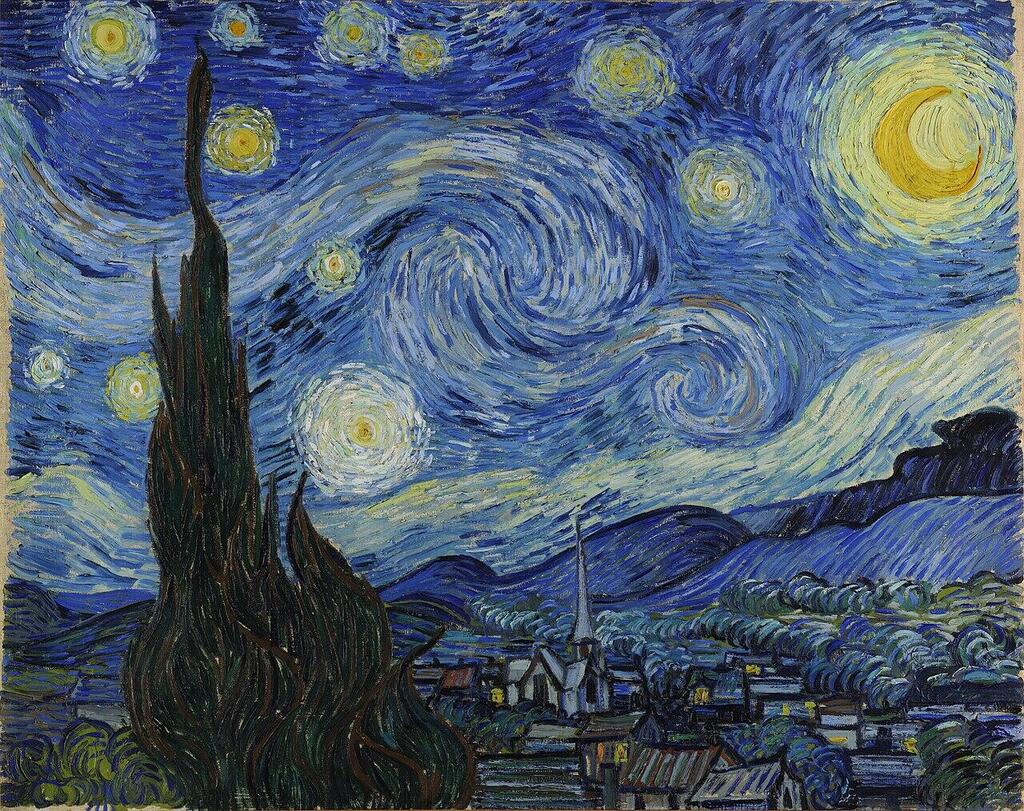
Van Gogh painted The Starry Night while staying at a psychiatric hospital in Saint-Rémy-de-Provence, southern France. He admitted himself in May 1889 while struggling with his mental health, several months after cutting off part of his left ear. Despite his condition and limited access to painting materials, he continued to produce art during his stay.
According to the conventional dating, The Starry Night, or De sterrennacht in Dutch, was completed in June 1889. Van Gogh had previously explored similar themes in Starry Night Over the Rhône, an earlier painting created in September 1888.
The famous 1889 painting is thought to be inspired by the landscape visible from the artist's window at the hospital. It depicts a group of tall trees, apparently cypresses, with a village and church in the background. The trees are greatly exaggerated in size, while the village was probably based on other scenes, since it was not visible from that window. Most of the canvas, roughly two-thirds of it, is devoted to the night sky.
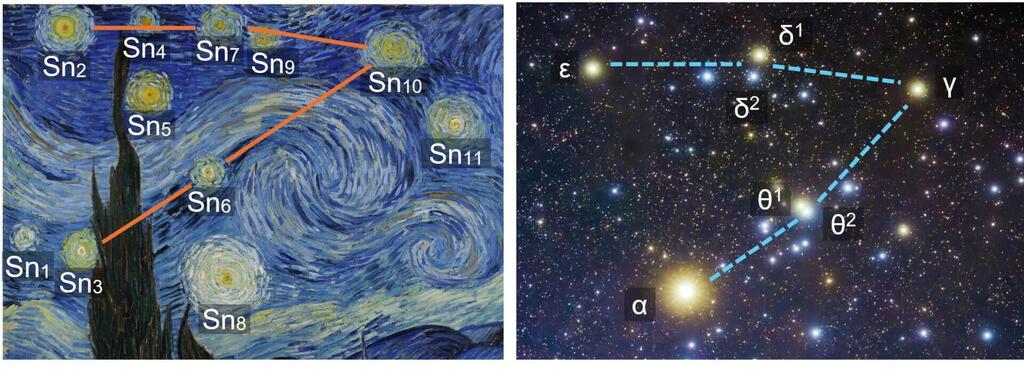
Researchers compared the stars depicted in the painting with those of the Hyades star cluster in the constellation Tauru
(Illustration: Kim et al., research paper)
Researchers led by Ho Jin and Elijah Jeong-hyun Kim, affiliated with South Korea's SLLAB and Kyung Hee University, set out to determine whether the sky depicted in the painting had a basis in reality.
They searched for a date when the positions of celestial bodies in the pre-dawn sky over southern France, with Venus visible above the horizon, would correspond to the arrangement in Van Gogh's painting.
The researchers argued that their approach shifts the burden of proof: If the arrangement of celestial bodies on the canvas matches the dawn sky of a particular date, those who believe the scene was entirely imagined must explain that correspondence.
Taurus and the cicadas
According to the researchers, most of the stars depicted in the painting correspond to the Hyades star cluster, a distinctive V-shaped arrangement of bright stars in the constellation Taurus that forms the bull's head.
By examining the apparent positions of these stars, along with the Moon's phase and position and the location of Venus, the researchers concluded that the painting most closely resembles the pre-dawn sky between July 20 and 24, 1889, about a month later than the date traditionally associated with the work.
More specifically, the arrangement of celestial bodies in the painting is particularly consistent with the sky before sunrise on July 22.
The researchers cross-referenced their astronomical findings with Van Gogh's letters, particularly those he wrote to his brother Theo. In letters from June, Van Gogh mentioned beginning work on a painting of a starry sky, but did not explicitly state that he had completed it.
His correspondence from July also contains descriptions of the intense summer heat and the sound of cicadas. The researchers considered these references as additional clues to the seasonal conditions surrounding his work.
An examination of historical weather records found that July 1889 was significantly hotter than June. During a prolonged period in July, temperatures reached between 30 and 34 degrees Celsius, conditions more consistent with sustained cicada activity than the relatively milder weather recorded in mid-June.
The researchers also examined the weather conditions during the nights of July 20, 21 and 22. Historical records suggest that skies were generally favorable for observing the stars, although some cloud cover on July 22 cannot be ruled out. By July 23, cloudier conditions would have made observations more difficult.
Combining the astronomical calculations with the historical weather records, the researchers propose that the painting reflects the sky as it appeared before dawn on July 22, 1889.
They also examined other information in Van Gogh's letters, including descriptions of an episode of illness that left him unable to work for several days. Their analysis suggests that this episode may have occurred later than previously believed, potentially after the date they propose for the celestial scene.
However, the precise timing of the episode remains uncertain because no contemporary clinical record establishing its onset has survived.
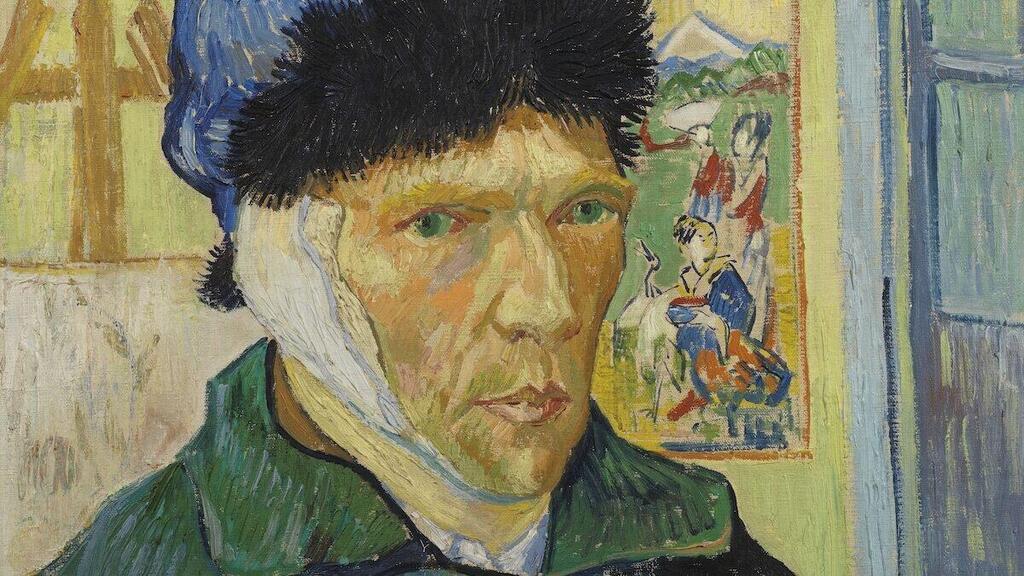
Vincent van Gogh's Self-Portrait with Bandaged Ear
(Photo: courtauld.ac.uk)
The study is another example of astronomical detective work, sometimes described as astronomical archaeology, which has helped researchers investigate details of famous artworks. Previous research has examined, for example, the color of the sky in Edvard Munch's The Scream and the date depicted in Claude Monet's Impression, Sunrise.
The South Korean researchers are careful, however, not to claim definitively that Van Gogh painted or completed The Starry Night on the date they propose.
They acknowledge the possibility that the artist observed the sky at one time but painted it later, or that he incorporated additional celestial details for artistic reasons. The painting may also combine impressions gathered over several nights rather than reproduce a single moment.
The authors emphasize that their findings establish a correspondence between the celestial arrangement in the painting and the real sky of late July 1889, but cannot determine exactly when work on the canvas began or whether it was subsequently revised.
Historical weather records from the 19th century also contain gaps and uncertainties, and new documentary evidence could alter the interpretation. The researchers acknowledge that their conclusions may need to be revised if additional historical sources emerge.
Nevertheless, they argue that their work places the relationship between observation and imagination on a foundation that can be tested scientifically. By combining astronomical calculations with geometric analysis, historical documents and weather records, the researchers demonstrate a way to turn questions traditionally confined to art history into hypotheses that can be examined using physical evidence.
The findings do not diminish the imaginative qualities of Van Gogh's masterpiece. Instead, they suggest that the swirling sky, long regarded as one of the most powerful expressions of the artist's imagination, may also preserve the recognizable arrangement of stars and planets he observed on a particular summer morning in 1889.
By Ettay Nevo, Davidson Institute of Science Education, the educational arm of the Weizmann Institute of Science