

A post shared by Western Australia’s Parks and Wildlife Service on October 16 showed a rare and decidedly odd sight: dolphins wearing sea sponges on their heads. But what exactly are they doing?
The dolphins in the photos are Australian humpback dolphins (Sousa sahulensis) living in the Dampier Archipelago. Wearing sponges as hats appears to be a new behavior—one never before documented in this population or in other groups of humpback dolphins.
This is not the first time dolphins have been seen using sponges, though in earlier cases the behavior was very different. In the 1980s, researchers documented Indo-Pacific bottlenose dolphins (Tursiops aduncus) in Shark Bay, further south along Western Australia’s coast, using sponges on their snouts. That behavior, seen mostly in females, protects the dolphins’ sensitive skin while they forage. The dolphins push their snouts into coarse sand and rocky sea floors to flush out fish, and the sponge acts like a protective glove. The behavior spread as young dolphins learned it from their mothers.

Researchers even tried the technique themselves, attaching a sponge to a stick and using it to prod for fish. “There was a lot of prey, and it was always there,” said Eric Patterson, who led the study, in an interview with Science. “The fish behavior was very predictable—they always shot out of the sand. It makes this hunting strategy efficient for dolphins.”
A dolphin fashion trend?
The new behavior in Australian humpback dolphins is more mysterious. They do not seem to be using the sponges as tools. Instead, they wear them simply as hats. According to the Parks and Wildlife Service researchers, the dolphins may be doing it for the same reason humans might wear stylish hats or jewelry: to attract a mate. “Male Australian humpback dolphins wear sea sponges as a way of courting females, a little like offering them flowers,” the team wrote in the post.
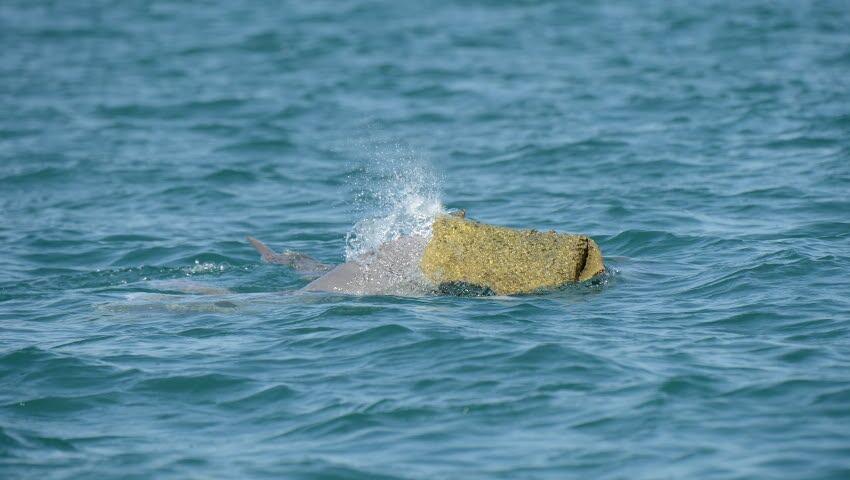
(Photo: WA Parks and Wildlife Service)
“The sponges come in all sorts of shapes, sizes and colors,” said senior researcher Holly Raudino in an interview with the Australian Broadcasting Corporation. “But everything is happening in one specific area.”
The behavior was likely started by one innovative dolphin and then copied by others. Dolphins learn from one another quickly, as seen with sponge-tool foraging and with another local hunting technique that uses shells.
Dolphins also pass along less practical behaviors. Some groups learn to “tail walk,” and chimpanzees in Zambia have been observed sticking leaves in their ears — and even in their behinds — seemingly because it is the fashion in their group.
Such socially learned traditions have been documented in many species. Some help animals survive, like new hunting methods, while others resemble cultural quirks. These behaviors offer a glimpse into animals’ inner lives and highlight how similar they can be to us.
Because these traditions differ between groups, the loss of an animal population — due to hunting or habitat destruction — also means the loss of its unique culture. It is impossible to know how many animal traditions have disappeared forever. This underscores the need to protect wildlife not only as species but as communities with their own social histories.