

During Iran’s missile attack on Israel in 2024, a message appeared in one of Israel’s birdwatching WhatsApp groups: “The mynas are invading. Take cover.”
Why were mynas chosen to represent missiles, and what does that say about the emotional relationship Israelis have with a bird that, within just three decades, has become one of the most common species in the country?
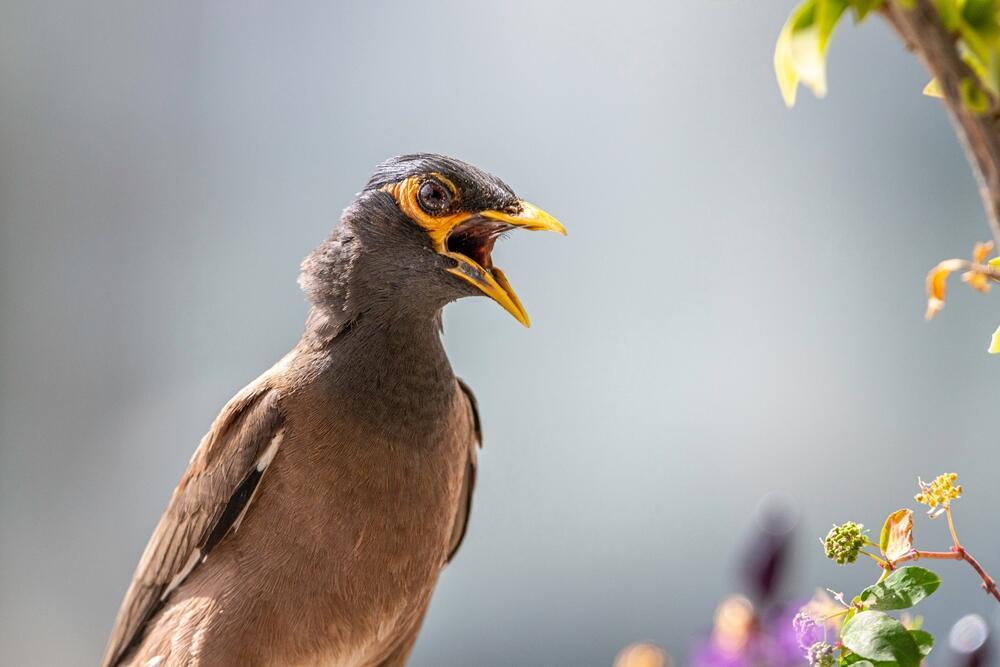
The message is one of many examples collected by Eran Schwarzfuchs, a doctoral student in the Department of Sociology and Anthropology at Tel Aviv University, illustrating the ecological and cultural integration of the common myna in Israel. In his research, titled ‘The Israeli Common Myna: Between Invasiveness and Belonging,’ Schwarzfuchs examines the complex relationship between the bird, the environment it invaded and the society that now lives alongside it.
Using fieldwork, interviews with birdwatchers and analysis of social media posts, Schwarzfuchs explores how the myna has become both a biological and symbolic presence in Israel.
Invasiveness and belonging
The common myna is a relatively new arrival in Israel’s landscape. According to the research, the bird was brought to the Safari Zoo in the 1990s, from where it either escaped or was released. It spread rapidly across the country, and in Israel’s annual bird count conducted in early 2024, it ranked as the second most common bird nationwide, after the hooded crow.
The myna is considered an invasive species and has been listed by the United Nations among the world’s 100 most dangerous invasive species. The designation is due to its high reproduction rate and aggressive behavior. The labels attached to it are telling: domineering, shrill, noisy and violent.
In recent years, Israelis have repeatedly complained about mynas invading balconies, screeching loudly, damaging crops and consuming almost anything in their path.
Myna attacks an owl


In research conducted at the Israeli Center for Citizen Science at the Steinhardt Museum of Natural History, Schwarzfuchs focused on human-animal-science relationships. Unlike other invasive species that attract less attention, he argues, the myna’s invasion is not only ecological but cultural.
“It was impossible to ignore the emotional charge around the myna,” he said. “After conducting observations, I realized it also has anthropological value.”
Schwarzfuchs explains that much of the classical literature on invasive species relies on binary frameworks: supporters versus opponents, good versus bad. “In the field, it’s much more complex,” he said. “Just as Israeli society is diverse, and just as Israeli perspectives on foreignness and belonging are not straightforward, the representations of the myna are also layered.”
A mirror of Israeli society
One example of the myna’s cultural assimilation appears in generational differences. Schwarzfuchs describes watching his 2-year-old daughter encounter a group of mynas in a neighborhood park.
“‘Myna!’ she shouted happily, waving her small hands toward them,” he wrote. “The mynas showed no fear and no interest in her excitement. My daughter’s relationship with the myna — officially labeled an invasive species and a threat to Israeli nature — reflects a very different perspective from that of most adults. For her, mynas are simply Tel Avivians, an inseparable part of the landscape she is growing up in.”
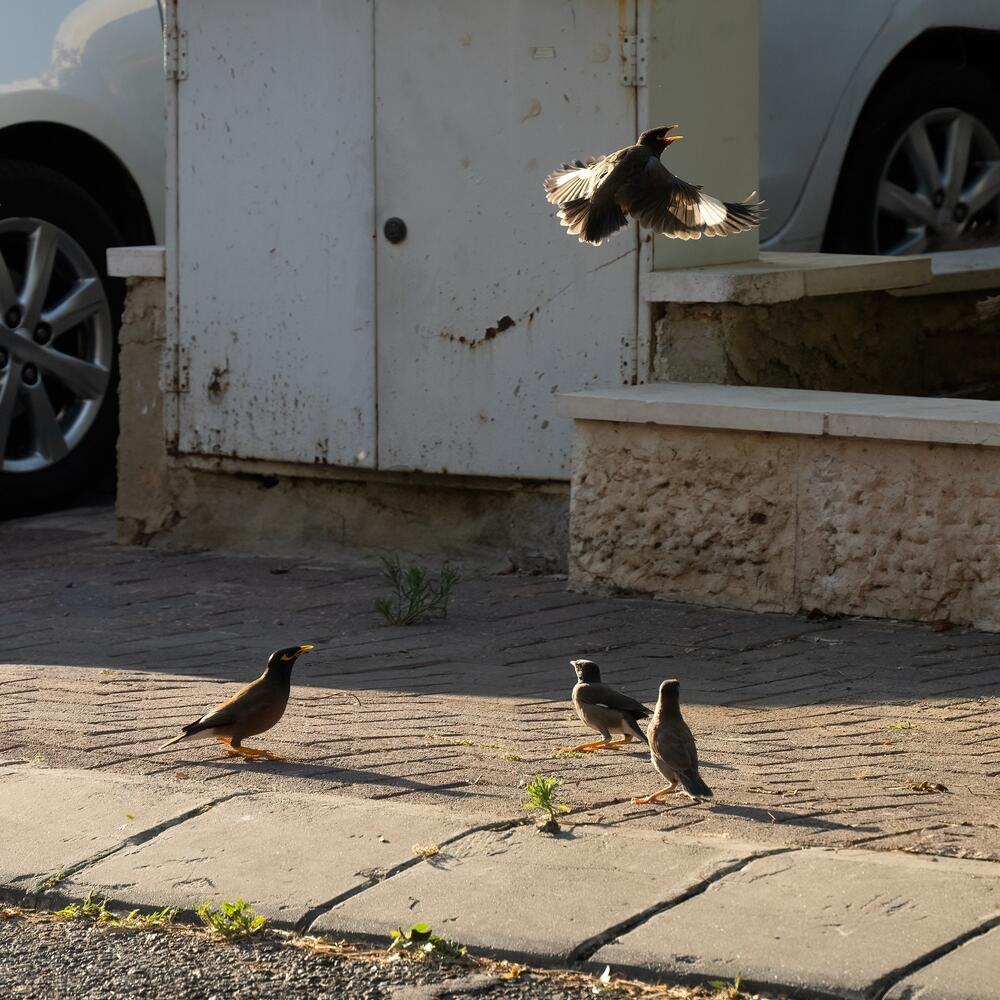
Common mynas in the urban environment
(Photo: Moshe Einhorn, Shutterstock)
Schwarzfuchs notes that the bird’s integration is already visible among younger generations, including its appearance in children’s books such as ‘Tzipi and Tzuf’ by Rinat Hoffer, where the myna is presented as just another Israeli bird.
“The myna is part of Israeli nature, for better or worse,” he said. “It belongs to Israel’s birds even if it is defined as a threat.”
He points to frequent symbolic uses of the myna to express danger or threat. In one Facebook post from the ‘Israeli Nature’ community, a hawk is shown catching a myna, prompting celebratory comments suggesting someone had finally taught the birds a lesson.
“Israelis see the myna both as an invasive threat and as a reflection of Israeli society itself,” Schwarzfuchs said. “You can identify contradictory metaphors that expose a complex relationship between ecological anxieties, social fears and the diversity of identities in Israel.”
Listening beyond headlines
As part of the study, Schwarzfuchs conducted in-depth interviews with seven birdwatchers to understand their experiences and concerns regarding the common myna.
“I wanted to speak with birdwatchers who are not responsible for the invasion or for managing it,” he said. “Unlike media headlines that tend to paint everything in stark terms, among birdwatchers you hear a range of views.”
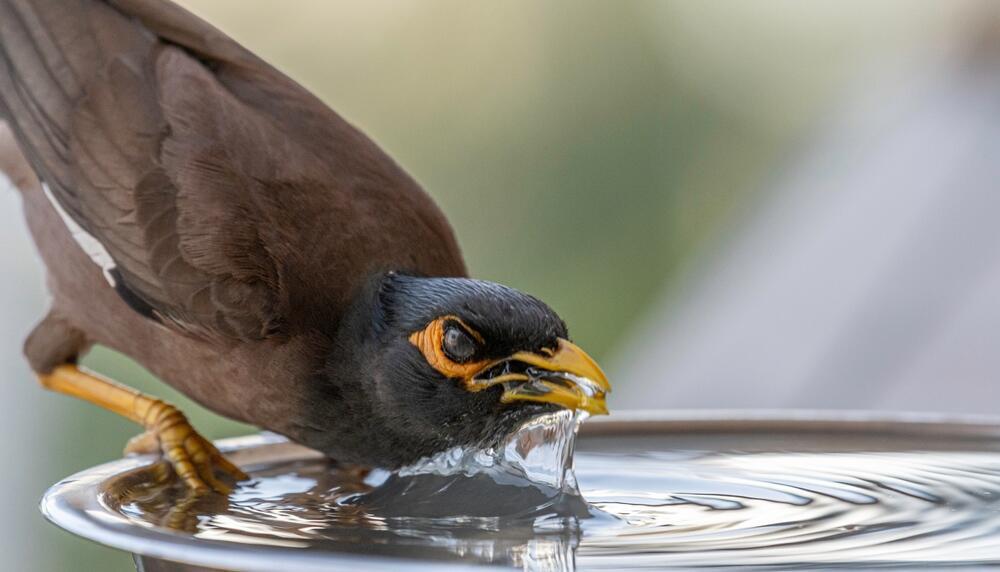
(Photo: Oren Ravid, Shutterstock)
Some expressed strong dislike for the bird. Others argued that the bird itself is not to blame and should not carry the emotional burdens projected onto it.
One interviewee, Dror, 20, a birdwatcher and tour guide, said: “The myna behaves differently. It’s much smarter, at least in my experience. It’s loud, aggressive and knows how to survive in places where most birds wouldn’t.”
Another participant said that through discussions with Schwarzfuchs, he began to view the bird differently. “Today I see it much more positively,” he said. “I hope that in the end our ecosystem will learn to live with it.”
Schwarzfuchs chose to conduct the research “from the field,” but he argues that its implications should reach policymakers as well.
“There is real importance to this kind of research in shaping policy,” he said. “Invasive species are not only a scientific phenomenon. They are also a social one. Any management approach that ignores this dimension is fundamentally flawed.”