

A rare sighting of an adult great white shark in the Mediterranean has drawn global attention to one of the sea’s most elusive predators: a critically endangered population that scientists know exists, but still struggle to locate, track or protect.
The shark was filmed in recent days by divers removing abandoned “ghost nets” from a shipwreck between Tunisia and Sicily. The footage quickly spread around the world, surprising many viewers who did not expect to see a great white in the Mediterranean.
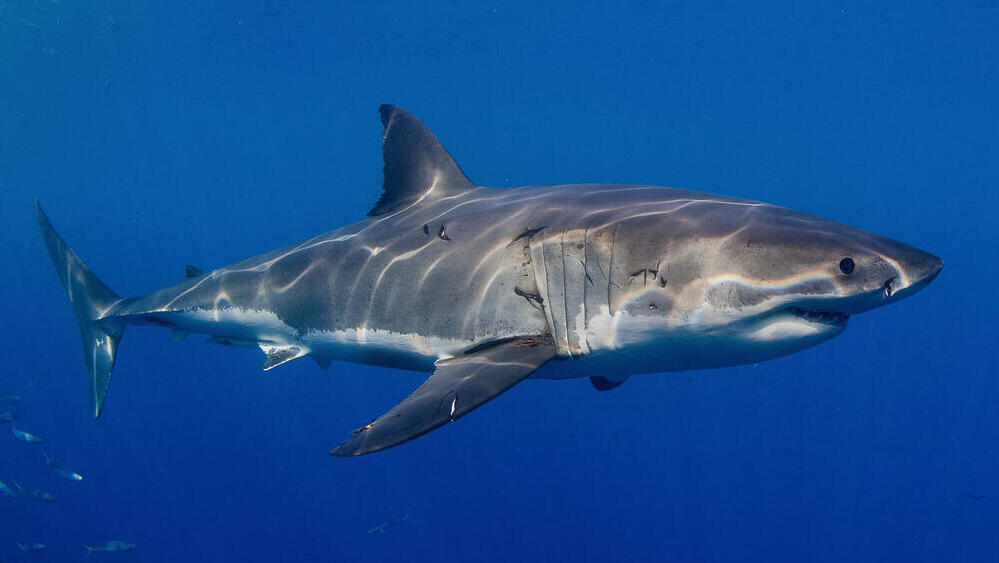
But the predator’s presence there is not new. The great white shark, Carcharodon carcharias, has long been part of the Mediterranean ecosystem. Historical records going back more than 150 years document great whites across the region, from Spain and France to Italy, Malta and Greece.
They were never especially abundant in the Mediterranean, but sightings were once more common than they are today. Over time, fishing, declining prey and accidental capture reduced their numbers so severely that encounters have become extremely rare.
Today, Mediterranean great whites are often described as a “ghost population”: not extinct, but barely seen. Many reports are difficult to verify, adding to the mystery surrounding the species.
Some have assumed that the sharks occasionally seen in the region are simply stray individuals entering through the Strait of Gibraltar. But genetic research suggests a very different story.
A study led by researchers from the University of Bologna and published in the Journal of Biogeography found that Mediterranean great whites are a distinct population. By sequencing and analyzing DNA from ancient shark remains, the researchers concluded that these sharks have been present in the Mediterranean for about 3.2 million years, making them one of the oldest and most distinct great white populations on Earth.

The great white shark documented in the Strait of Sicily
(Photo: Derk Remmers/Healthy Seas/SDSS/Ghost Diving)
The study also found that today’s Mediterranean great whites are genetically closer to great whites in the Pacific Ocean than to those living in the nearby Atlantic, pointing to a complex evolutionary history.
That history, however, has not protected them from decline. The researchers found extremely low genetic diversity, a sign of a small and vulnerable population. That makes Mediterranean great whites critically endangered and potentially more exposed to further pressure.
Despite their long presence in the region, major gaps remain. Scientists still know little about where these sharks spend most of their time, how they use different habitats, where they feed, where they migrate or where they reproduce. That uncertainty creates a serious conservation problem: it is difficult to protect a species without knowing its key habitats.
The latest sighting reinforces the idea that great whites still live in the Mediterranean, but in very low numbers. In April 2023, tuna fishermen accidentally caught a young great white about 40 kilometers off the coast of Alicante, Spain. Together with the new footage from the Strait of Sicily, such encounters suggest the species never truly disappeared from the region.
The question is why these sightings are becoming visible now.
Part of the answer may be better monitoring. Advanced underwater cameras, satellite tracking, citizen science and faster reporting mean rare encounters are more likely to be documented and shared. But environmental change may also be affecting when and where sharks appear.

Close-up footage of a great white shark
(Photo: Greg Skomal/Massachusetts Division of Marine Fisheries/AP)
Marine ecosystems around the world are changing rapidly. Ocean temperatures are rising, prey distribution is shifting and many species are altering their movements and behavior in response. Great whites, as highly mobile apex predators, are especially sensitive to such changes.
More sightings do not necessarily mean the population is recovering. Climate change often redistributes species rather than increasing their numbers. As waters warm and prey patterns change, sharks may appear in places where they were once rare, or at different times of year.
Evidence of such shifts is emerging globally. Along the east coast of North America, researchers have documented changes in great white movements, including in Florida and the Gulf of Mexico. Satellite tagging shows that shark movements are closely linked to environmental conditions and prey availability, with individuals adjusting their distribution accordingly.
The same may be true in the Mediterranean, where the recent sighting could be part of a broader pattern of ecological change.
The footage has prompted calls for stronger marine protections, including the expansion of protected areas. But that raises a difficult question: where should protection begin?
Great whites are highly mobile and cross national borders, meaning conservation cannot rely on isolated locations. Scientists need to identify critical habitats such as migration routes, feeding areas and possible nursery grounds, which may stretch across multiple countries.
In the Strait of Sicily, if great whites continue to move through the area, understanding their routes could become central to future conservation planning.
More than 150 years after they were first documented in the Mediterranean, scientists still do not know where these sharks spend most of their lives or how many remain. The latest sightings suggest the Mediterranean is not empty of great whites, but rather a low-density region where encounters are rare and easily missed.
The challenge now is no longer proving that they are there. It is protecting a critically endangered apex predator before the Mediterranean’s “ghost population” disappears for good.