

Seahorses are among the easiest marine animals to admire. Their upright posture, elongated snout and curled tail make them look so unusual that it is easy to forget they are fish.
They live in oceans and seas around the world, including the Mediterranean and Red Sea. Yet their poor swimming ability and dependence on specific coastal habitats leave them especially vulnerable to human activity, pollution and environmental change.
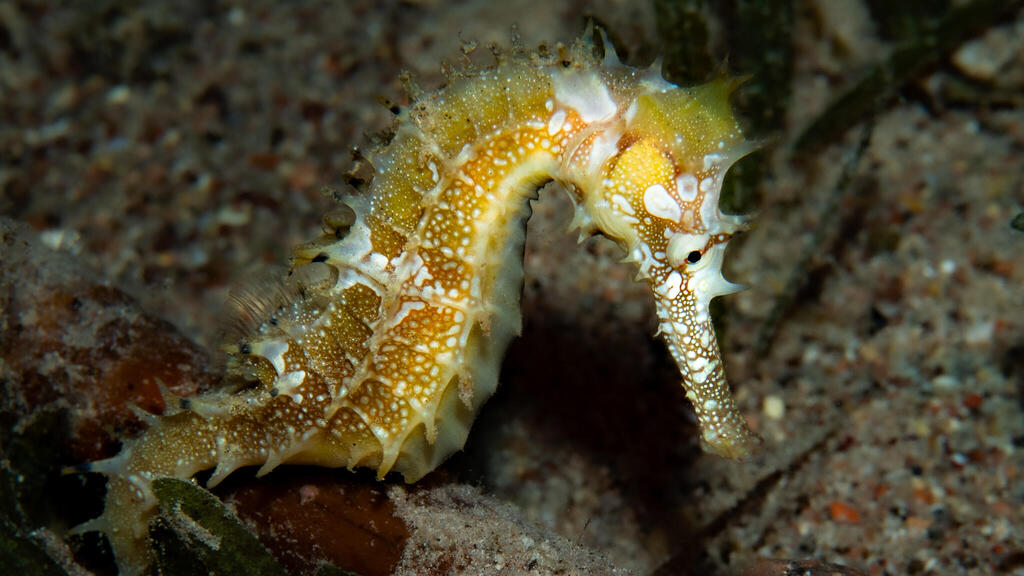
Dr. Hadar Ella of Tel Aviv University and the Interuniversity Institute for Marine Sciences in Eilat studies seahorses under the supervision of Prof. Roi Holzman. Her research focuses on the remarkable feeding system hidden behind their delicate appearance.
Where are seahorses found?
“Seahorses are a broad group of fish found in Israel in both the Mediterranean and Red Sea,” Ella said. “In fact, they can be found across most of the world’s oceans.”
They are generally most common in warm, shallow tropical waters and in a wide range of coastal habitats.
Some seahorse species are endangered or close to being classified as such, while scientists still lack enough information about others. The group as a whole is considered highly sensitive to human activity, including damage to coastal habitats, pollution and fishing.
What makes them unique?
Unlike most familiar fish, seahorses hold their bodies in a relatively upright position. They have long, narrow snouts, small fins and a prehensile tail that allows them to grip plants, coral and other structures.
Because they are poor swimmers, they generally do not chase prey. Instead, they remain in place and wait for it to move close enough.
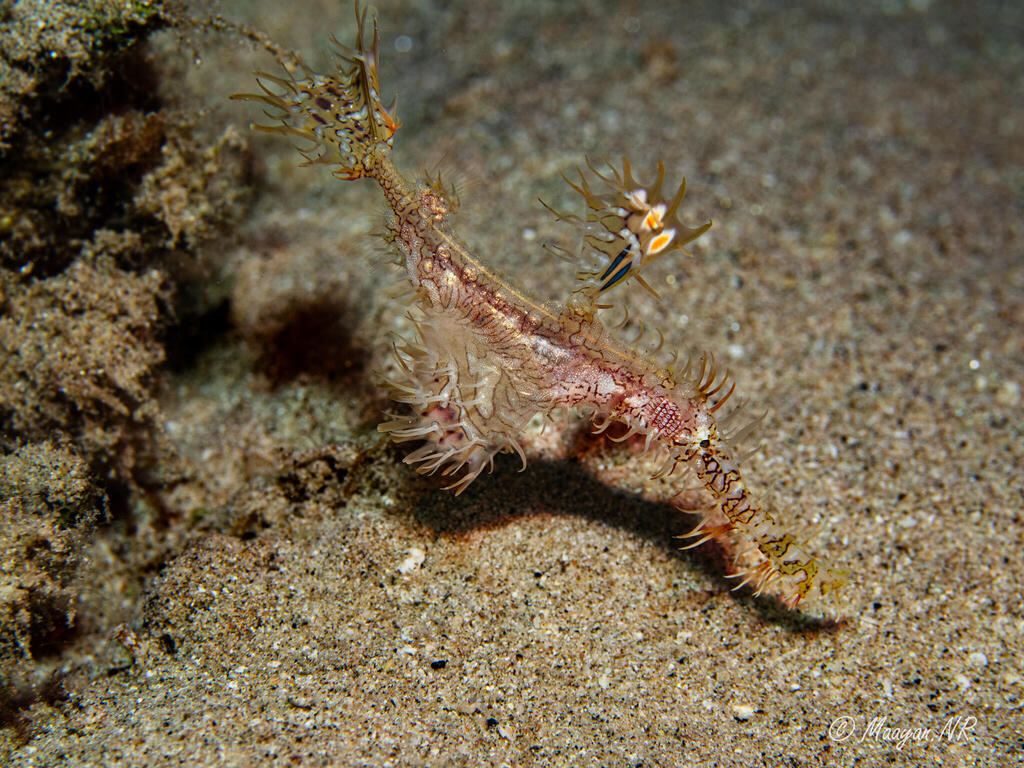
Some seahorse species are endangered or close to being classified as such
(Photo: Maayan Neiger Rahmilevitz)
Their feeding mechanism is what makes them truly exceptional.
“Seahorses use a kind of biological spring inside their heads,” Ella said.
The mechanism is known scientifically as latch-mediated spring actuation, or LaMSA. Their muscles gradually stretch elastic tissues, including tendons, where energy is stored.
That stored energy is then released almost instantaneously.
“The rapid release allows the seahorse to lift its head, open its mouth and suck in prey at tremendous speed,” Ella said. “It is much faster than muscles alone could produce, and considerably faster than in any other fish species we know.”
Seahorses are also unusual because the male carries the developing embryos.
The female transfers unfertilized eggs into a specialized brood pouch in the male’s body. The male fertilizes the eggs there, and the embryos develop inside the pouch until they are released into the water as miniature seahorses.
A fragile-looking predator
The greatest surprise, Ella said, is the gap between how seahorses look and how they function.
“From the outside, they appear delicate, slow and almost fragile,” she said. “But when feeding, they activate an extraordinarily fast and precise mechanism.”
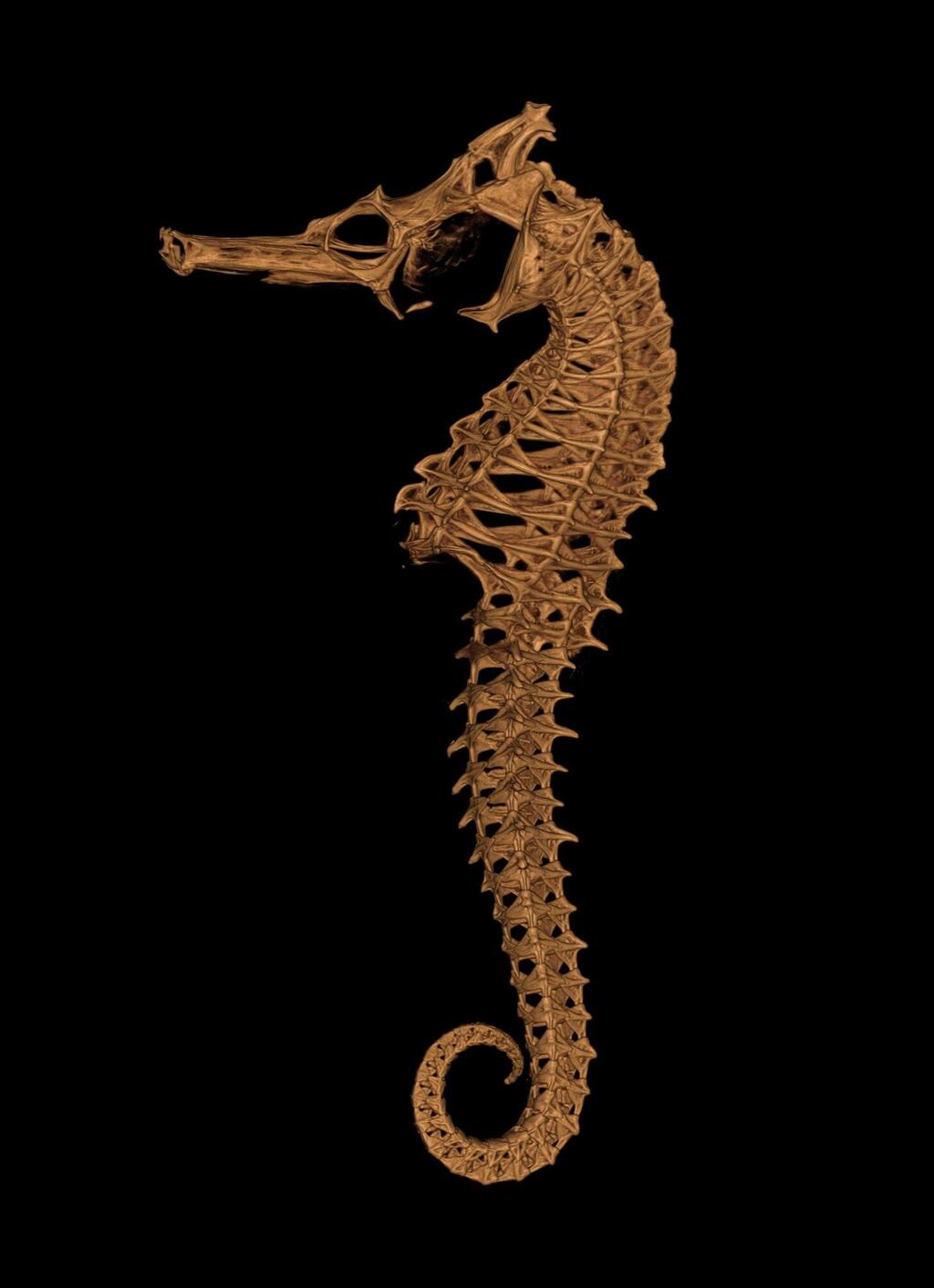
Seahorse undergoing a CT scan
(Photo: Prof. Graham Alan Short)
“They look as though they can barely move, but in the moment of the hunt, they become extremely fast predators.”
How climate change threatens seahorses
Climate change may affect seahorses in several ways.
Like other marine animals, their behavior is influenced by water temperature, which affects metabolism, activity, feeding and reproduction.
One study of a particular seahorse species found that warming seawater alone did not necessarily cause dramatic changes in feeding or behavior. But when warming was combined with ocean acidification, meaning a decline in the water’s pH level, more troubling effects appeared.
These included reduced activity, lower food intake and changes in the rate at which the animals ventilated their gills.
Climate change also threatens seahorses indirectly by damaging the habitats on which they depend.
They live in coastal ecosystems such as seagrass meadows, coral reefs, mangroves and algae beds. These environments are highly sensitive to warming, acidification, extreme storms and declining water quality.
“When the habitat is damaged, the seahorses that depend on it are also harmed,” Ella said.
Some marine animals may respond to warming water by moving north or shifting to different depths. For seahorses, however, relocation may be far more difficult.
They are weak swimmers, often live in small and scattered populations and rely on structures they can grip. Environmental change may therefore occur faster than their ability to reach a suitable new habitat.
How can seahorses be protected?
Conservation efforts focus first on preserving their habitats.
On an individual level, Ella said, the public can make a meaningful difference by reducing marine plastic pollution.

Dr. Hadar Ella
Plastic that reaches the sea does not disappear. It accumulates in coastal habitats, entangles animals and eventually breaks down into microplastics that damage the ecosystems seahorses rely on.
Reducing the use of disposable plastic, avoiding littering at beaches and collecting bags, fishing line or other waste found along the coast can help not only seahorses but marine life more broadly.
People who encounter a seahorse in the water should not touch it, move it or remove it for a photograph.
“Simply observe it from a distance and allow it to continue its natural behavior,” Ella said.
How the research works
Ella studies seahorses in the laboratory using a combination of CT scans and high-speed video.
The CT scans allow her to measure the structure of the head with great precision, including the bones, mechanical levers and relationships between the different components of the feeding system.
The scans used in her research were obtained through a collaboration with Prof. Graham Alan Short of Australia, who studies seahorses and pipefish.
Researchers also film seahorses while they feed using high-speed cameras.
The animals being recorded are not taken from the wild for the research. They come from aquariums or captive breeding programs and are kept under controlled conditions.
This makes it possible to study the feeding mechanism without harming natural populations.
The footage reveals events that take place within extremely short periods, including how the head moves, how the mouth opens and how suction is generated to pull prey inside.
What remains unknown?
One of the most compelling unanswered questions, Ella said, is exactly how the seahorse feeding system evolved.
Scientists know that the animals use stored elastic energy and release it rapidly, but many questions remain about which anatomical changes were necessary for the mechanism to emerge.
Researchers are also examining the evolutionary trade-offs involved.
A structure that enables extremely rapid suction may come at the cost of other abilities, including swimming performance, range of motion or the variety of prey the animal can capture.
Another major question is how seahorses will cope with rapid environmental change.
Warming seas, ocean acidification, pollution and habitat destruction are all accelerating. Scientists still cannot say whether seahorses will be able to adapt quickly enough.
The article was prepared by Zavit, the news agency of the Israeli Society of Ecology and Environmental Sciences.