

The ancient Roman city of Pompeii, destroyed by the eruption of Mount Vesuvius in A.D. 79, continues to offer new insights into daily life — this time through the water that once flowed through its public baths.
A new study published in Proceedings of the National Academy of Sciences traces how Pompeii’s water system evolved over time, revealing shifts in technology, hygiene and water management as the city transitioned from groundwater wells to a Roman aqueduct.
Researchers from Johannes Gutenberg University Mainz and several international institutions analyzed carbonate deposits — mineral crusts left behind by flowing water — preserved in Pompeii’s wells, aqueduct, water towers and public bath pools. Using stable isotope and trace element analysis, they were able to distinguish between water drawn from deep wells and water supplied later by the aqueduct.
Before the aqueduct was built, Pompeii relied on wells that tapped highly mineralized groundwater from volcanic deposits, the study found. These wells required mechanical water-lifting devices to meet demand, and hygiene conditions in the public baths were limited.
“Bathing facilities were originally supplied by deep wells that depended on water-lifting mechanisms,” said lead author Gül Sürmelihindi, an earth scientist at Johannes Gutenberg University Mainz. “These systems underwent technological improvements before eventually being replaced by gravity-fed water from an aqueduct in the first century A.D.”
The aqueduct, fed by karst springs, dramatically increased the volume and quality of water available for both bathing and drinking. The researchers found that the geochemical signatures of carbonate deposits differed sharply between structures supplied by wells and those fed by the aqueduct, allowing them to reconstruct how and when the transition took place.
Particularly revealing were samples from Pompeii’s Republican Baths, the city’s oldest public bath complex, dating to around 130 B.C. Carbonate deposits from wells, pools and drainage channels showed cyclical patterns in carbon isotopes, offering clues about how the baths were operated and maintained.
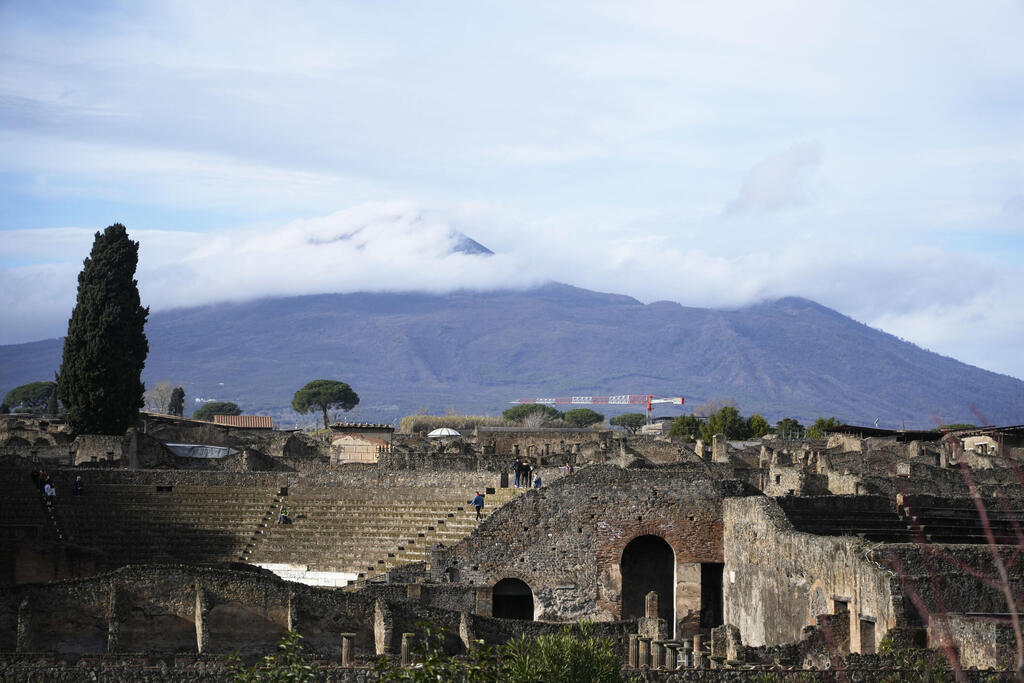
(Photo: Gregorio Borgia/AP)
The study found a sharp drop in carbon isotope values between well water and bath pools, suggesting contamination from human waste and indicating that bathwater was not regularly replaced during the early period.
The researchers also detected trace amounts of lead, zinc and copper in carbonate deposits, pointing to heavy metal contamination likely linked to water boilers and piping. Changes in oxygen isotope values further suggest that bathwater temperatures increased following renovations.
Beyond hygiene and engineering, the carbonate records may also preserve environmental signals. Cyclical variations in carbon isotopes could reflect fluctuations in volcanic carbon dioxide entering the groundwater, offering rare insight into Mount Vesuvius’ activity long before its catastrophic eruption.
The researchers say anthropogenic carbonate deposits serve as valuable archives for reconstructing ancient water systems and bathing practices, highlighting their importance not only for understanding Roman technology but also as elements of cultural heritage.