

Global climate change is creating growing challenges for environmental protection and agricultural development. At the same time, it is increasing the need for data-driven solutions that can balance nature conservation with food security for a growing global population. One such challenge is the major role the cattle industry plays in greenhouse gas emissions that contribute to global warming. Since it is unrealistic to expect humanity to give up meat entirely, perhaps part of the solution lies in how we manage grazing lands.
A study conducted by researchers in New York University’s Department of Environmental Studies offers a targeted road map for addressing climate change. Rather than addressing meat production as a whole, it proposes returning selected grazing lands to their natural state. The study shows that carefully identifying the most suitable grazing areas could remove vast amounts of carbon dioxide from the atmosphere at minimal nutritional and economic cost.
Gallery
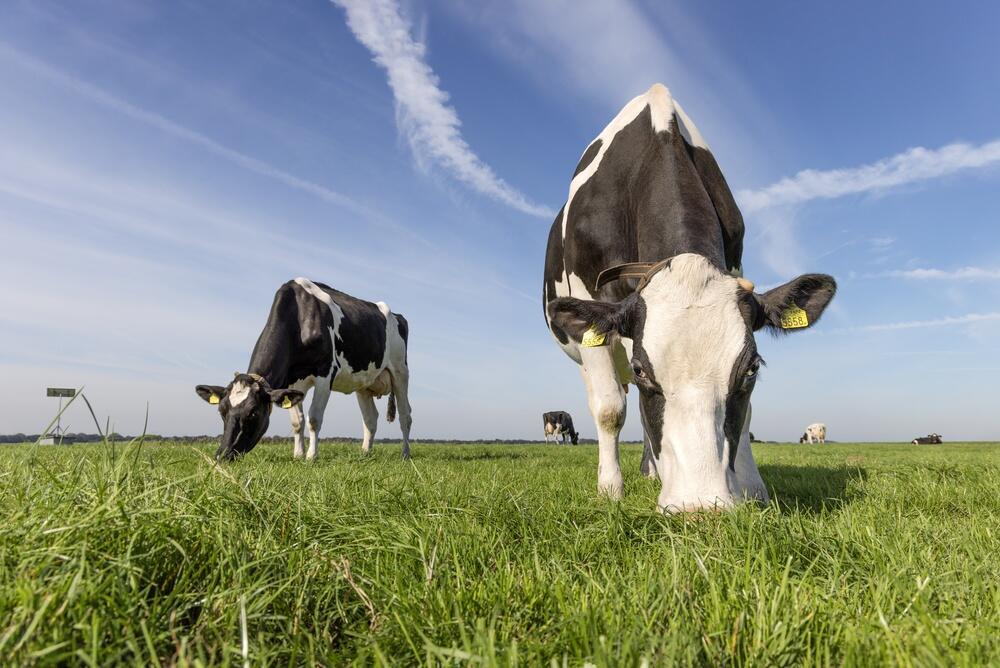
Could the solution lie in how we manage grazing lands? Cows grazing in a pasture
(Photo: Clara Bastian, Shutterstock)
From the atmosphere into the soil
Carbon sequestration is the process of capturing carbon dioxide (CO₂), one of the main greenhouse gases driving global warming, from the atmosphere and storing it over time in natural reservoirs such as vegetation, soil or ocean water. Plants do this through photosynthesis: they absorb carbon dioxide from the air, break it down, and use the carbon to build their trunks, branches, leaves and roots. Some of that carbon eventually makes its way into the soil, as organic matter such as fallen leaves decomposes and remains in the ground. This process is a crucial natural component of the carbon cycle and of the fight against climate change, because it does more than limit greenhouse gas emissions; it can actively remove them from the air.
The study’s main innovation lies in the breadth and precision of its approach. The researchers focused exclusively on land currently used for grazing, a vast area covering about 27 million square kilometers worldwide, or roughly one-third of Earth’s land surface. They divided this area into a dense grid of millions of cells at a resolution known as “5 arc minutes,” a geographic measure that breaks land into small, precise units of just a few square kilometers each. Rather than conducting field measurements, they mapped these areas by drawing on and cross-referencing existing global databases on grazing-land distribution, meat and milk production, and the geographic potential for carbon storage in vegetation and soil.
Each grid cell was analyzed to estimate what would happen if cattle grazing stopped there: how much carbon would be restored in regrowing vegetation and recovering soil, and how much meat and milk production would be lost from that same area. Earlier analyses were much less precise and therefore could not target conservation efforts as effectively.
The study used a complex computational and analytical approach, combining geographic information system (GIS) models with data from a wide range of sources. The researchers first collected global land-use data to identify areas used for grazing. They then examined vegetation patterns in those areas to estimate how much carbon is already stored in the existing vegetation, and how much additional carbon could be stored if grazing were halted and the vegetation were allowed to recover.
They also used additional data to estimate how much carbon is currently stored in the soil and how much more the soil could potentially sequester. To account for food production, the researchers mapped the global distribution of cattle and meat production across different regions. Climate data — including temperature, rainfall and climate type — were also factored in, since these conditions strongly affect vegetation growth and carbon sequestration.
Using these data, the researchers developed an index called “carbon opportunity intensity.” This index measures the carbon-sequestration potential of each unit of land if cattle were removed from it. It accounts for carbon that could be stored both in aboveground vegetation and in the soil, and weighs that potential against the current meat production from the same area. Using statistical models, machine-learning models and optimization methods, the researchers identified where carbon sequestration could be maximized while minimizing harm to meat production.
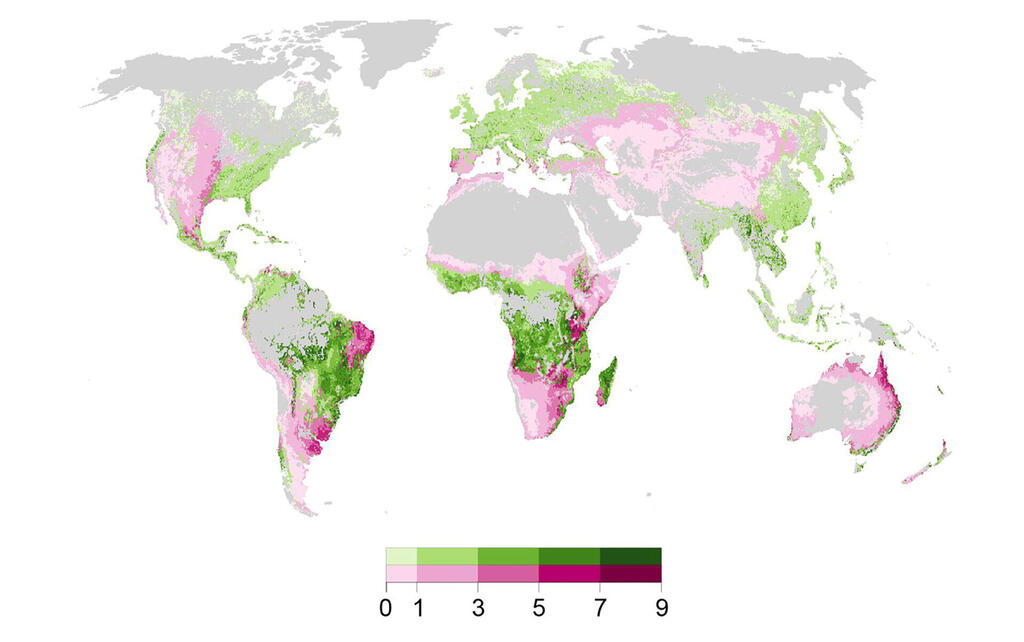
The amount of edible vegetation that grows each year in grazing lands. Darker shades indicate more vegetation growth per unit area. Green marks grazing lands in areas with natural potential for forest, while pink marks grazing lands in natural grasslands
(Illustration: Matthew Hayek and Johannes Piipponen)
A double benefit
The study offers hope for meaningful progress in addressing the climate crisis. Its findings show that stopping grazing in specific areas identified as having “high carbon opportunity intensity” could lead to the sequestration of about 34 gigatons of carbon in vegetation and soil by the end of this century — equivalent to removing nearly 125 gigatons of carbon dioxide from the atmosphere. That is an enormous amount, greater than the total global carbon dioxide emissions from fossil fuel burning in 2021–2023. The projected impact underscores the vast potential of targeted, carefully planned changes in grazing-related land use as part of the fight against climate change.
Just as important, the study proposes an approach that would not seriously undermine global food security — our ability to provide enough food for the world’s population. The proposed approach takes into account the role of cattle in the global food system. Animal products currently provide 18 percent of the calories consumed by humans and 34 percent of the world’s protein, and they are an essential source of nutrients such as vitamin B12 and iron. Livestock also plays a major economic role, providing livelihoods for more than half a billion people in rural areas.
The study shows substantial potential for removing carbon from the atmosphere while causing only limited harm to the pasture-based cattle industry: a loss of just 13 percent of its output. Moreover, most of that impact would occur in economically developed regions, where there is relatively strong potential to change consumption habits and encourage a shift toward other protein sources without severely harming people who depend on cattle for their livelihoods.
The study, then, does not call for eliminating the cattle industry, but for making it more efficient. It offers insights that could help maximize carbon sequestration on grazing lands while maintaining a reasonable level of food security. This approach, grounded in precise science and detailed data analysis, could help shape more effective and balanced policy for addressing climate change.