

A mystery that has followed scientists in the Galapagos Islands for decades may finally have an answer, thanks in part to Israeli researchers who combined modern DNA analysis with specimens and records stretching back nearly a century.
The question centered on Asparagopsis taxiformis, a red seaweed now found throughout the Pacific archipelago. Scientists knew it was widespread, but not whether it had evolved as part of the Galapagos ecosystem or arrived there through human activity. Because its origin remained uncertain, it had been classified as cryptogenic.
Asparagopsis taxiformis
(Video: Dr. Tal Luzzatto Knaan)


A team led by doctoral student Omri Nahor from the laboratory of Dr. Tal Luzzatto Knaan, together with Prof. Alvaro Israel of the University of Haifa’s Leon H. Charney School of Marine Sciences and researchers from the Charles Darwin Foundation and the United States, set out to resolve the question.
Their study, published in Diversity and Distributions, combined samples collected by divers in 2024 with preserved historical specimens, records from scientific expeditions and earlier surveys of the islands’ algae. The researchers collected 65 samples from 27 sites and even recovered genetic information from a dried specimen dating to 1985.
Using three genetic markers and comparing the results with sequences from around the world, they found that every sample successfully sequenced belonged to the same genetic lineage, known as L2. That lineage is not known elsewhere in the eastern Pacific, and its nearest documented population is in Hawaii, about 5,000 kilometers from the Galapagos.
Gallery
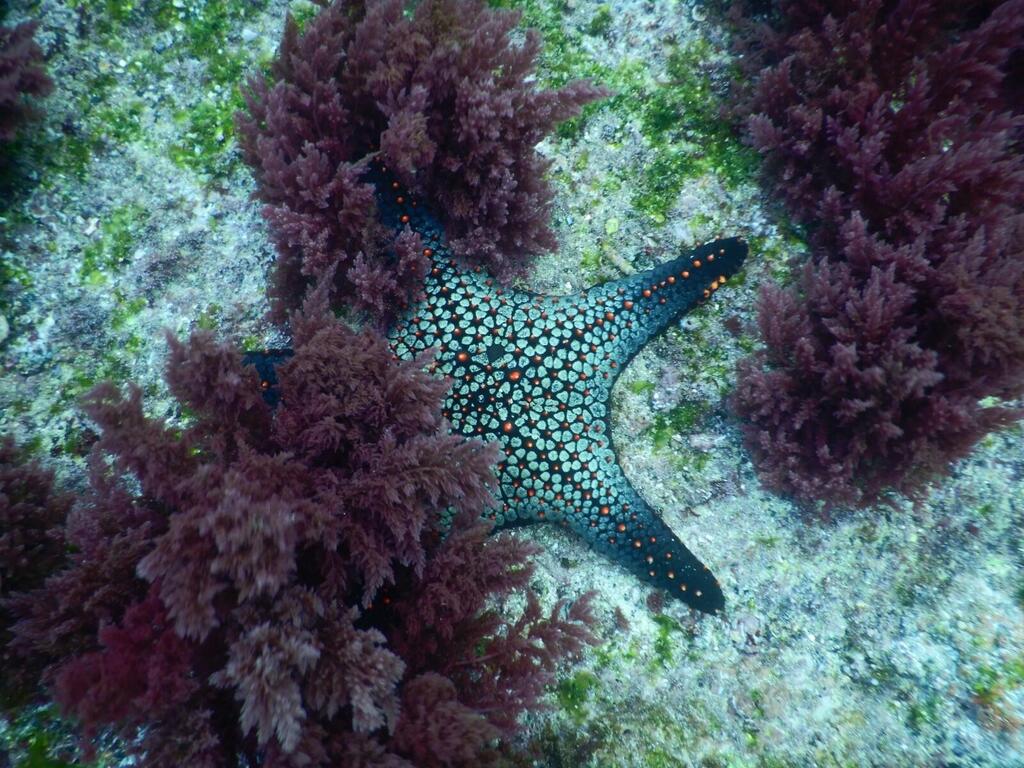
A starfish among branched Asparagopsis algae in the Galapagos Islands
(Photo: Dr. Tal Luzzatto Knaan)
The genetic uniformity suggested the population was not an ancient, isolated Galapagos lineage. Historical records then provided the missing piece: extensive surveys in the 1930s found no reliable trace of the seaweed, yet by 1962 it was already described as abundant on Santa Cruz, the archipelago’s second-largest island.
That gap coincides with World War II and its aftermath, when military bases were established in the Galapagos and ship traffic increased sharply. Taken together, the genetic and historical evidence led researchers to conclude that the seaweed was most likely carried to the islands by ships during the war or shortly afterward.
DNA as a time machine
The research is the first molecular survey of Asparagopsis taxiformis across the Galapagos and has led scientists to classify it as the first seaweed confirmed to have been introduced to the islands.
The work also shows how preserved biological collections can act as a kind of time machine. By linking modern samples with dried algae stored for decades, researchers were able to reconstruct an ecological history that could not be resolved through observation alone.
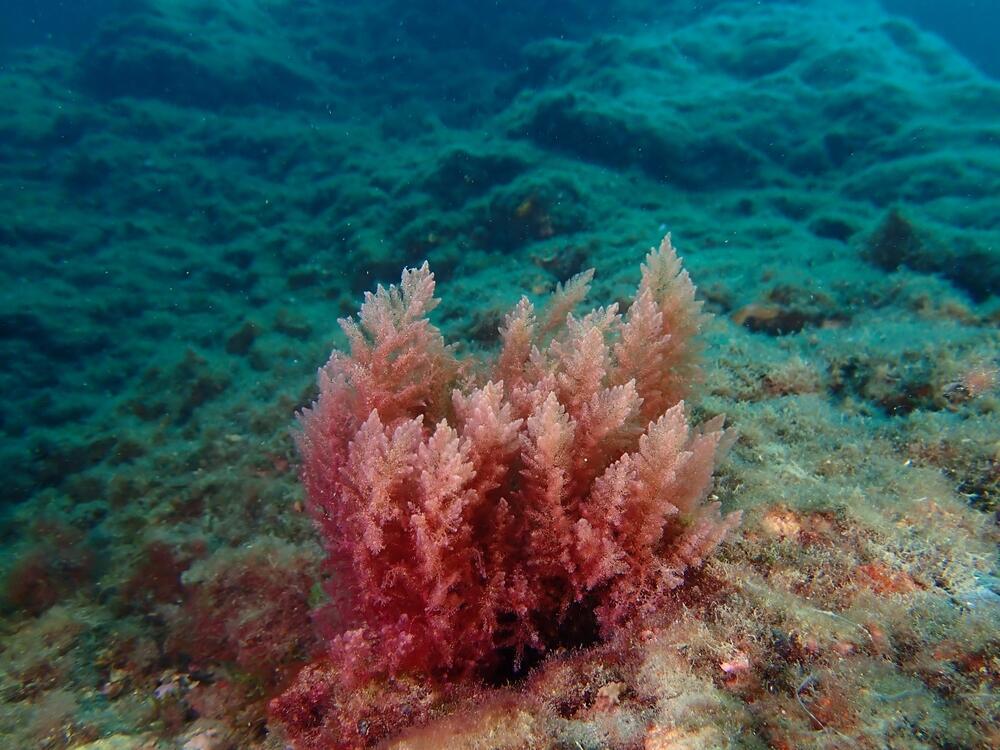
Branched Asparagopsis, a type of red algae
(Photo: Edu Ktion, Shutterstock)
The finding matters because the Galapagos, closely associated with Charles Darwin and the development of evolutionary theory, are among the world’s most distinctive ecosystems. Their geographic isolation allowed unique species and ecological systems to develop, making the introduction of foreign organisms potentially especially significant.
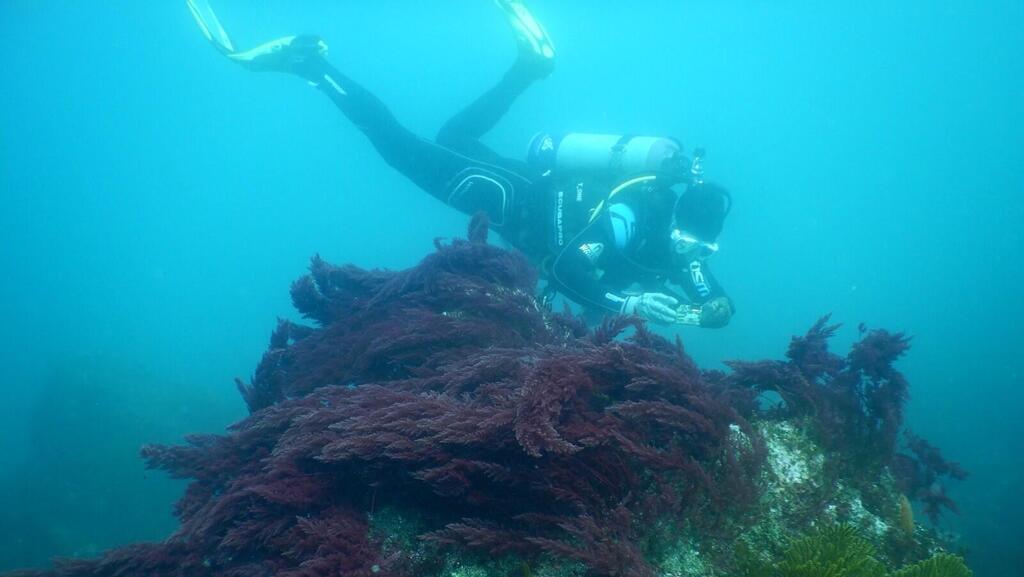
Branched Asparagopsis algae in the Galapagos Islands
(Photo: Dr. Tal Luzzatto Knaan)
Asparagopsis taxiformis produces a range of natural compounds that may give it an advantage over native algae and marine animals. The study does not determine what ecological impact it is having in the Galapagos, but its widespread presence and abundance in some areas point to the need for continued monitoring and risk assessment.
“Species invasions have critical implications, especially in unique environments such as the Galapagos Islands, an area that serves as the only home for certain species and exceptional biodiversity,” Luzzatto Knaan said. “Understanding invasion processes enables monitoring, forecasting, decision-making and prevention, in order to protect such a rare and iconic environment, including a population whose livelihood depends largely on that biodiversity.”
Luzzatto Knaan noted that the same seaweed has also invaded and become established along Israel’s coast and elsewhere in the Mediterranean, where researchers are already seeing its effects on other species.
“This seaweed is considered one of the 100 worst invasive species,” she said, “even though we love it in the lab because it contains so many chemical compounds with potential practical applications.”