

Wednesday morning’s magnitude 8.8 subduction-zone megathrust event off Russia’s Kamchatka Peninsula and the ensuing transoceanic tsunami alerts across Japan, Hawaii and the U.S. west coast have set alarms off the world over, underscoring escalating global seismicity. It is scientifically untenable to treat Israel’s earthquake threat as hypothetical.
Gallery
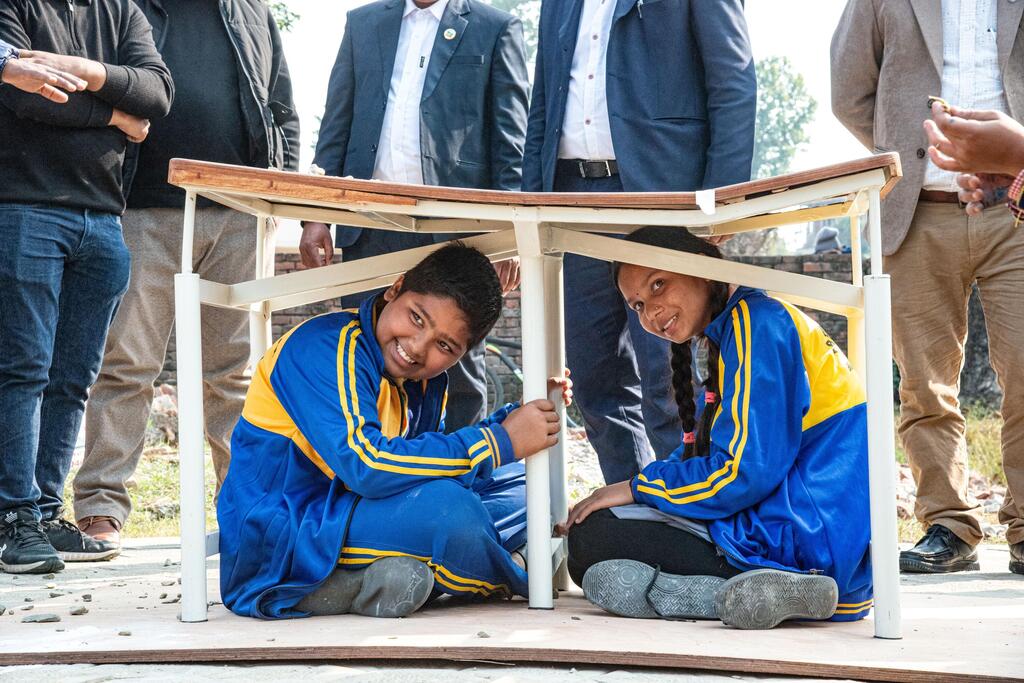
Students demonstrate the use of an earthquake-resistant classroom desk during a safety drill, designed to withstand heavy debris, at a school event in a high-risk seismic zone
(Photo: Ido Bruno)
Given the nation’s tectonic position along the Dead Sea Transform (DST), a major strike-slip fault boundary between the African and Arabian plates, the pertinent question is not if, but when a significant seismic rupture will occur.
Anticipating collapse: Engineering innovation for seismic survivability
A novel example of impact mitigation design is the earthquake-resilient classroom desk, a structural innovation initiated at Bezalel Academy by Prof. Ido Bruno and developed by industrial design student Artur Bertoro. The desk, conceptualized after the catastrophic 2010 Haiti earthquake, exhibits enhanced load-bearing capacity (up to one metric ton) and is intended for use in educational facilities vulnerable to progressive collapse.
Its performance was validated through dynamic load testing at the University of Padua, and it has since been procured by high-risk nations such as Nepal, Haiti and Bhutan—despite current Israeli civil defense policy advocating evacuation rather than in situ sheltering.
Seismically responsive sheltering systems: Global case studies
1. Adaptive seismic bed (Turkey): The Dahir Insaat earthquake survival bed incorporates MEMS-based accelerometric sensors which, upon detecting ground motion above preset PGA (Peak Ground Acceleration) thresholds, actuate a motorized enclosure mechanism to shield the occupant. Internal provisions include potable water, medical kits and fire-resistant materials. A logic override system prevents closure if occupant positioning poses a hazard.
Earthquake-resistant desk?
(Video: Ido Bruno)


2. Air-lifted foundation decoupling (Japan): The Air Danshin system exemplifies a base isolation method using pneumatic lift. Upon seismic triggering, inflatable air bladders inserted beneath the structure raise the building off its foundation, effectively converting it into a quasi-floating mass decoupled from ground shear and vertical accelerations. Upon cessation of strong motion, the system depressurizes, allowing gradual resettlement.
Get the Ynetnews app on your smartphone: Google Play: https://bit.ly/4eJ37pE | Apple App Store: https://bit.ly/3ZL7iNv
3. Spherical survival capsule (U.S.): The Survival Capsule, a rigid spherical refuge engineered by aerospace professionals, is designed to withstand multi-hazard environments, including tsunamis, hurricanes and seismic events. Fabricated from marine-grade aluminum and fitted with restraint systems, GPS, ventilation and water-tight entry points, the capsule provides up to 72 hours of autonomous protection. Models are scalable from 2 to 16 occupants and meet hydrostatic and thermal endurance criteria.
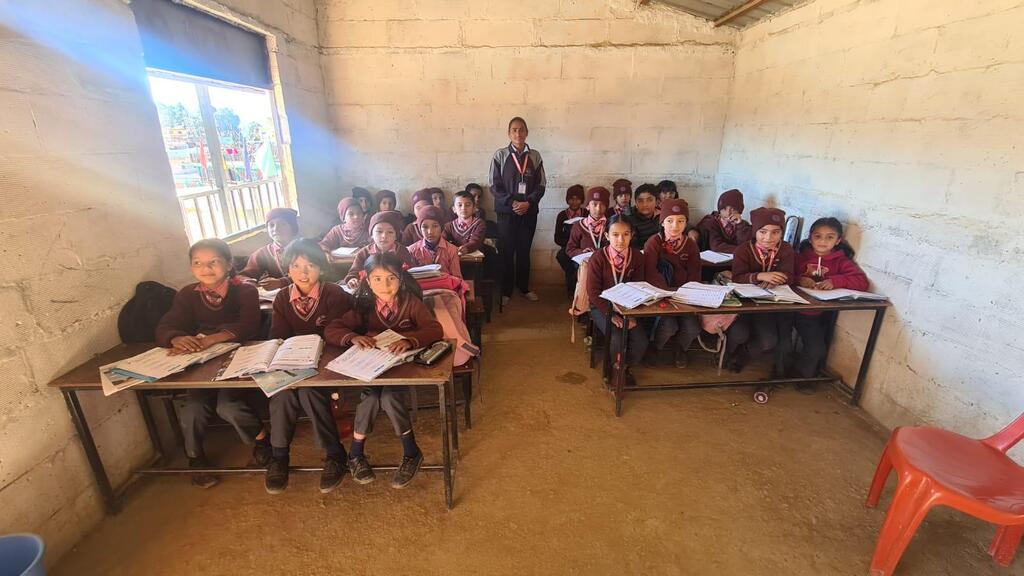
Classroom full of earthquake resistant tables
(Photo: Ido Bruno)
Industrial designer Eran Lederman, head of the Disaster Environment Design Lab at Bezalel, has spent the last decade studying the intersection of spatial design and extreme-event resilience. What once seemed like speculative work now intersects directly with Israel’s seismic hazard profile.
Structural vulnerability and seismic code modernization in Israel
Daniel Birsch, CEO of engineering consultancy BK-BR Group, notes that Israel’s seismic risk is systemic and non-trivial. With tens of thousands of pre-1980s structures non-compliant with IS 413, the national seismic resistance standard, the built environment remains highly susceptible to pancake collapse and torsional failure during moderate-to-large earthquakes.
Key advancements include:
- Upgraded IS 413 standard, updated frequently to reflect international best practices and seismic microzonation data
- Shear wall densification and column jacketing with ductile concrete and steel
- Base isolation retrofits and energy-dissipating dampers for high-occupancy buildings
- Use of viscoelastic construction materials, allowing controlled deformation without brittle failure
Moreover, the government’s push for urban seismic renewal via TAMA 38, reinforced safe rooms (mamadim), and demolition-rebuild (pinui-binui) schemes represents a paradigm shift from reactionary to anticipatory resilience.
Safe rooms (mamadim): Israel’s hybrid solution
Despite public misconceptions, mamad (short for Merhav Mugan Dirati, or Apartment Safe Space, in Hebrew) —when constructed per the latest IS 413 standards—serves not only as a blast shelter but also as lateral stiffness elements that contribute significantly to global structural integrity. Their presence improves a building’s moment frame performance and can prevent soft-story collapse.
In events where evacuation is unfeasible, official protocol recommends immediate sheltering in the mamad, ensuring the door remains operable to prevent entrapment. Broadening retrofits to include such structural cores across the legacy housing stock will elevate community seismic resilience.
Conclusion: From hazard awareness to holistic risk reduction
Earthquakes are multi-dimensional hazards requiring integrated mitigation across seismology, structural engineering, public policy and urban planning. Israel’s current trajectory toward comprehensive seismic preparedness—anchored in updated codes, innovative shelter systems and resilient infrastructure retrofits—represents a critical national security priority. The scientific and engineering communities must maintain pressure for data-driven policy, robust public education, and investment in seismic resilience technologies, lest the inevitable arrives unheeded.