

The Artemis II astronauts are already leading a new era of lunar exploration. Now they are set to break a distance record.
Launched last week on humanity’s first trip to the moon since 1972, three Americans and one Canadian are aiming to surpass Apollo 13’s farthest distance from Earth. As they loop around the moon Monday without landing, they are expected to become the most distant humans ever before heading back home.
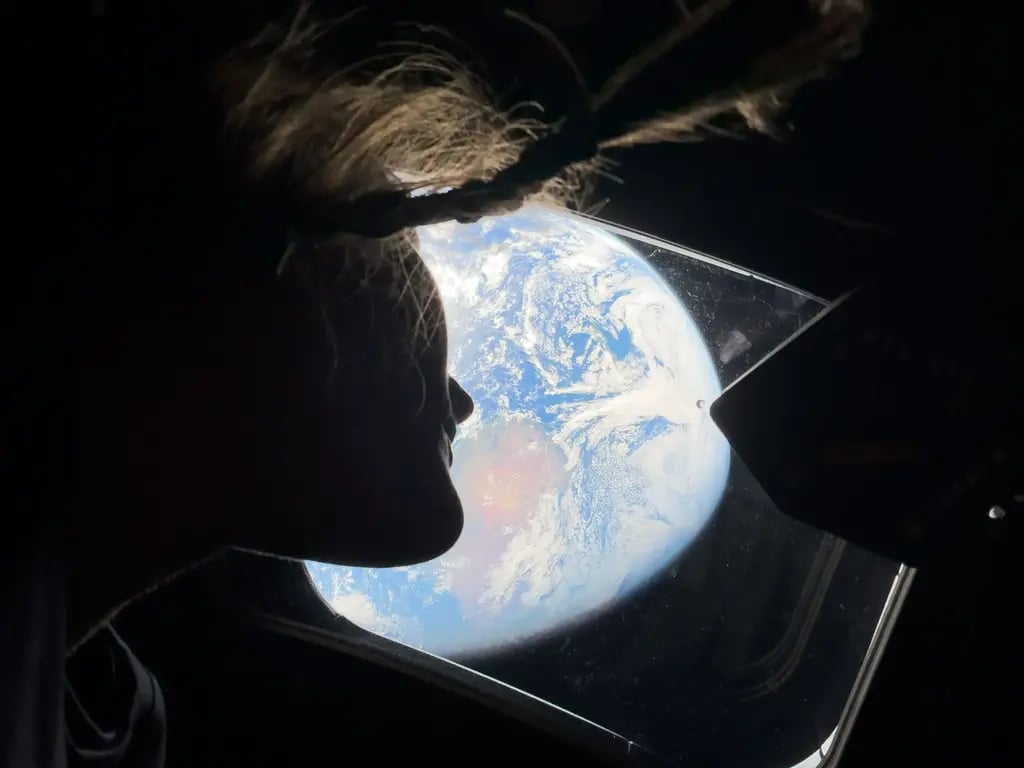
Their roughly six-hour flyby will offer views of the moon’s far side that earlier Apollo crews could not fully see. The astronauts will also witness a total solar eclipse, with the moon blocking the sun and revealing the glowing corona.
“We’ll get eyes on the moon, map it out and then come back in force,” flight director Judd Frieling said, referring to NASA’s long-term goal of building a sustained lunar presence with landers, rovers, drones and habitats.
Apollo 13 set the current distance record in 1970 after an oxygen tank explosion forced the crew to abandon a planned landing and swing around the moon to return safely. The mission became known as NASA’s most famous “successful failure.”
Its astronauts reached 248,655 miles (400,171 kilometers) from Earth. Artemis II, following a similar free-return path, is expected to exceed that mark by nearly 3,400 miles (5,400 kilometers).
Astronaut Christina Koch said the milestone helps connect past, present and future exploration in a way people can easily understand.
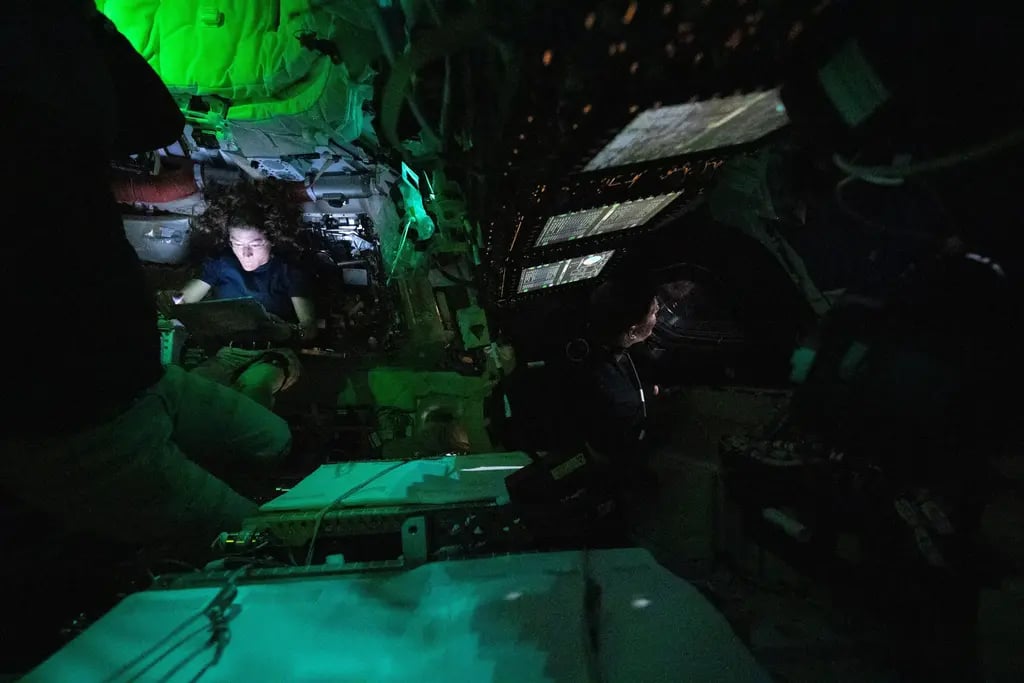
Inside the darkened Orion spacecraft
(Photo: NASA via AP)
During the flyby, the crew will work in pairs to photograph the moon, coming within about 4,000 miles (6,400 kilometers) of the surface. While lighting conditions will limit some views, they are still expected to see portions of the far side never observed directly by humans, including parts of the Orientale Basin.
The astronauts will document what they see using professional cameras and iPhones, after months of training with lunar maps and visual guides.
Because of the April 1 launch timing, the crew will also experience a total solar eclipse visible only from their Orion capsule. They will study the sun’s outer atmosphere and watch for unusual solar activity, using eclipse glasses for protection.
As Orion passes behind the moon, communication with Mission Control will be lost for about 40 minutes, a routine but tense phase also experienced during Apollo missions.
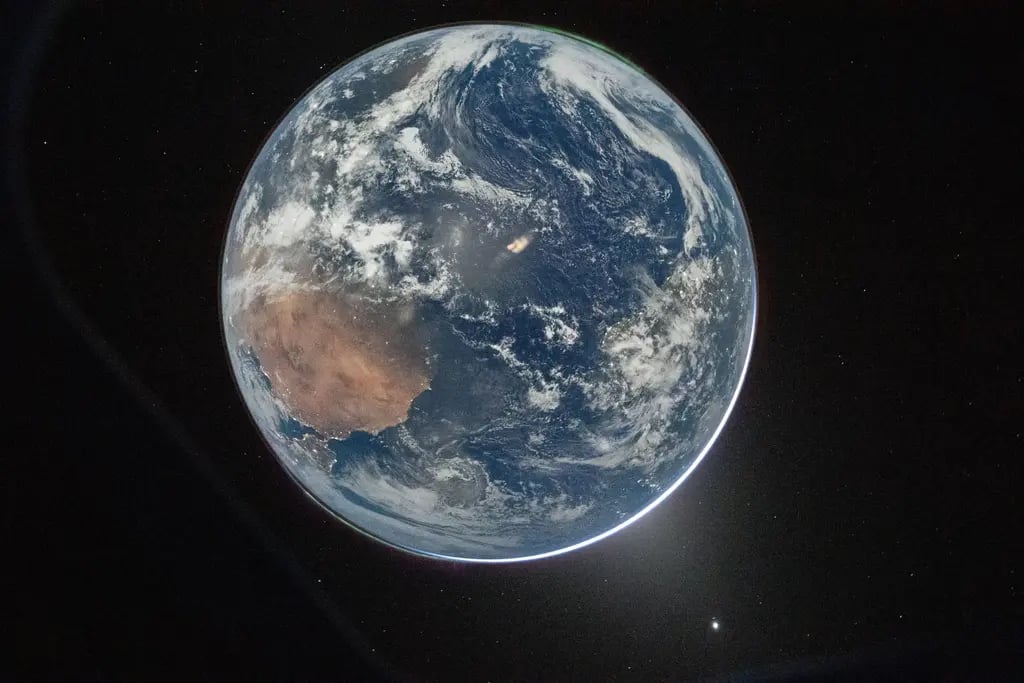
View of Earth from the spacecraft
(Photo: NASA via AP)
After the flyby, the spacecraft will begin a four-day journey home, targeting a Pacific splashdown near San Diego on April 10. On the return trip, the astronauts will radio the International Space Station crew — the first time moon-bound astronauts and orbiting astronauts have operated simultaneously — including a reunion between Koch and Jessica Meir, who conducted the first all-female spacewalk in 2019.