

Sport is usually associated with values such as health, community and achievement. Yet it is precisely this positive image that makes it difficult to recognize the environmental price it exacts. Countries and organizations host Olympic Games, World Cups and international tournaments not only for the sake of competition, but also to build prestige, gain political influence, promote tourism, develop infrastructure and generate revenue.
The benefits can be significant, but in the pursuit of exposure and profit, the substantial environmental costs of flights, venue construction, energy and water consumption, food and waste, all integral parts of hosting such events, are sometimes pushed aside.

This does not mean we should give up sport. Its benefits extend to many aspects of life. However, we need to examine the components that make sporting activities possible: raw materials, equipment manufacturing, transportation and disposal at the end of a product's life, the construction and maintenance of facilities, and how participants and spectators travel to events. Doing so can help identify where changes could reduce environmental impact.
In motorsport, for example, emissions are generated both by burning fuel during races and practice sessions and by transporting cars and equipment and flying teams between competitions. Ski resorts require water and energy to produce artificial snow, operate ski lifts and provide heating. At major soccer events, spectators' travel to matches can be a major source of greenhouse gas emissions.
Even equipment that seems small and insignificant can accumulate into enormous quantities of materials and waste. Used tennis balls are one example, and most are never recycled.
Systems thinking is key to addressing this challenge because it connects equipment design and manufacturing, use and end-of-life treatment with decisions made by players, manufacturers and regulatory bodies.
A small yellow ball that generates enormous waste
Estimates suggest that more than 330 million tennis balls are manufactured worldwide every year. This represents a vast market and a continuous stream of rubber, felt, adhesives and packaging materials used in production.
Most tennis balls do not biodegrade within a reasonable period. In addition, the materials that make up the balls are tightly bonded to withstand repeated impacts, making them difficult to separate and recycle once they are no longer usable.
When examining the tennis ball itself, many factors must be considered. The court surface affects how quickly it wears out, players decide when to replace it, tennis clubs determine which types to purchase, and manufacturers control the materials and packaging.
The International Tennis Federation sets requirements for characteristics such as weight, diameter, bounce, deformation and durability. These standards are designed to ensure consistent playing conditions, but they currently do not require recycling, collection for reuse or responsibility for managing waste at the end of a product's life.

Jannik Sinner
(Photo: AP Photo/Lynne Sladky)
The question, therefore, is not simply what a tennis ball is made of, but how many hours of acceptable play it provides before becoming waste.
A ball containing recycled materials that wears out quickly could increase the frequency of replacement and may therefore not be a more environmentally friendly alternative. A more durable ball, on the other hand, could reduce purchases and waste, but only if players are willing to keep using it for longer.
It is therefore important to assess both the environmental impact and cost of a tennis ball per hour of acceptable play, while maintaining safety and performance standards.
What's new with the ball: Environmental solutions under development
Several initiatives aimed at reducing the environmental impact of tennis balls have already reached the market. Renewaball, for example, markets a ball that, according to the company, contains more than 30% material recovered from recycled tennis balls. It also operates a collection system for used balls to facilitate recycling. A commercial assessment reported a 29% lower carbon footprint, although independent verification is still needed.
Wilson has developed the Triniti, a ball designed to maintain its performance for longer and marketed in more sustainable packaging.
Another area of research examines the interaction between the tennis ball and the playing surface. One study showed that balls wear differently when they come into contact with grass, clay or hard courts. The researchers therefore recommended developing ball-wear tests tailored to different court surfaces.
Meanwhile, RecycleBalls and Laykold announced that during the first year of their partnership, they would incorporate materials recovered from more than 2.1 million used tennis balls into the construction of court surfaces in North America.
This is not complete ball-to-ball recycling, but it demonstrates the potential to establish substantial collection systems for tennis balls that have reached the end of their original useful lives.
Another possible direction involves combining recycled materials with materials from renewable sources, alongside biomimicry, the development of engineering solutions inspired by structures and mechanisms found in nature.
One example is exploring whether the structure of pomelo peel or other naturally crack-resistant materials could inspire improvements to the outer layer of tennis balls.
At this stage, these remain research directions rather than proven solutions. Their performance, durability, safety and environmental impact throughout their life cycle must still be evaluated before they can be incorporated into commercial products.
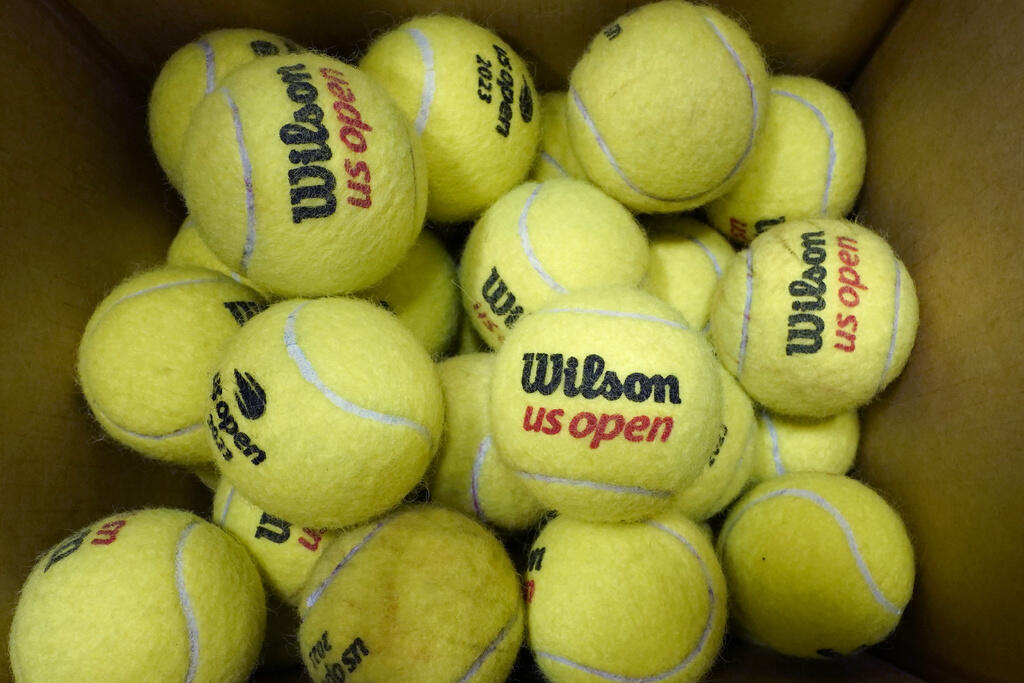
Tennis balls at the US Open
(Photo: AP Photo/Eduardo Munoz Alvarez)
However, developing new materials alone will not be enough to substantially reduce the environmental impact of sport.
Systems thinking also requires changing the rules of the game and incorporating environmental considerations into international standards. Without such adjustments, even a successful engineering solution may remain a small pilot project rather than becoming a widely accepted commercial product capable of reducing environmental damage on a large scale.
To achieve this, clubs and tournaments could serve as testing grounds for additional solutions and more environmentally responsible standards.
The combination of a market involving hundreds of millions of products and growing demand for credible environmental claims creates a business opportunity, provided the proposed solutions can demonstrate genuine performance, competitive pricing and measurable benefits.
An opportunity for Israeli tennis to test greener solutions
Israel, with its advanced technological capabilities, could serve as a testing ground for developing environmental solutions in tennis. A starting point could be a joint pilot involving the Israel Tennis Association, tennis clubs, importers, materials researchers, engineers, recycling companies and investors.
Such a pilot could compare the performance and durability of tennis balls on different court surfaces, measure their usable playing hours and wear rates, gather feedback from players and track the balls collected for waste treatment or reuse.
These data could help promote solutions that can be commercialized and expanded, advancing the shared interests of everyone involved in the sport while reducing its environmental impact. The tennis ball is only a case study. The same approach could be applied to running shoes, other types of sports balls, swimming goggles, rackets and more.
Innovation does not necessarily have to involve developing a revolutionary new material. It can also mean implementing a system that combines durable products, longer periods of use, appropriate standards, a viable business model and responsibility for products after they are discarded.
That is where the environmental and economic potential lies, and where we may find the solution to making sport both healthy and environmentally responsible.
- Dr. Rani Lefler is an expert in environmental project management and systems engineering and leads sustainability efforts at the Israel Tennis Association.
- This article was prepared by Zavit, the science and environment news agency of the Israeli Society of Ecology and Environmental Sciences.