

A new species of predatory dinosaur, roughly the size of a large tiger and armed with long, curved claws, has been identified from a fossil that spent more than a century in the collections of London's Natural History Museum. Originally discovered on the Isle of Wight off England's southern coast, the fossil belongs to a previously unknown member of the megaraptoran group, providing the first evidence that these formidable hunters once roamed Europe.
The dinosaur, named Invictibellatrix amberina, is described in a study published in the journal Royal Society Open Science. It belonged to a group of agile, two-legged carnivores known as megaraptorans, which were related to tyrannosaurs, including the famous Tyrannosaurus rex.
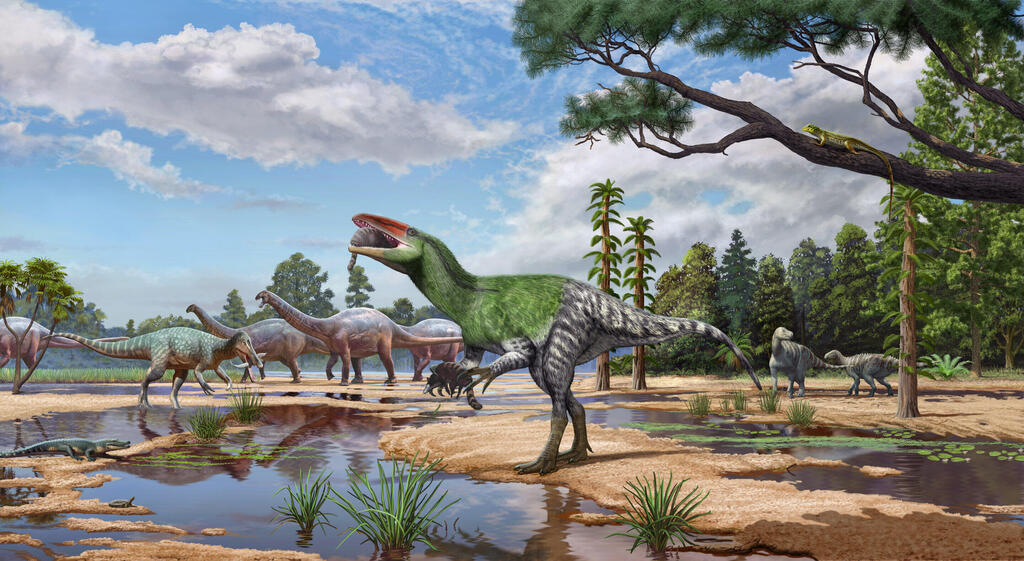
Unlike T. rex, however, megaraptorans had relatively narrow heads and relied primarily on their powerful forelimbs and enormous hooked claws to seize prey rather than their jaws. Some eventually evolved into gigantic predators comparable in size to tyrannosaurs, but the newly identified species was among the smallest and earliest members of the group. It lived during the Early Cretaceous period, approximately 120 million years ago.
The name Invictibellatrix means "unconquered female warrior," a reference to the evolutionary success of megaraptorans, which eventually became dominant predators in parts of the prehistoric world. The species name amberina refers both to amber found in the rock layers where the fossil originated and to a female given name.
The fossil consists of a fragment from the back of the dinosaur's skull. It was acquired by the Natural History Museum in 1924 but had never undergone a detailed scientific examination.
"Despite more than 200 years of fossil collecting, the Isle of Wight continues to surprise us with previously unknown dinosaur species," said Professor Paul Barrett of the Natural History Museum in London, one of the study's senior researchers. He noted that fossils belonging to meat-eating dinosaurs such as Invictibellatrix amberina have proved particularly difficult to find.
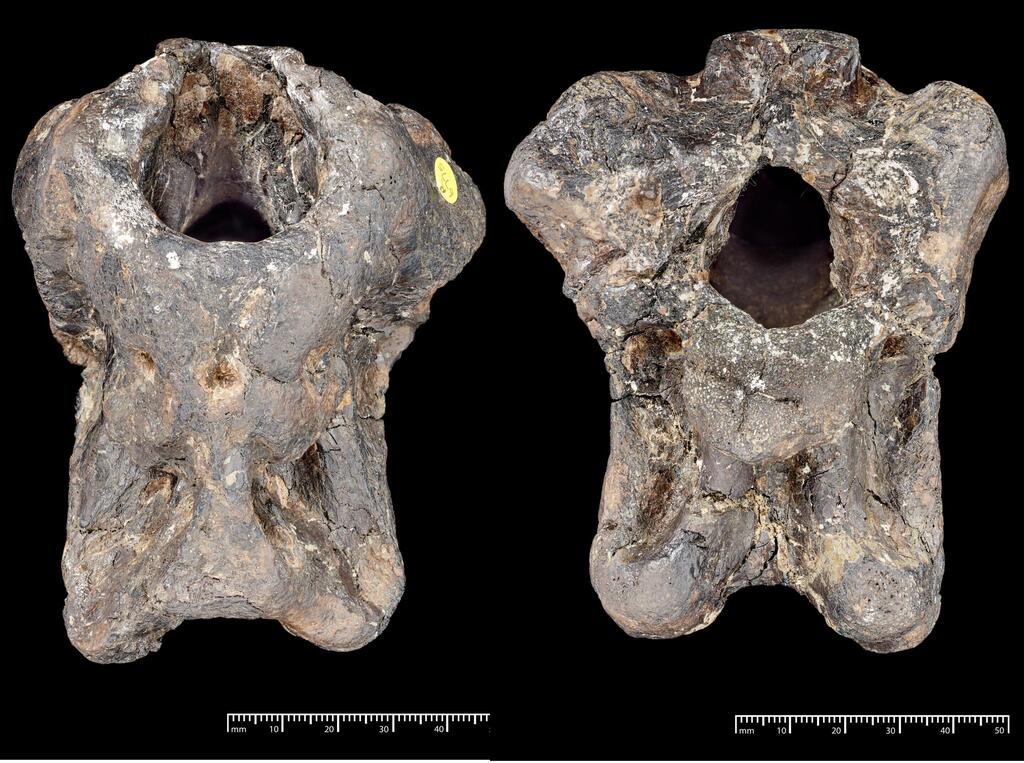
The fossil of Invictibellatrix amberina, which lay in the Natural History Museum's drawers for more than 100 years
(Photo: The Trustees of the Natural History Museum, London)
Dr. Cassius Morrison of University College London's Department of Earth Sciences, who led the research, said comparisons with closely related dinosaurs suggested that the predator measured between three and four meters in length and stood slightly more than 1.5 meters tall, approximately the height of an adult human.
The dinosaur was probably covered in feathers, while its claws may have measured between 10 and 20 centimeters long. Researchers believe it fed on small dinosaurs, lizards and mammals, occupying an ecological role somewhat comparable to that of a modern hyena.
Morrison suggested that, had humans existed alongside the dinosaur, they could have been attractive prey because of their size.
Although Invictibellatrix was not the dominant predator of its time, Morrison argued that it could have posed a greater threat to humans than a T. rex. A human would have weighed approximately one-third as much as the dinosaur, making people suitable prey for a predator of its size.
"They definitely would have chased us," Morrison said, explaining that humans would probably have been too small to interest a much larger T. rex.
A forgotten fossil and a missing piece of dinosaur history
The discovery is particularly remarkable because the fossil remained largely unnoticed in the museum's collections for more than 100 years.
The Isle of Wight, situated off England's southern coast in the English Channel, is one of Britain's richest dinosaur fossil sites. Despite more than two centuries of paleontological discoveries there, researchers believe many important specimens have yet to be identified.
Megaraptorans are among the most mysterious groups of large carnivorous dinosaurs, largely because relatively few fossils have been found. Scientists believe they originated in Asia before spreading westward through Europe and eventually reaching Gondwana, the vast southern supercontinent that included present-day South America, Africa, Australia, Antarctica and India.
Until now, however, one crucial piece of evidence had been missing. No megaraptoran fossils had been definitively identified in Europe, leaving researchers uncertain about the route these predators took between the northern and southern continents.
Charlie Scherer, a doctoral researcher at University College London's Department of Earth Sciences and a member of the research team, said the new discovery provides the first physical evidence supporting the theory that megaraptorans migrated through Europe before spreading into Gondwana, rather than moving between islands farther south.
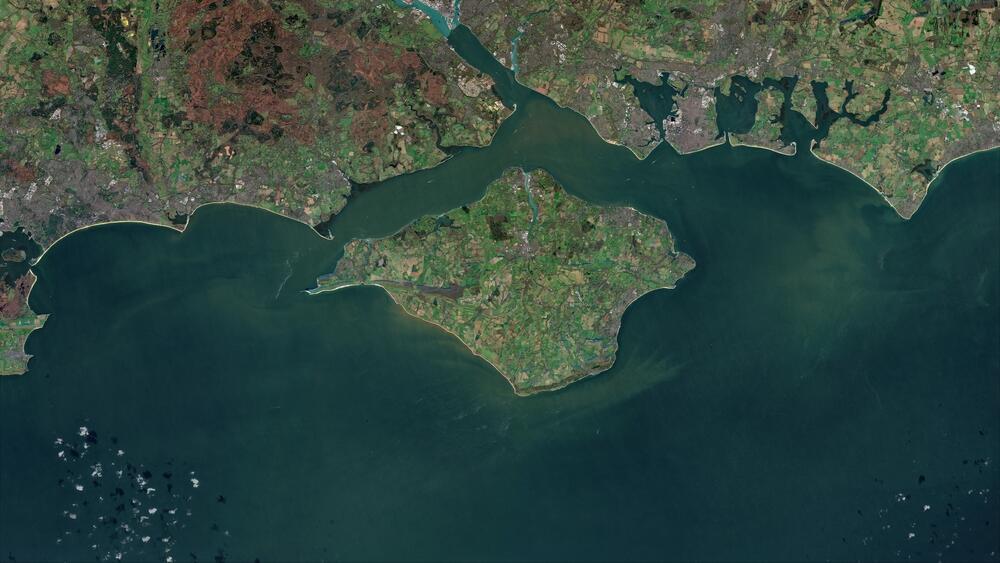
Satellite image of the Isle of Wight, where the fossil of Invictibellatrix amberina was discovered
(Photo: zelvan/Shutterstock)
To investigate the fossil, the researchers used computed tomography, or CT scanning, to produce a three-dimensional reconstruction of the skull fragment and its internal structure, including the space that once housed the brain.
They compared the specimen with skulls and braincases belonging to tyrannosaurs, spinosaurs, raptors and other two-legged carnivorous dinosaurs.
A distinctive combination of anatomical features, including an oval opening where the spinal cord connected to the brain and an hourglass-shaped bony ridge, led the researchers to conclude that the fossil represented a previously unknown species.
Computer algorithms comparing these features with those of other dinosaur species consistently placed the specimen within the megaraptoran lineage.
The researchers also used mathematical modeling to reconstruct how megaraptorans spread around the prehistoric world. Their analysis incorporated existing fossil discoveries, evolutionary relationships between dinosaur species and geographical and climatic data.
The findings suggest that megaraptorans were distributed widely across the world during the Early Cretaceous, when Invictibellatrix amberina lived. By the Late Cretaceous, tens of millions of years later, they had apparently disappeared from Laurasia, the vast northern supercontinent that included present-day North America, Europe and most of Asia.
Tyrannosaurus rex
(Photo: Shutterstock AI)
In contrast, megaraptorans flourished across Gondwana in the Southern Hemisphere, where they evolved into enormous apex predators with claws reaching lengths of up to 35 centimeters. Why they disappeared from the northern continents remains uncertain. Possible explanations include climatic changes, environmental pressures and competition from other large carnivorous dinosaurs.
The fossil of Invictibellatrix amberina was originally recovered from the foot of a cliff on the southwestern coast of the Isle of Wight by amateur paleontologist Reginald Walter Hooley. It was among more than 1,000 specimens collected by Hooley that were acquired by the Natural History Museum following his death.
The discovery highlights the scientific value of revisiting historical fossil collections using modern technologies. Specimens that were difficult to interpret when they were first discovered can sometimes reveal entirely new species when examined with advanced imaging and analytical methods.
The researchers also attached a message of encouragement to the dinosaur's unusual name. In their paper, they explained that Invictibellatrix was intended to offer hope and strength to people who experience bullying, discrimination, mistreatment and oppression, reminding them not to surrender in the face of adversity.
More than a century after it was collected, the forgotten fossil has not only revealed a previously unknown predator but also helped solve a longstanding puzzle about the evolution and global expansion of some of the prehistoric world's most formidable hunters.