

For years, researchers have wondered why Venus, a planet similar to Earth in size, mass and structure, has no moon. Now, it appears that our neighboring planet may simply have swallowed its moon, according to a study published in The Astrophysical Journal and led by researchers at the University of California, Riverside.
One previous hypothesis held that Venus once had a moon that was struck by a massive object, shattered and disappeared. Other theories suggested that Venus, the second planet from the sun, never experienced the kind of collision that could have created a moon in the first place. The study's authors argue that neither theory provides an adequate explanation.
Gallery
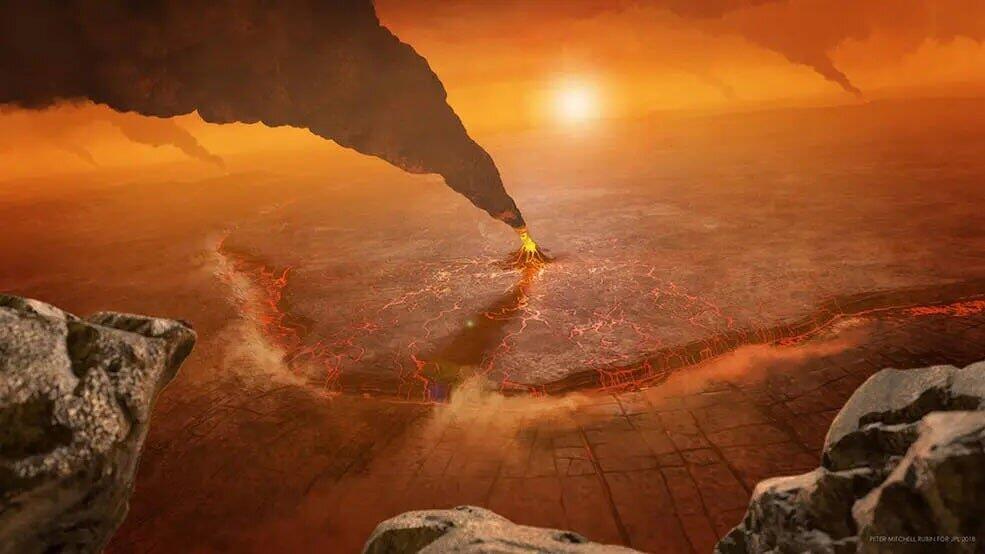
Visualization of volcanic activity in Venus' southern hemisphere
(Rendering: NASA/JPL-Caltech/Peter Rubin)
"Venus didn’t require a catastrophe to arrive at what we can see today," said astrophysicist Dr. Stephen Kane of the University of California, Riverside, who led the study. "It turns out the gravity of the planet itself combined with the rate at which it spins naturally caused the moon to collapse on top of it."
Scientists can measure the distance between Earth and the moon with great precision, in part thanks to mirrors left on the lunar surface by NASA's Apollo 11 mission.
"We know that the moon is slowly moving away from the planet, at a rate of around four centimeters per year," Kane said.
He explained that this happens because Earth rotates relatively quickly, completing one rotation every 24 hours. Energy from that rotation is transferred to the moon, causing it to move farther away from Earth. Venus is the opposite: The hottest planet in the solar system takes 243 days to complete a single rotation on its axis.
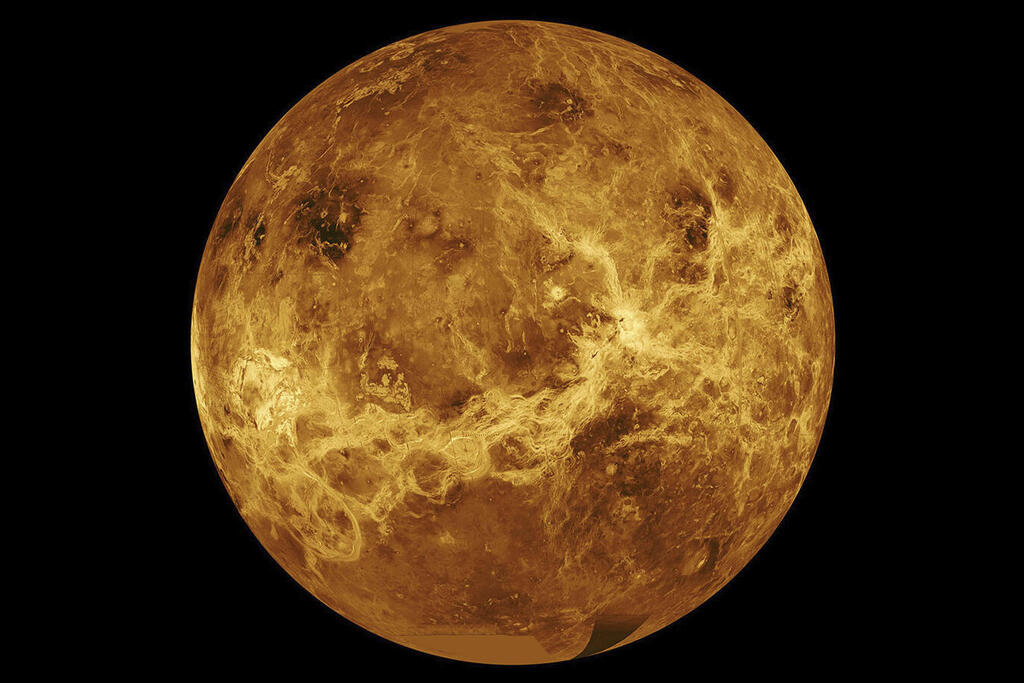
The planet Venus
(Photo: NASA/JPL-Caltech/AP)
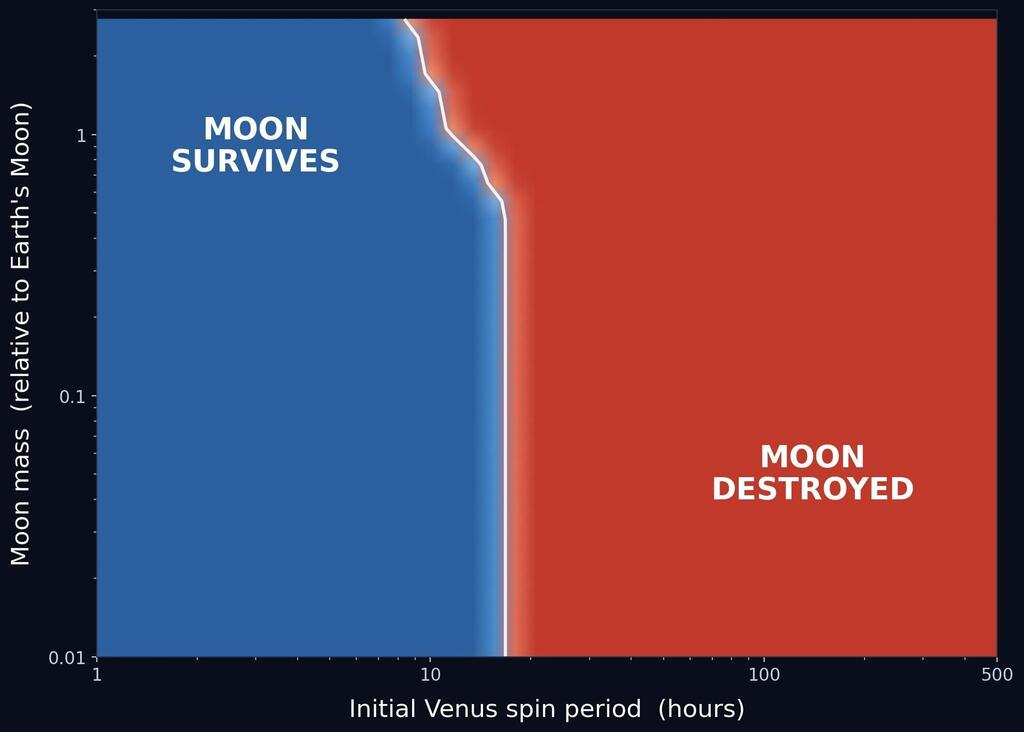
The likelihood of a scenario in which Venus' moon crashed into the planet
(Illustration: Stephen Kane/UCR)
To test their hypothesis, Kane and his colleagues developed computer models based on the physics governing gravitational interactions between planetary bodies. They first recreated the evolution of the Earth-moon system to make sure the model accurately represented a known system.
The researchers then adjusted the rotation rate to match Venus and varied the sizes of its hypothetical moons, testing moons ranging in mass from half that of Earth's moon to 10 times its mass.
In most simulations, the result was the same: The moon crashed into Venus. The more massive the moon, the faster the collision occurred.
"When I made this discovery, I was shocked," Kane said. "I thought surely the broad range of scenarios I was exploring would lead to a variety of results. But it all went pretty much in the same direction."
However, the finding does not prove that Venus ever had a moon. Kane believes it is possible that it did, but whether such a moon ever formed remains an open question.
The study's authors show that if Venus did have a moon, it could not have survived indefinitely.
Finding physical evidence of such a collision would be difficult. About 80% of Venus' surface dates to roughly the same period, evidence of a major resurfacing event about 1 billion years ago that erased much of the planet's early geological history.
Venus, right, in the night sky alongside Earth's moon
(Photo: Dmitri Lovetsky/AP)
Evidence may be hidden below the surface. Scientists believe Earth's moon formed after a giant collision early in our planet's history. Seismic studies have revealed unusual structures deep inside Earth that may be remnants of that impact. Similar measurements on Venus could therefore provide clues as to whether a comparable event occurred there.
Such a collision could also help explain another long-standing mystery about Venus: whether life could once have existed on Earth's closest planetary neighbor.
A moon crashing into Venus would have transferred enormous amounts of energy and angular momentum to the planet, potentially altering its rotation, geology and climate. If Venus once had oceans or other conditions suitable for life, such an impact could have changed the course of its development.
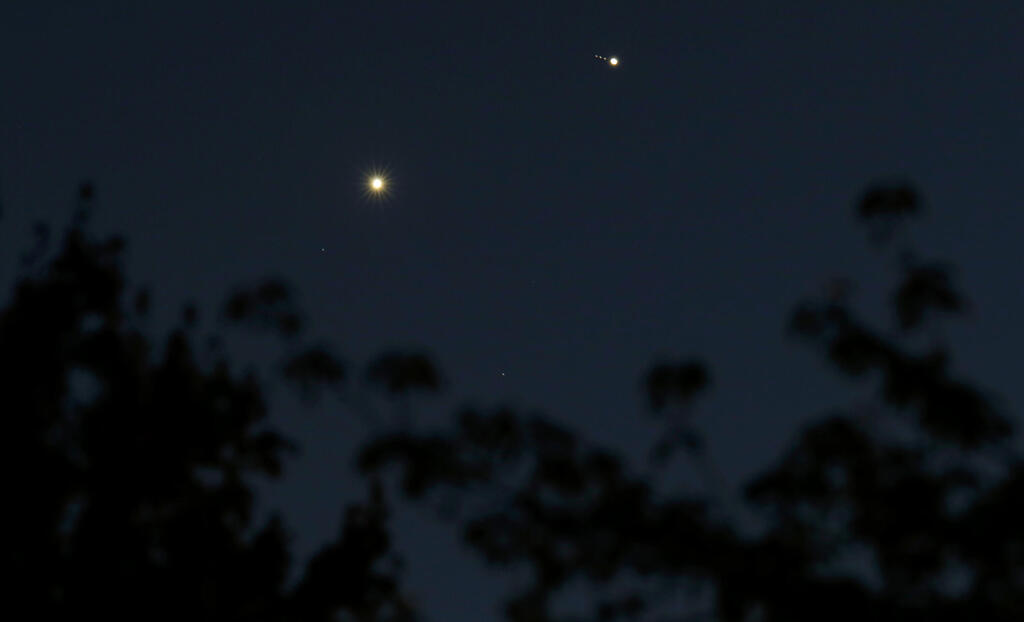
Venus, left, in the night sky alongside Jupiter
(Photo: Ted S. Warren/AP)
The findings also have implications far beyond Venus. The search for potentially habitable worlds around other stars often focuses on planets similar to Earth, and the presence of a moon is considered one of the factors that could affect a planet's ability to support life.
Earth's moon drives the tides, may have helped sustain geological activity on our planet and has played a major role in Earth's evolution. However, there is no conclusive evidence that a large moon is necessary for life to exist.
"When people think about Earth twins around other stars, one question they ask is, ‘Does it have a moon?’ My study shows a disturbing scenario for many of those cases. If these planets don’t rotate fast enough, the moon will crash to the surface, and that would change the course of history for those planets," Kane concluded.