

Short but intense rainstorms have become a defining feature of Israeli winters. They trigger sudden flooding, cause property damage and, at times, tragically result in loss of life. At the end of last month, the Environmental Protection Ministry and the Israel Meteorological Service published Israel’s 2025 annual climate change preparedness report. The report focuses on rising rainfall intensity, one of the most immediate and tangible risks of the climate crisis in Israel. Despite its importance, it has received little public attention.
The report’s central message is clear: Israel is expected to see fewer rainy days overall, but more intense, short and dangerous rainfall events. Storms once considered 50-year or even 100-year events are becoming increasingly common. While the short-term impacts have already been widely documented, but the long-term consequences include cumulative damage to infrastructure, the economy, public health and ecosystems.
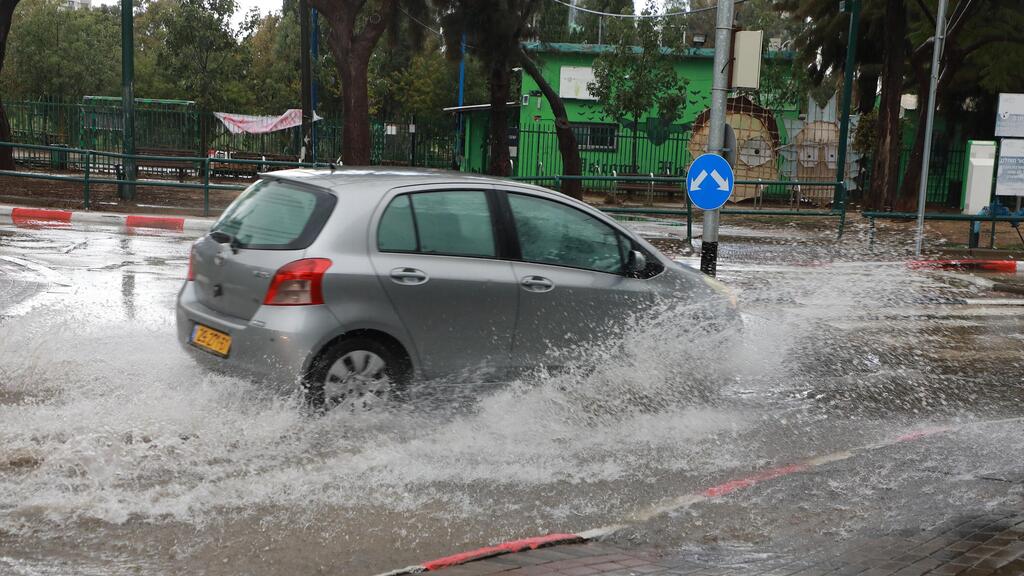
Flooding across the Tel Aviv area; archive photo
(Photo: Dana Kopel)
Limited recovery capacity
The report is based, as is customary internationally, on up-to-date scientific research and deliberately examines a severe emissions scenario alongside a severe socio-economic impact scenario. Its proposed preparedness framework rests on two main pillars. The first is infrastructure, including planning, drainage, standards and systems designed to cope with unusually large volumes of water. The second is emergency preparedness, addressing readiness, early warning and real-time response capacity.
The report explicitly states that the public is neither sufficiently prepared nor aware of flood risks, and that the level of preparedness among local authorities is uneven.
The gap between advanced professional knowledge and real-world practice is already evident in the growing scale of damage. These impacts are not distributed evenly. Flood events that lead to water entering basements or sewage overflows disproportionately affect dense neighborhoods in socio-economically weaker areas, where recovery capacity is limited. While vulnerable populations are mentioned in the report, it does not include a social risk map or clear priorities for investment and intervention.
From an economic perspective, the report presents a preliminary analysis of a residential neighborhood where the original drainage system was designed for an extreme rainfall event expected once every 20 years. Under a severe climate scenario, expanding key sections of the drainage network would translate into an added cost of roughly 2,200 shekels per housing unit for homebuyers.
Flooding in Netanya
(Ron Crissy, Eylon El Hai, Dorit Bitran, under Section 27A of the Copyright Law)


This is a relatively modest sum compared to other costs borne by homebuyers, and certainly when weighed against the damage caused by flooding. The conclusion is clear: early preparedness is far cheaper than handling severe damage retroactively.
However, there is no comprehensive national estimate of the cost of adapting infrastructure to extreme rainfall events, nor is there any discussion of funding mechanisms or support for weaker local authorities. In the absence of such a framework, there is concern that disparities will deepen and that risk will be shifted onto residents.
No single body managing stormwater risks
One of the key gaps identified in the report remains largely unaddressed: there is no coordinating body responsible for urban stormwater management under a binding strategic framework. Responsibility is scattered among government ministries, local authorities and professional bodies, without clear regulatory authority or a dedicated budget.
Within this fragmented landscape, the work of Agma, a knowledge center for waterways, dams and streams established in 2020, is noteworthy. The center promotes professional tools, basin-based planning and efforts to develop a shared language for local authorities and planning institutions. This is an important foundation, but in the absence of a binding regulatory framework, its impact depends on the willingness and capacity of authorities to use the information and adopt the tools.
The report outlines a broad range of stormwater management solutions, including conveyance, detention and retention, infiltration, recharge and water quality improvement. Detention and retention within urban areas are particularly important. Beyond reducing flooding, these measures slow water flow, allow infiltration into the ground and enable local use through aquifers and groundwater, rather than losing the water to the sea.
Another major gap emerges at this point. While the emphasis is rightly placed on the responsibility of the state and local authorities for stormwater management, the link between these efforts and building design remains partial.
Today, development companies are required to meet drainage standards that are largely based on historical data and do not test resilience to increasingly severe extreme events. Without updated standards, buildings continue to be constructed with systems that are not suited to a changing climate reality.
Flooding is a risk that must be considered as part of everyday decision-making, when purchasing a home, planning a building or assessing property value.
Developers who choose to evaluate a property’s resilience to extreme climate scenarios act responsibly and cautiously, beyond the existing standard. As damages increase, the insurance and financing markets will likely begin to demand this as a condition. Complementary steps are therefore needed, including practical guidelines and tools for the private sector, to bridge the gap between policy and on-the-ground implementation.
Public discourse around extreme rainfall events often remains stuck in outdated terms. News broadcasts and weather forecasts tend to focus on percentages of annual or multi-year averages. However, the way stormwater is managed matters just as much as total rainfall amounts.
The direction outlined in the preparedness report is sound, and the extensive work being carried out within government ministries is important and welcome. What is now needed is a connection between national policy, local responsibility and civic and business accountability. A nationwide mapping of risks and vulnerabilities is required to establish clear priorities for action and budgeting. Without it, even the most accurate forecasts will remain on paper, and water, as always, will find the easiest path to the sea.
Dr. Galit Palzur is an economist specializing in climate risk management, sustainability, natural disasters and extreme events, and a member of the Dvorah Forum.