

Researchers at the Technion–Israel Institute of Technology say that porous materials — structures filled with tiny voids ranging from the scale of atoms to centimeters — will play a decisive role in the future of global energy systems. Their review, published in the journal Science, outlines how advances in porosity design could reshape technologies used for producing, converting and storing energy.
The study, led by Professor David Eisenberg and Dr. Eliyahu Farber, examined how pores act as conduits for energy “streams,” enabling the movement of mass, charge, heat, radiation and pressure. These capabilities, the researchers say, already underpin an array of technologies used in fuel extraction, batteries, solar power and nuclear energy. “Porous materials represent a fascinating meeting point between being and nothingness, between matter and void,” Eisenberg told ynet Global. “Each of these parts can conduct energy in different forms.”
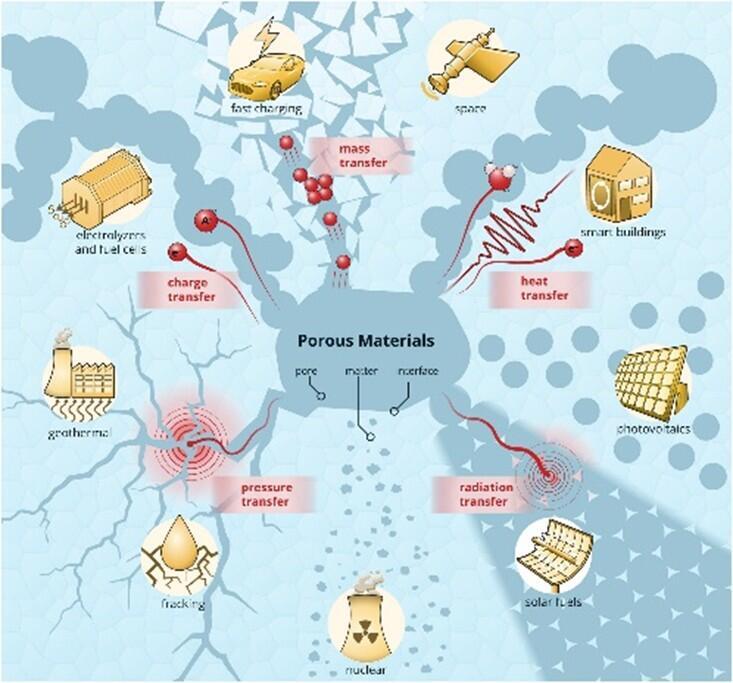
(Illustration: Technion Spokesperson’s Office)
The review argues that many performance breakthroughs — from improving battery power density to enhancing solar heat storage — depend on tailoring the geometry and spatial distribution of pores. By adjusting pore size, shape and orientation, scientists can modulate how quickly heat travels through a material, how efficiently ions move in an electrolyte or how gases are absorbed during energy reactions.
According to the authors, the interconnected relationship between a material’s solid and void phases enables simultaneous transfer and conversion of multiple energy streams. In electrochemical devices, for example, maximizing the internal surface area of porous electrodes improves both mass and charge transport, boosting the output of supercapacitors, fuel cells and batteries. Similarly, in thermoelectric generators, introducing disconnected pores can reduce heat conductivity without disrupting electron flow.
 Prof. David EisenbergPhoto: Dr. Thierry Slot
The researchers note that pores are not static. They evolve in real-world systems: inside nuclear fuel pellets, through cracking in battery particles or in underground rock formations during oil, gas and geothermal extraction. Understanding these changes, they argue, is essential for predicting performance and preventing degradation.
Farber began the research during his doctoral work at the Technion and continued it while working for a flow-battery startup in Munich. The paper offers a set of general principles that apply across length scales, from molecular structures to large engineering systems. These principles, the team says, can guide development of porous components for future solar cells, batteries, electrochemical cells and fuel-production systems.
 Dr. Eliyahu Farber
The study also lays out the challenges ahead. Designing task-specific porous architectures will require advances in synthesis, mathematical modeling and high-resolution imaging techniques capable of capturing a material’s full three-dimensional structure. Better computational tools, the authors write, will help predict how different pore arrangements influence energy transfer and allow researchers to borrow strategies from adjacent fields such as catalysis, heat storage and subsurface energy extraction.
The Technion researchers say their goal is to accelerate the creation of next-generation materials that support cleaner, more efficient energy systems worldwide. The work was supported by the Israel Ministry of Energy and Infrastructure.
First published: 18:38, 12.08.25