

Dozens of endangered spiny butterfly rays have been spotted gathering in shallow waters off Shavei Zion, near Nahariya on Israel's northern Mediterranean coast, in an unusual underwater encounter documented by marine rangers from the Israel Nature and Parks Authority (INPA). The rays were seen swimming close to the seabed, moving alongside one another and occasionally clustering tightly together. Experts believe the gathering may be related to courtship and reproduction, although further observations are needed to determine its purpose.
The remarkable scene was discovered in recent days by INPA marine rangers Shay Kabsa and Ziv Neder during a routine snorkeling survey. As they swam among schools of small fish, they suddenly encountered dozens of rays moving across the sandy seabed. The rangers spent an extended period documenting the animals, including one distinctive ray with white markings swimming among the others.
Rare sight off Israel's coast: Dozens of endangered butterfly rays gather in shallow waters
(Photo: Shay Kabsa, Ziv Neder, Israel Nature and Parks Authority)


"There are moments when nature makes you forget about the entire world," Kabsa said. "I put my head underwater, and at first I mostly saw schools of small fish. I continued a little farther, and suddenly, as if someone had lifted a curtain, the seabed appeared and dozens of rays were right beneath me. I floated quietly and didn't want to get out of the water. The entire seabed seemed to come alive. Sometimes we think we need to travel far to see the wonders of nature, but they're right here, in our Mediterranean Sea."
The spiny butterfly ray (Gymnura altavela) is a large, flat-bodied cartilaginous fish with broad pectoral fins that resemble wings as it moves through the water. It feeds on animals living along the seabed, including those found in sandy and muddy habitats. Like sharks, butterfly rays belong to the group of cartilaginous fish, all of which are protected under Israeli law.
Dr. Ruti Yahel, head of marine ecology at the INPA's Science Division, explained that the species is endangered globally and critically endangered in the Mediterranean, according to the International Union for Conservation of Nature (IUCN). Unlike mammals, butterfly rays are fish, but they give birth to live young following a pregnancy lasting approximately six months. Because they produce relatively few offspring during each reproductive cycle, their populations are particularly vulnerable to harm and recover slowly from declines.
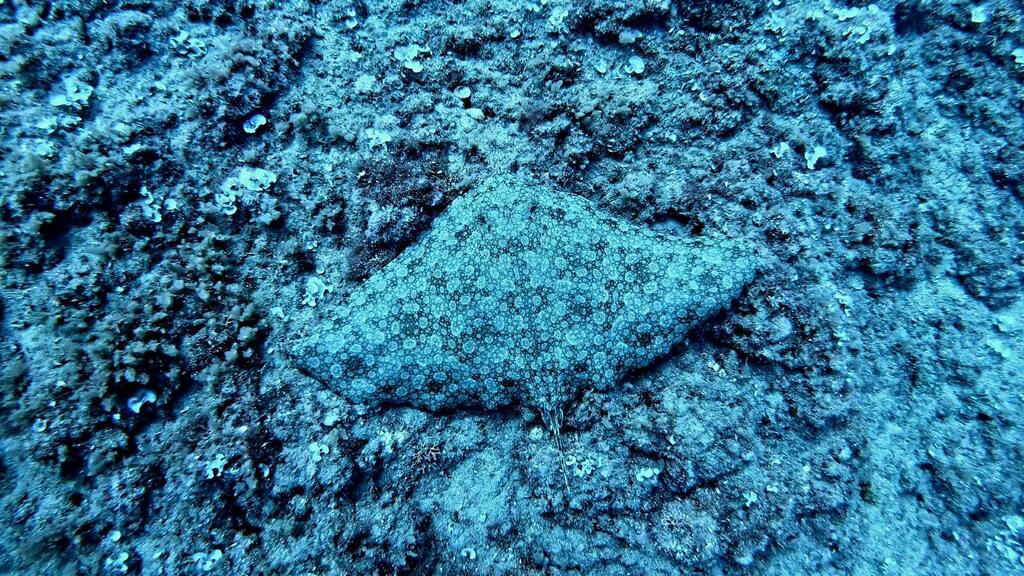
A spiny butterfly ray
(Photo: Ilya Baskin, Israel Nature and Parks Authority)
"It is certainly reasonable that the gathering documented here is related to reproduction, although additional observations are needed to establish that," Yahel said. "Encountering dozens of individuals in one location illustrates the importance of protecting marine habitats and allowing these animals to live and reproduce without disturbance."
The Nature and Parks Authority urged swimmers, snorkelers and divers to observe the animals only from a safe distance, warning that approaching, touching or chasing them could disrupt their natural behavior.
"Anyone who comes to watch the rays is asked not to chase them, touch them or try to force their way closer," Neder said. "Keep your distance and let them choose whether to approach or move away. If this gathering is indeed related to courtship and reproduction, it is especially important not to interfere. We don't need to touch nature to experience it. Sometimes all we need to do is float quietly and watch."
The INPA conducts marine patrols, wildlife monitoring, enforcement operations and rescue efforts along Israel's coastline to protect vulnerable species and their habitats against threats including fishing, habitat damage and human disturbance. The authority reminded the public not to approach, touch or feed wild animals, even for photographs. Anyone encountering an injured animal, an animal in distress or one posing a danger to visitors should contact the INPA hotline at *3639.