

Deep beneath the ocean’s surface, danger is hiding in plain sight. Not in the form of mythological creatures such as the kraken, but in the powerful geological forces that continue to reshape the seafloor itself. Most of Earth’s volcanic activity takes place underwater, yet much of its evidence and many of its consequences remain unseen.
Now, using an AI-assisted search of the ocean floor, a team led by volcanologist Dr. Andrea Verolino of Paris-Saclay University in France has identified 73 previously unknown volcanic calderas hidden beneath Earth’s oceans. ScienceAlert reported that the newly identified calderas span a wide range of depths, reaching up to 5,600 meters (about 18,400 feet) below the surface, and diameters of up to 20 kilometers (about 12 miles).
Start of the Hunga Tonga volcanic eruption
(Video: Reuters)


Calderas are vast crater-like depressions that form when the roof of a magma chamber beneath a volcano empties and collapses inward, creating a broad basin. They can stretch for many kilometers and often fill with water, becoming dramatic lakes. Some are extinct, but others are volcanic systems that may erupt again.
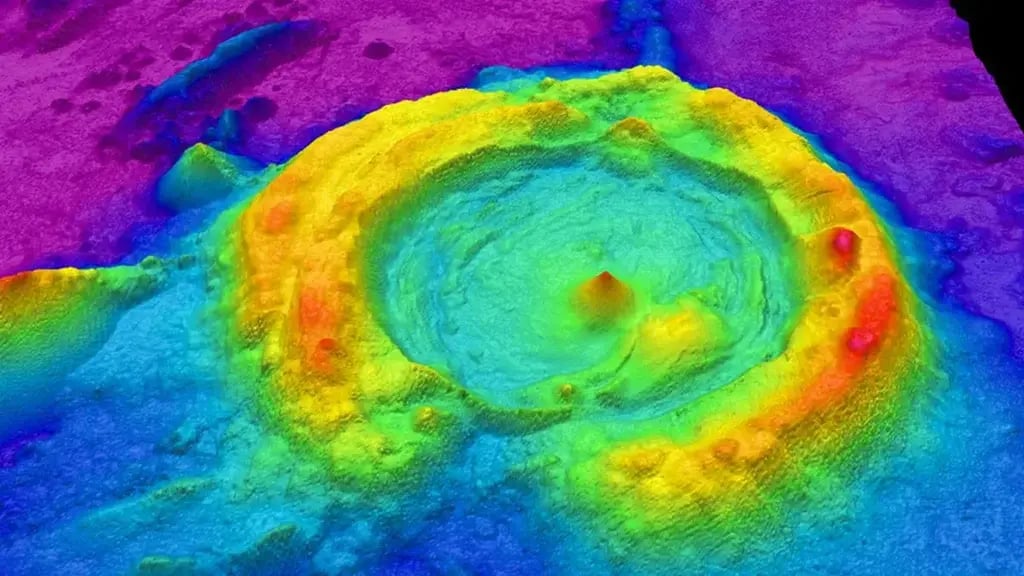
Most of Earth’s volcanic activity occurs beneath the sea, where tectonic plates constantly move apart, collide and slide beneath one another. Underwater, hot magma meets cold ocean water, hardens and builds layer upon layer of rock until it forms a seamount. In some cases, that process creates new islands when the summit rises above the waterline.
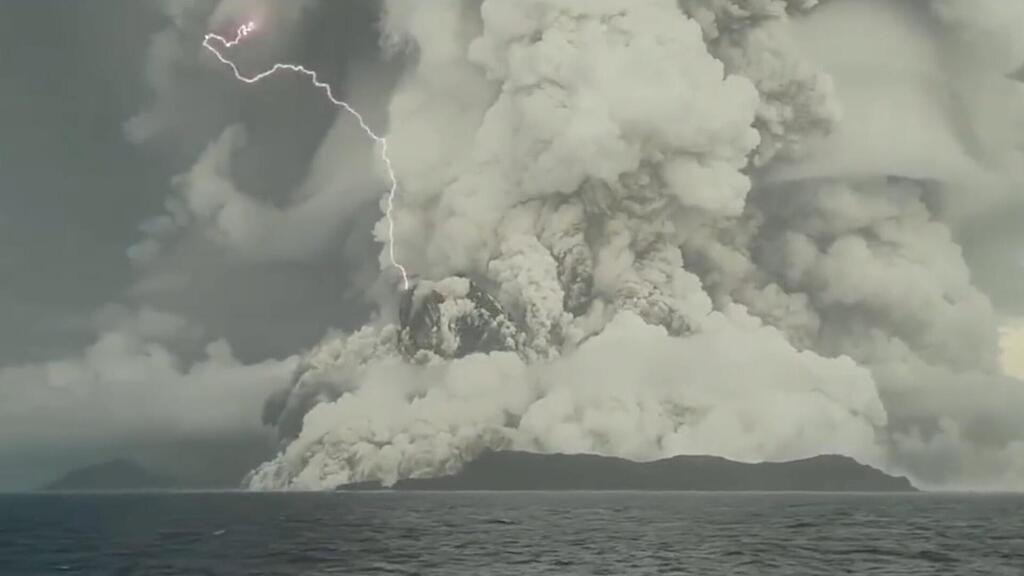
Eruption of the submarine Hunga Tonga volcano
(Photo: Tonga Geological Services/EYEPRESS, Reuters)
Much of this submarine volcanic activity consists of relatively gentle basaltic eruptions along spreading ridges. But at times, the results can be far more dramatic. Undersea calderas can produce powerful eruptions, tsunamis, shock waves, ash plumes and vast amounts of steam when they explode deep below the ocean.
The 2022 eruption of Hunga Tonga-Hunga Ha’apai, an explosive eruption from an submarine caldera in the Tonga archipelago, served as a wake-up call. It generated atmospheric pressure waves that reached space, triggered a widespread and destructive tsunami and caused damage thousands of kilometers away.
That is why the new study, published in Communications Earth & Environment, carries significant importance. If scientists do not know where submarine calderas are located, they cannot determine which ones may deserve closer monitoring.
Before the survey carried out in the study, fewer than 30 submarine calderas had been documented. To address that gap, Verolino and his colleagues used an algorithm originally designed to identify impact craters on Mars and applied it to bathymetric maps, which chart the topography of the seafloor.
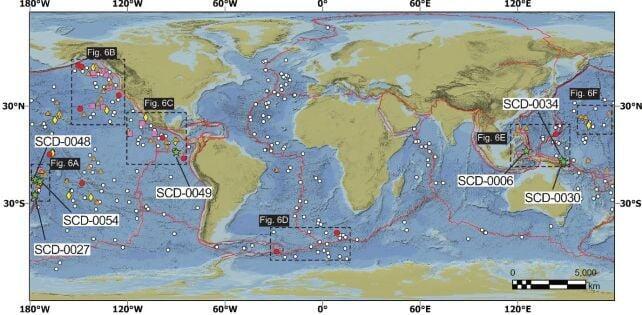
Mapping of the newly identified submarine calderas
(Illustration: Communications Earth & Environment)
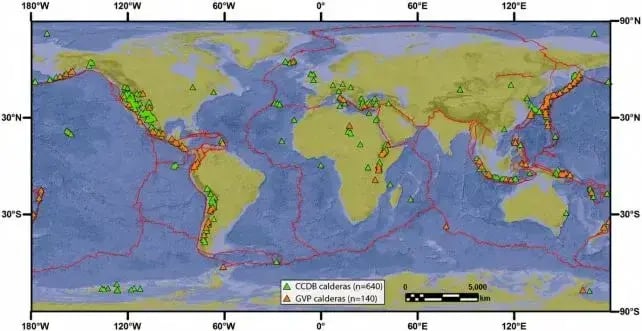
Global distribution of previously documented calderas
(Illustration: Communications Earth & Environment)
The algorithm initially flagged 87,435 possible formations, though most turned out to be false positives. After applying a series of filters and then manually examining the remaining formations, the researchers narrowed the final list to 78 calderas. Five of them had already been identified as submarine calderas, meaning the study added 73 new ones.
The findings also reveal where submarine calderas are most likely to appear, including along tectonic plate boundaries and volcanic arcs.
The researchers highlighted seven of the newly identified calderas as especially promising targets for future investigation. Their location, water depth and shape suggest they may be important for understanding submarine volcanic hazards.
The study’s authors did not determine whether any of the newly identified calderas are currently active. However, recent research has suggested that even volcanoes once thought to be extinct may quietly recharge with magma and become active in the future.
For that reason, the researchers say the new work provides a critical foundation for assessing submarine volcanic risks and improving global preparedness.