


"Sheshet," the six-legged mountain gazelle born two years ago in the fields north of Kibbutz Kissufim near the Gaza border, was recently spotted in a territory he’s claimed as his own. Now part of a small herd with four females, Sheshet was seen with a newborn fawn — possibly his offspring.
Nature photographer and Society for the Protection of Nature in Israel field expert Amir Balaban documented the sighting. "It was moving to see our Sheshet surviving, overcoming his rare mutation and even thriving in these difficult times," Balaban said.
(Sheshet, the 6-legged gazelle, has a baby)
"He’s adapted to the pair of extra legs growing from his back and, as he matured, he migrated east to HaBesor Stream Nature Reserve, where he settled."
Balaban noted that years of monitoring Sheshet and his herd have highlighted the increasing threats facing Israel’s native gazelle population — mainly habitat destruction due to development and the impact of war. “He’s an inspiration,” Balaban added. “He’s fending off predators, poachers and enduring a severe drought.”
Get the Ynetnews app on your smartphone: Google Play: https://bit.ly/4eJ37pE | Apple App Store: https://bit.ly/3ZL7iNv
Balaban was especially encouraged by the sighting of the new fawn, who appears healthy and, unlike Sheshet, has the usual four legs. Still, survival won't come easy.
“He already has to contend with stray dogs from Gaza, packs of jackals, poachers and off-road vehicles tearing through the reserve. We can only hope he makes it and that Sheshet’s females give birth to more fawns this season,” he added.
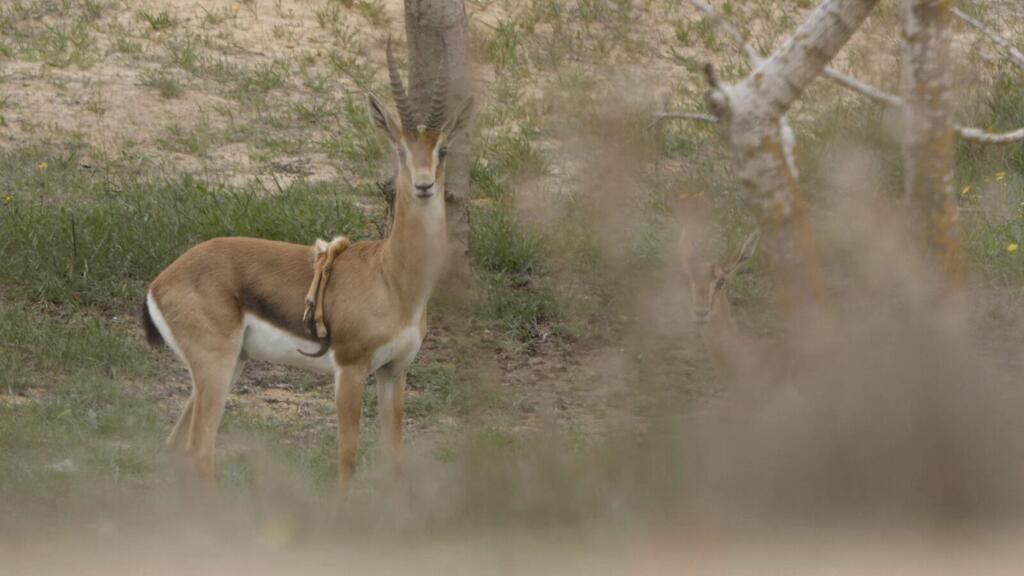
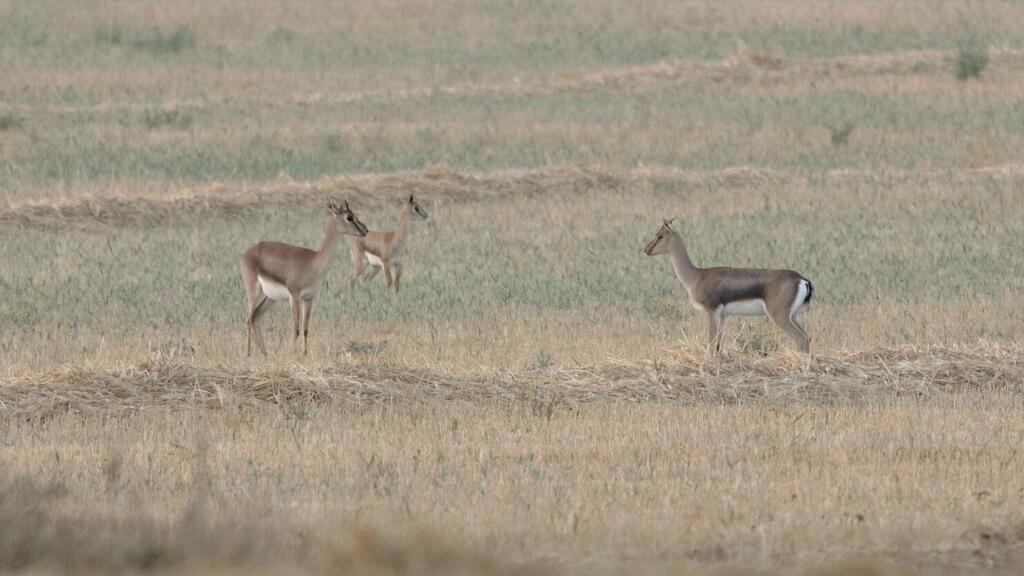
Sheshet with his new herd
(Photo: Amir Balaban, Protection of Nature in Israel)
Israel’s mountain gazelle population is in steep decline. Fewer than 5,000 are believed to remain in the wild. The main threats include urban expansion, road construction that fragments their habitat, illegal hunting and predation.
Preserving remaining open spaces and ecological corridors is critical, Balaban stressed. “We’ve got a long road ahead. Even so-called 'open areas' are often blocked by fences and infrastructure. Illegal hunters target gazelles for meat, and there’s been a surge in stray dogs and jackals preying on them and their young due to the war,” he said.