

An international team of astronomers has identified an exceptionally bright red point in the early universe that appears to belong to an entirely new class of astrophysical object.
It resembles an enormous star roughly the size of our solar system. But there is a problem: It emits about 100 billion times more energy than any known star could physically produce. Such energy levels are far more consistent with a black hole.
Gallery
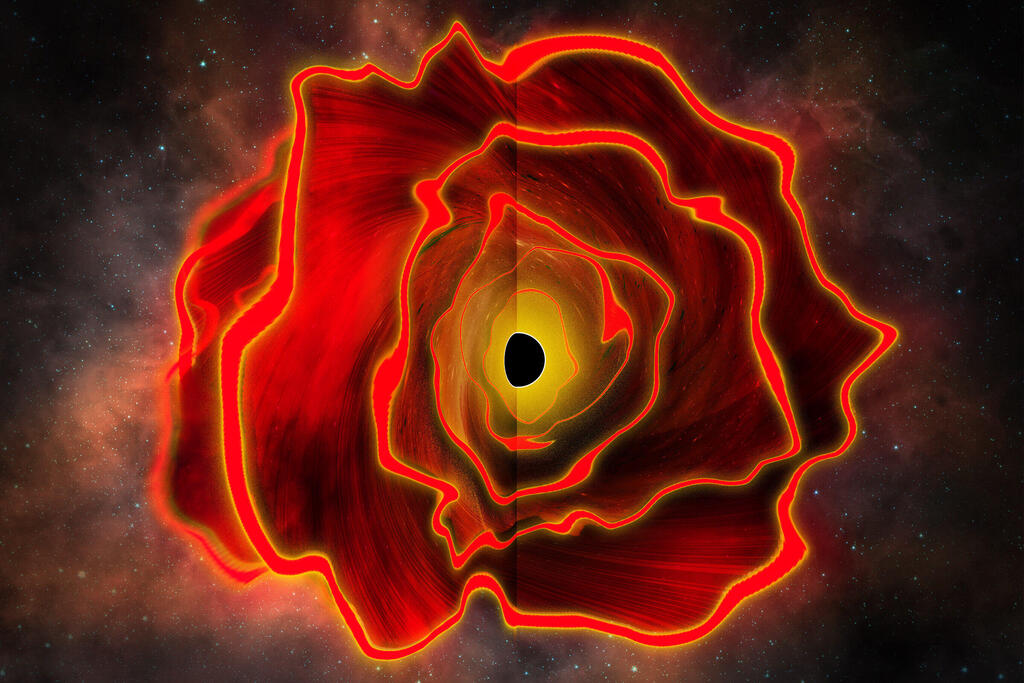
Illustration of a ‘black hole star,’ an exceptionally bright red point in the early universe that appears to represent a new type of astrophysical object
(Photo: Jose-Luis Olivares, MIT)
That strange combination has led astronomers to describe the object as a “black hole star.” A study published in the journal Nature details the analysis of the object, discovered using NASA’s James Webb Space Telescope. Webb observed it in the very early universe, just 660 million years after the Big Bang.
Researchers say the most plausible explanation is a combination of a black hole and something resembling a star, a configuration never previously observed. Rather than an ordinary star powered by nuclear fusion, the object is thought to consist of an extraordinarily dense cloud of gas surrounding and being powered by a central black hole.
“Our picture of this object is changing very rapidly,” said Dr. Rohan Naidu of the University of Hawai‘i’s Institute for Astronomy, one of the study’s authors. “We think there is a central black hole with a mass about 100,000 times that of the sun. Around this black hole is a very extended gaseous envelope that looks like a star the size of the solar system.”
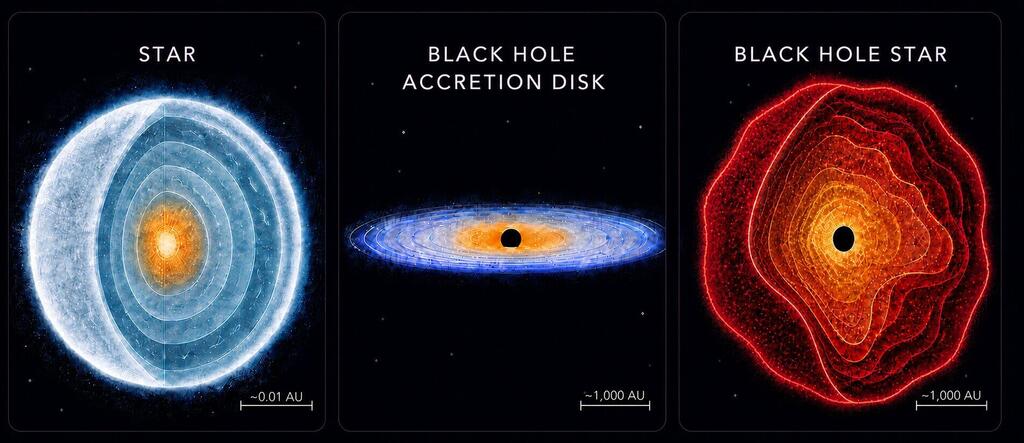
From right to left: a black hole star, a black hole accreting matter from its surroundings, and an ordinary star like those in our solar system
(Photo: Rohan Naidu (University of Hawai'i))
If the bright red object is indeed a black hole star, researchers say it could help explain another mystery that has emerged since Webb began observing the distant universe: the abundance of enigmatic “little red dots.”
The objects have appeared in many of Webb’s deep-space images, but astronomers still do not fully understand what they are. “These little red dots seem to be everywhere in the early universe, but in reality we know very little about them,” Naidu said. “What exactly these objects are has been one of the most debated topics of the James Webb Space Telescope era.”
Naidu and his colleagues were not initially looking for a black hole star. They were searching for some of the universe’s earliest and most distant galaxies as part of a targeted survey. Using Webb’s ability to peer deep into space and therefore far back in cosmic time, the team examined the universe when it was only a few hundred million years old, hoping to identify galaxies that had formed during that period.
“When we see a very red object in the universe, we often assume it is surrounded by dust, such as soot or ash,” explained Dr. Robert Andrew Simcoe, director of the MIT Kavli Institute for Astrophysics and Space Research and a member of the research team.
“Much like smoke from Canadian wildfires recently made Boston’s skies appear bright red, astronomical objects can appear redder than they really are when viewed through a screen of dust.”
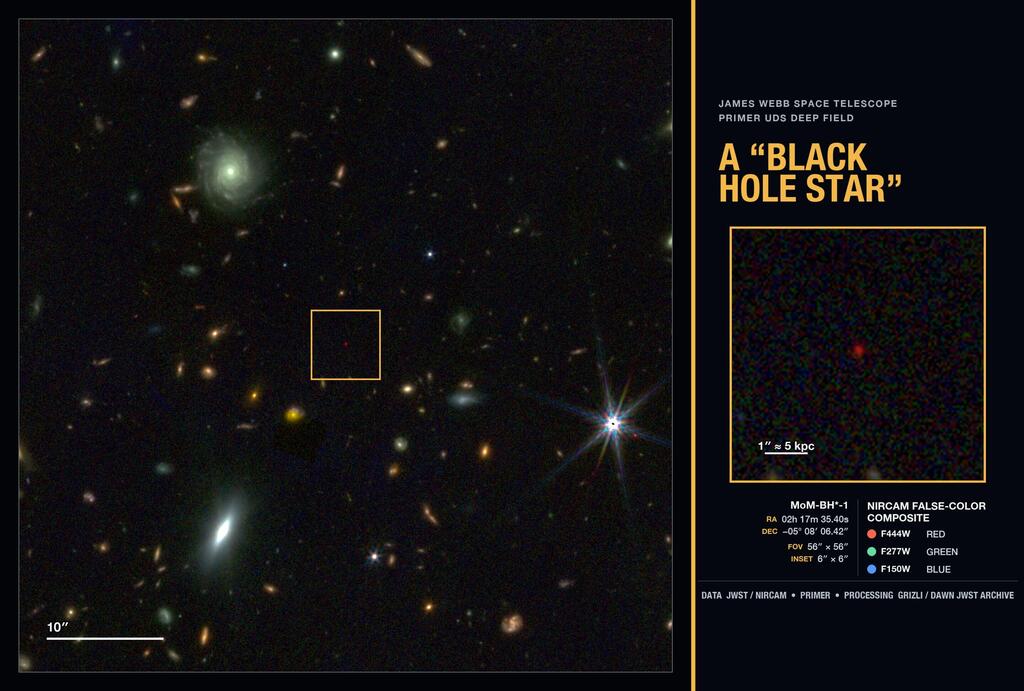
The black hole star MoM-BH*-1, as detected by the James Webb Space Telescope
(Photo: NASA, ESA, CSA, STScI, DAWN JWST Archive, PRIMER Survey (PI: James Dunlop), Rohan Naidu (University of Hawai'i))
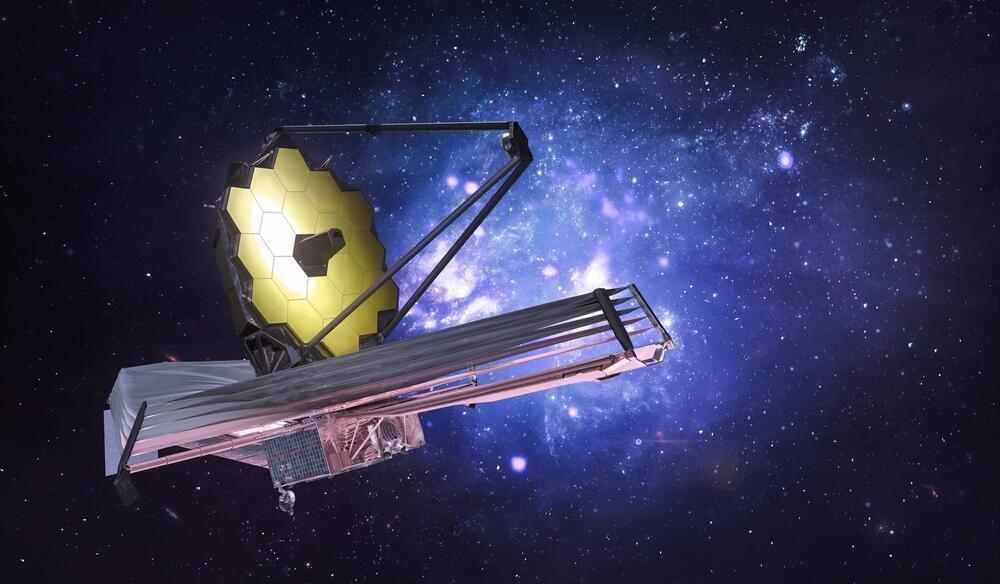
James Webb Space Telescope
(Photo: Dima Zel/Shutterstock)
But the newly identified object did not behave like an ordinary dusty galaxy. The team noticed another unusual pattern: Its light was extremely bright across much of the spectrum but disappeared completely below certain wavelengths. Vega, one of the brightest stars in the night sky, displays a similar pattern.
Even more strikingly, the object’s light showed almost no evidence of metals or elements other than hydrogen and helium. “It was really unique in so many ways,” Naidu said.
To determine what could be producing the strange red signature, the researchers ran simulations testing different combinations of astrophysical conditions.
Their models suggested that the object could consist of an enormously powerful energy source buried inside an extremely dense hydrogen envelope. Such a configuration could explain both the missing light at particular wavelengths and the near-total absence of elements besides hydrogen and helium.
But it still left one major problem: the object’s extraordinary brightness. “There is something that looks a little like a star, but is 100 billion times brighter,” Naidu said. “That means its source of energy cannot be nuclear fusion, the energy source at the heart of every star we know.”
Black holes, by contrast, routinely generate energy on the scale observed by the researchers as matter falls toward them. After comparing their simulations, the team concluded that the closest match was a black hole surrounded by a star-like gaseous envelope. They named the object MoM-BH*-1.
Although other mysterious red objects observed by Webb are not as bright as MoM-BH*-1, the researchers believe black hole stars could potentially explain many of the telescope’s little red dots.
“What is special about MoM-BH*-1 is that the black hole star completely outshines the host galaxy around it,” Naidu said, “so we are seeing light that comes purely from the black hole star.”