


Heavy air pollution and thick haze blanketed much of Israel from midday Monday, sharply reducing visibility, before gradually dissipating overnight, the Israel Meteorological Service said Tuesday morning.
Forecasters said intermittent rain accompanied by isolated thunderstorms began in northern and central Israel during the night and would continue through Tuesday, at times still punctuated by thunderstorms. A marked drop in temperatures was also expected.
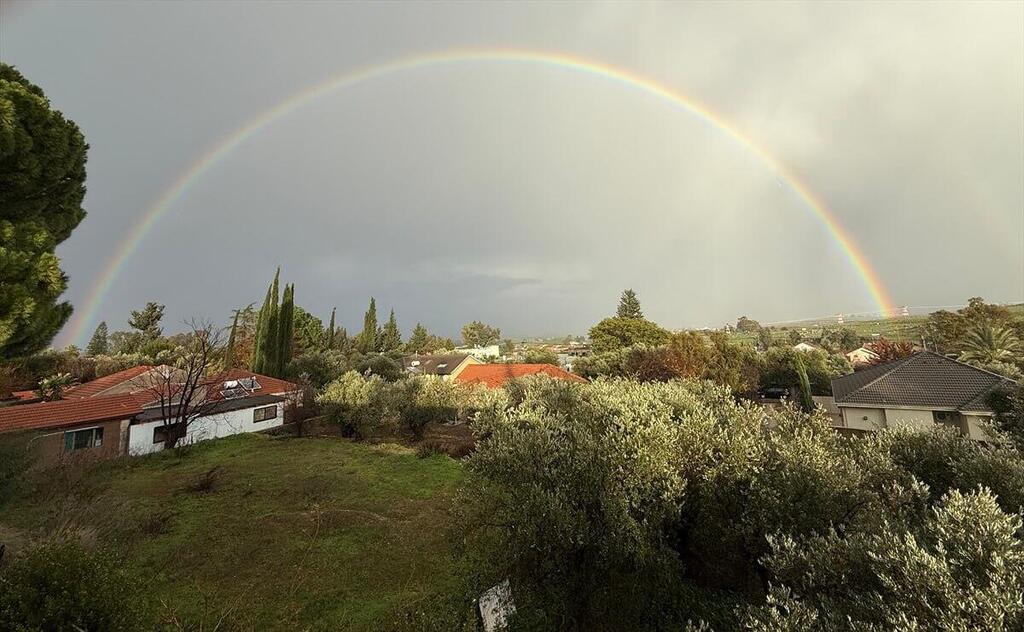
Rainbow over Rosh Pina
(Photo: Anna Shalit)
Light local rain was forecast for the northern Negev, with a slight risk of flash floods in the Judean Desert and around the Dead Sea. Strong winds were expected to blow through much of the day, weakening and tapering off toward evening.
Meteorologists said this would likely be the only significant rainy spell in the first half of February. From Thursday onward, temperatures are expected to rise again, running above seasonal norms, with most areas topping 68°F (20°C). Friday is likely to remain warm, with the possibility of drizzle or light local rain in some areas.
February has so far continued what officials describe as an erratic 2026 winter. January was significantly warmer than average compared with previous years, even as rainfall varied widely by region.
Compared with the 1991–2020 average, daytime temperatures in January were 2.7–4.5°F (1.5–2.5°C) above normal along the coastal plain, in the lowlands, in the central highlands and in the Arava Valley. In the northern mountains, northern valleys and Negev, temperatures were 1.8–2.7°F (1–1.5°C) higher than average.
At night, southern Israel ran 2.7–4.5°F (1.5–2.5°C) above average, while the coastal plain, lowlands and central highlands were 1.8–2.7°F (1–1.5°C) warmer. Northern valleys were 0.9–1.8°F (0.5–1°C) above normal.
The meteorological service said that in its records dating back to 1950, January 2026 ranked as the 12th warmest January on record, though cooler than the past three Januaries from 2023 to 2025.
Rainfall was uneven. January was wetter than average in the central highlands, lowlands, southern coastal plain and northern Negev, near average on the Golan Heights, in the valleys, northern Sharon and Lower Galilee, and drier than average elsewhere. The Arava and southern Negev received no rain.
Meteorological Service Director Dr. Amir Givati warned that the trend pointed toward warmer winters and fewer rainy days. “The entire first half of February is expected to be warm, and it looks like winter is slipping away,” he said. “We are likely to see spring arriving earlier with each passing year.”
Forecast temperatures:
• Jerusalem: 48–64°F (9–18°C)
• Tel Aviv: 61–70°F (16–21°C)
• Haifa: 63–72°F (17–22°C)
• Safed: 50–63°F (10–17°C)
• Katzrin: 54–70°F (12–21°C)
• Tiberias: 57–73°F (14–23°C)
• Nazareth: 57–70°F (14–21°C)
• Afula: 55–72°F (13–22°C)
• Beit She’an: 57–77°F (14–25°C)
• Lod: 55–70°F (13–21°C)
• Ashdod: 54–70°F (12–21°C)
• Ein Gedi: 59–72°F (15–22°C)
• Be'er Sheva: 52–70°F (11–21°C)
• Mitzpe Ramon: 54–68°F (12–20°C)
• Eilat: 68–81°F (20–27°C)