

When chef Moti Sofer was 15, he walked into the kitchen of his mother, Yvonne, and began learning the secrets of cooking from her. His father, David, a building contractor who immigrated to Israel from Tripoli, was not thrilled to see his youngest son among the pots.
“My late father didn’t like seeing it,” Sofer recalls. “He really hated that I went into the kitchen. In his chauvinistic view, it made no sense — a man doesn’t cry and a man doesn’t cook. My mother, on the other hand, loved that I was receiving her knowledge.”
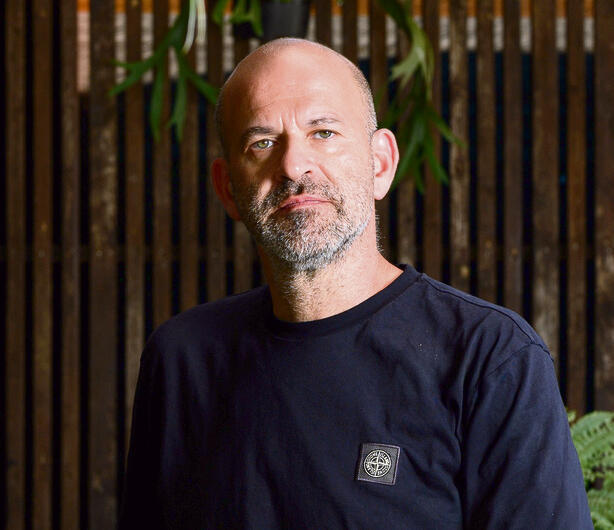
When Sofer speaks about Yvonne, who died 22 years ago at 67, his expressive eyes begin to fill with tears.
“She was a beautiful woman, amazing, brilliant, cynical, funny. A woman of spirit,” he says. “Almost every two days, at 5:30, before service, I would speak to her on the phone. When my mother died in 2004, a few months after my father, my world collapsed. I felt I was alone in the world and that there was no one protecting me. No one I could turn to. To this day I am connected to my mother. She is still with me: her voice, her stories, her guidance, her knowledge. Her sentences still echo in me.”
Then, suddenly, he declares: “By the way, I have the heart of a woman.”
How does that show?
“There is a lot of heart in my kitchen. I don’t shout at my employees, I don’t throw plates and I don’t aggressively kick cooks out. I am a father figure and a mother figure for them. I speak to them at eye level.”
So how did you end up straight?
“Interesting question,” he says with a smile. “But I’m straight.”
Gender questions even enter the conversation when it turns to chraime.
(Photo: Galya Aviram)
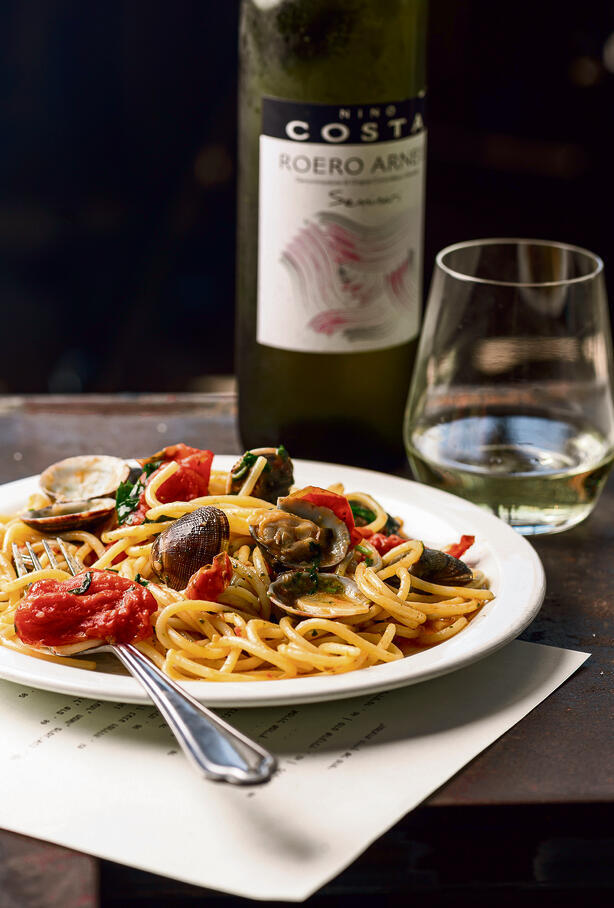
“My uncle was the legendary fisherman of Jaffa, Rafi Badusa. Everyone knew him, and still does,” Sofer says. “Uncle Rafi would come on Friday with groupers and amberjacks and say to my mother: ‘Move aside for a second.’ Then he would start filleting and making men’s chraime. Yes, there is men’s chraime and there is women’s chraime. Men’s chraime has tomatoes and half a lemon, rough and wild. Women make chraime flatter and more delicate, with tomato paste and paprika. The chraime I make is men’s chraime.”
From politicians to ambassadors
Sofer is now marking 30 years in the restaurant business. Over the years, he worked in restaurants including Pronto, Keren, where he says he learned from Haim Cohen “how to run a tight kitchen,” and Stefan Braun. In the mid-2000s, he broke through with RoniMoti, the Italian deli-restaurant he opened with his then-partner Roni Belfer, which won glowing reviews. The late Shimon Peres liked holding important meetings there, and Sofer would close the restaurant for him.
Sofer and Belfer eventually separated romantically, but in 2011 they opened the upscale Italian restaurant La Repubblica together in a large, carefully designed space in central Tel Aviv. With its lush garden terrace, the restaurant drew politicians, including Ehud Olmert, media figures and actors. Hanna Laslo liked sitting at the bar. The Italian ambassador was a regular customer, and there is no greater compliment than that.
(Photo: Galya Aviram)
“At La Repubblica, I was everything, including the host, but I never sat with customers. I don’t think that’s right,” Sofer says. “The late writer Meir Shalev was a charming man. He used to eat here. He loved simple food. Someone recently sent me a quote from one of the eulogies at Yair Garbuz’s funeral, where Yair wrote to his friend: ‘Let’s meet at La Repubblica.’ Yair was also a beloved customer. People would come back from Italy and come eat at my place and say: ‘Moti, we came for a correction.’ I didn’t think I was doing anything special. I simply brought Italy.”
After surviving COVID, the protests over the judicial overhaul, Tel Aviv construction work and the professional split from Belfer, October 7 arrived. At the start of 2024, Sofer decided to close La Repubblica.
“Until October 7, I survived in an impossible way,” he says. “Many people along the way suggested I give up, and I refused. On October 7, I tried to understand what was going to happen with the business. After three months, I understood there was no one to talk to and that I had to return the property to the landlord. It is not simple to be a restaurateur during wars and rounds of fighting. Opening a restaurant in Israel is very risky. In this country, everything has an impact, even the World Cup.”
We meet at a café overlooking the place where La Repubblica once stood. Sofer, 54, looks at the space where he worked for 12 years, now occupied by a kosher Asian restaurant. He refuses to surrender to sentimentality or sadness.
(Photo: Galya Aviram)
Is it not hard to see what happened to your life’s work?
“La Repubblica is actually part of my life’s work. I don’t look back. It was another chapter. A good chapter,” he says. “After I closed La Repubblica, I developed insights and understandings about where I was going. I received all kinds of offers to consult and to join existing restaurants. I did some consulting here and there, and mainly gathered myself inward and returned to the family, to my partner and to our 8-year-old son Michael. I made up for gaps after many years in which I devoted myself to customers and work and didn’t get to be home for Friday night dinner. Now it was time to return to the truth, to home. Michael got me back. I’m Mother Goose now. We start the morning with a meal together.”
You became a father relatively late, at 46, when Michael was born.
“People ask me how I didn’t have children all those years,” he says. “My answer is that in none of my relationships was it an important thing. At 46, the time had come. Customers even asked me whether it wasn’t too late, and I told them: ‘No, this is the exact time. I’m ready.’ I am a teacher and educator, and I pass knowledge to my employees, and I want to pass that knowledge to my son too.”
He says he enjoys watching Michael grow and take shape.
“Michael loves music and listens to jazz, he is an amazing painter and carpenter,” Sofer says. “Michael washes my car on Fridays at 4 p.m., exactly when I used to wash my father’s big American car. Michael is also a culinary figure. He loves crab gnocchi and pasta vongole. He has a singular palate. He knows the names of cheeses. Sometimes it makes things difficult for me. I give him a plate and he comments.”
‘Tahini will not be here’
Over his career, Sofer trained generations of chefs, including Aviad Peled and Tom Gove of the much-discussed restaurant Pereh. Now, after a break, he is cooking not only for his partner and son. He is launching a new restaurant, Lento, in Hutzot Shefayim, the shopping and entertainment complex between Herzliya and Netanya, surrounded by kibbutzim and moshavim.
“At the beginning of 2024, businessman and entrepreneur Gilad Yarkoni suggested that I open a restaurant with him next to his café-deli, HaHatzer HaAhorit,” Sofer says. “At first Gilad wanted us to serve Greek, Mediterranean food. But in the end we went for Italian food. I don’t know how to do anything other than Italian food. As much as I try to run away from it, I can’t.”
Before finalizing the menu, Sofer held tastings for people close to him and tried to understand how to make something different from La Repubblica.
“There, the menu had 40 dishes, and I ran headfirst into the wall and hosted 300 people on Friday,” he says. “Now at Lento, the menu has 18 lovely, cute dishes, small and medium in size, without breaking our heads. For now, we are open only in the evenings.”
The name Lento means “slow” in Italian, and Sofer says that is the opposite of him and Yarkoni.
“We are both restless people. But it is important to stop for a moment and try to understand how to do things correctly.”
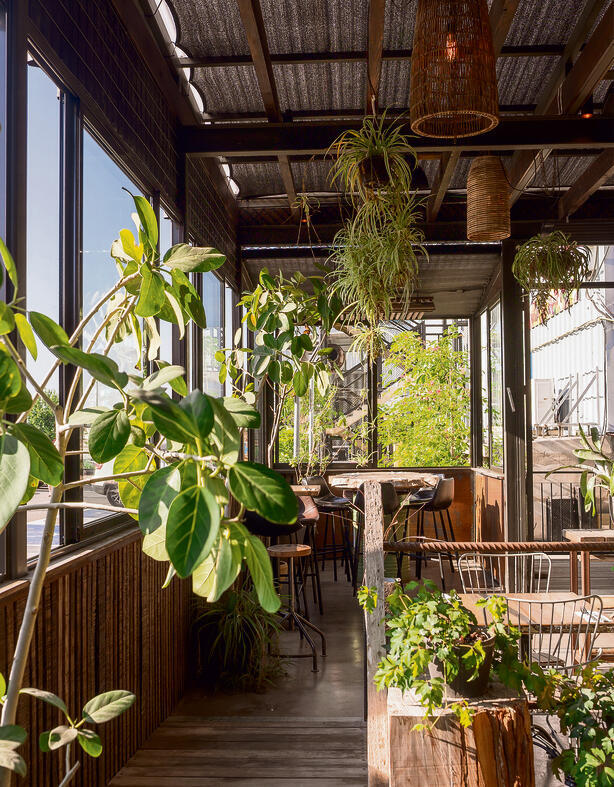
The restaurant’s design is warm, inviting and full of plants. Among its flagship dishes are asparagus with sheep’s cheese, shrimp with preserved lemon and garlic, and a 48-day-aged entrecote, which Sofer calls “a stunning dish.”
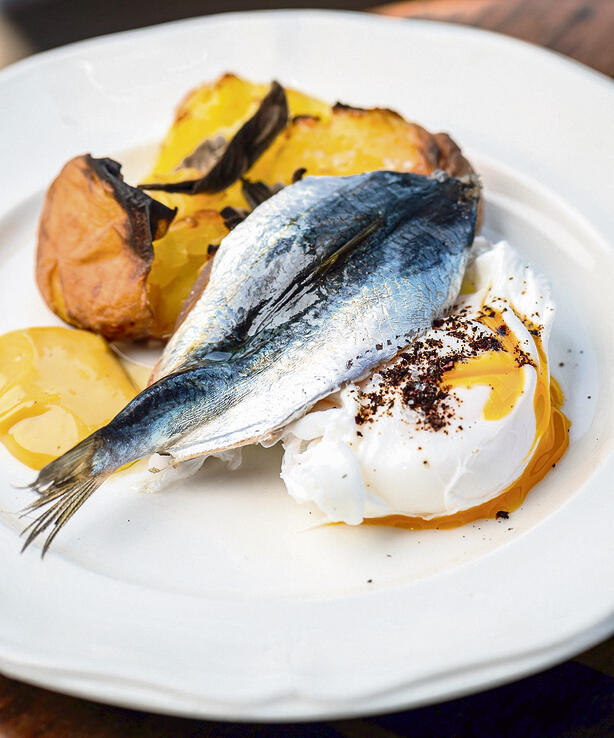
(Photo: Galya Aviram)
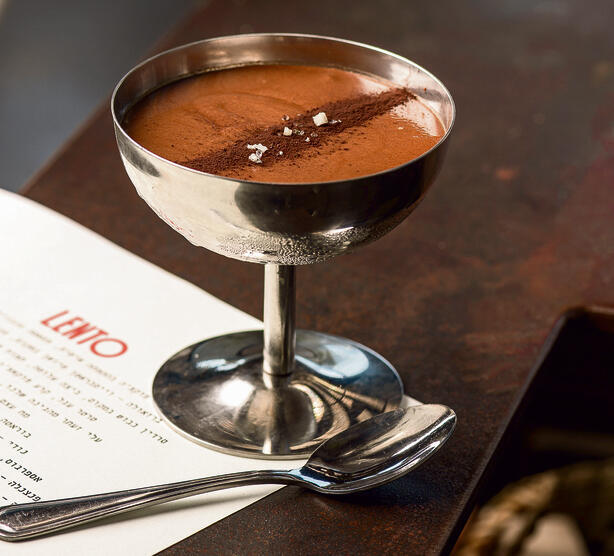
Some dishes migrated from La Repubblica, including gnudi in parmesan butter sauce, panzanella salad and the focaccia, which Sofer says he makes “according to a divine recipe from semolina flour.”
“In general, I try to bring the local kitchen into the Italian kitchen, but there will be no tahini here,” he says. “The main innovation at Lento is the Spanish Josper oven. As simple as it is, it is the jewel of the kitchen. It protects the food and creates the wood aroma that I missed at La Repubblica. The pricing here is also more logical and smart. Most dishes are under 100 shekels.”
Why did you not choose to open again in Tel Aviv?
“Because the city is really saturated,” he says. “Today the restaurant market is controlled by groups that open many places. I visit restaurants that have opened recently and see the investments and the prices, and it doesn’t suit me. There is no tourism now, and not enough movement. So it suited me to open in Shefayim. The audience in this area is not a critical audience, unlike the Tel Aviv audience. It knows how to appreciate that I brought something to this area that didn’t exist here.”
He calls the area “a parallel universe.”
“People sit here with arak and ouzo, as if they were on a beach in Greece. Many customers come to us from Ramat Hasharon, people who have followed me for many years. Surprisingly, a Tel Aviv crowd also comes, and they really love my food. It’s wonderful. I hope Lento becomes an institution.”
Sofer believes in “less is more.”
“Italian cuisine is minimal. Five items on a plate. Today in most restaurants there are many items on a plate, sometimes 15. There are also a lot of games on the plate.”
Lento’s menu relies in part on produce now including zucchini flowers, chard, basil, lettuce, za’atar and spinach from the garden Sofer has cultivated at Hakfar Hayarok since 2009. Sofer was among the pioneers of farm-to-table thinking in Israel, and many chefs followed.
“I started with 100 square meters and now the garden has become two dunams of organic crops,” he says. “I pick, plant, sow and prepare the soil. It is tremendous. Soil is therapy, a psychologist. When I don’t work the land, I feel like half a person. My son Michael grew up in it.”
A dream of Yossi Banai
Sofer inherited his skill and love of handwork from his parents, who immigrated to Israel from Libya as teenagers.
“In the transit camp, my father, who was a smart man, began working in polishing and became a carpenter and building contractor who built buildings at a dizzying pace,” he says. “My father knew many languages. In the transit camp he learned to speak Yiddish, German and Romanian. After the army, I worked with him in the construction company, yes, I built buildings. But at 24, I decided to do something connected to baking and cooking, and then I began working at the Italian restaurant Pronto in Tel Aviv. My mother was a seamstress and knitter, and also an amazing baker. The door was always open. The neighbors would sit with a notebook, ask my mother, ‘What did you make today?’ and write down the recipes.”
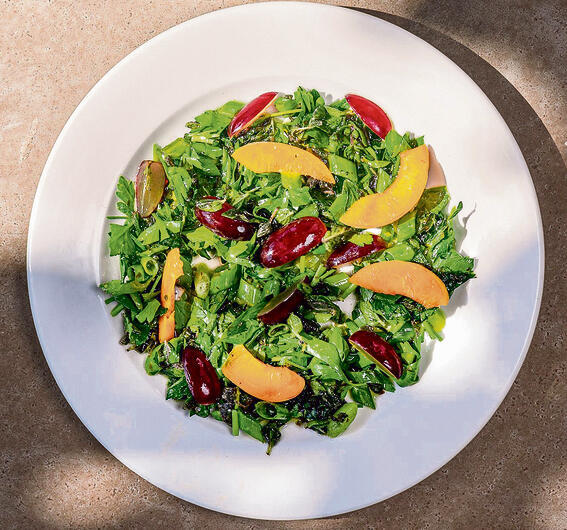
(Photo: Galya Aviram)
Sofer is a gifted storyteller, using his eyes, face and hands as much as his words. His presence is extroverted, fascinating and colorful, which makes it strange that he has not become a television personality.
How are you still not a celebrity chef?
“I think it’s a matter of television. It wasn’t offered to me,” he says. “Of course I appeared on morning and cooking shows. There was also talk that I would do more television because I’m extroverted, but it didn’t work out. I see chefs who are not famous appear on television, and after two shows, their restaurant becomes known. That is the new world, and it’s nice. I hope it happens for me too.”
Whom do you dream of feeding?
“I dreamed of feeding the late Yossi Banai. A figure I admire and love. I once invited him to the opening of my first restaurant, but he didn’t come. He sent his wife.”