

Israelis do not need a special reason to eat meat. It is a fixture on plates year-round, whether grilled in the backyard or at the park, on restaurant menus or in pots simmering in home kitchens. Steaks, skewers and shawarma are familiar territory. But one category has remained on the margins: dried meat.
Around the world, products such as biltong and beef jerky are everyday, legitimate and common snacks. In Israel, however, dried meat is still seen as something foreign, with an unusual texture.
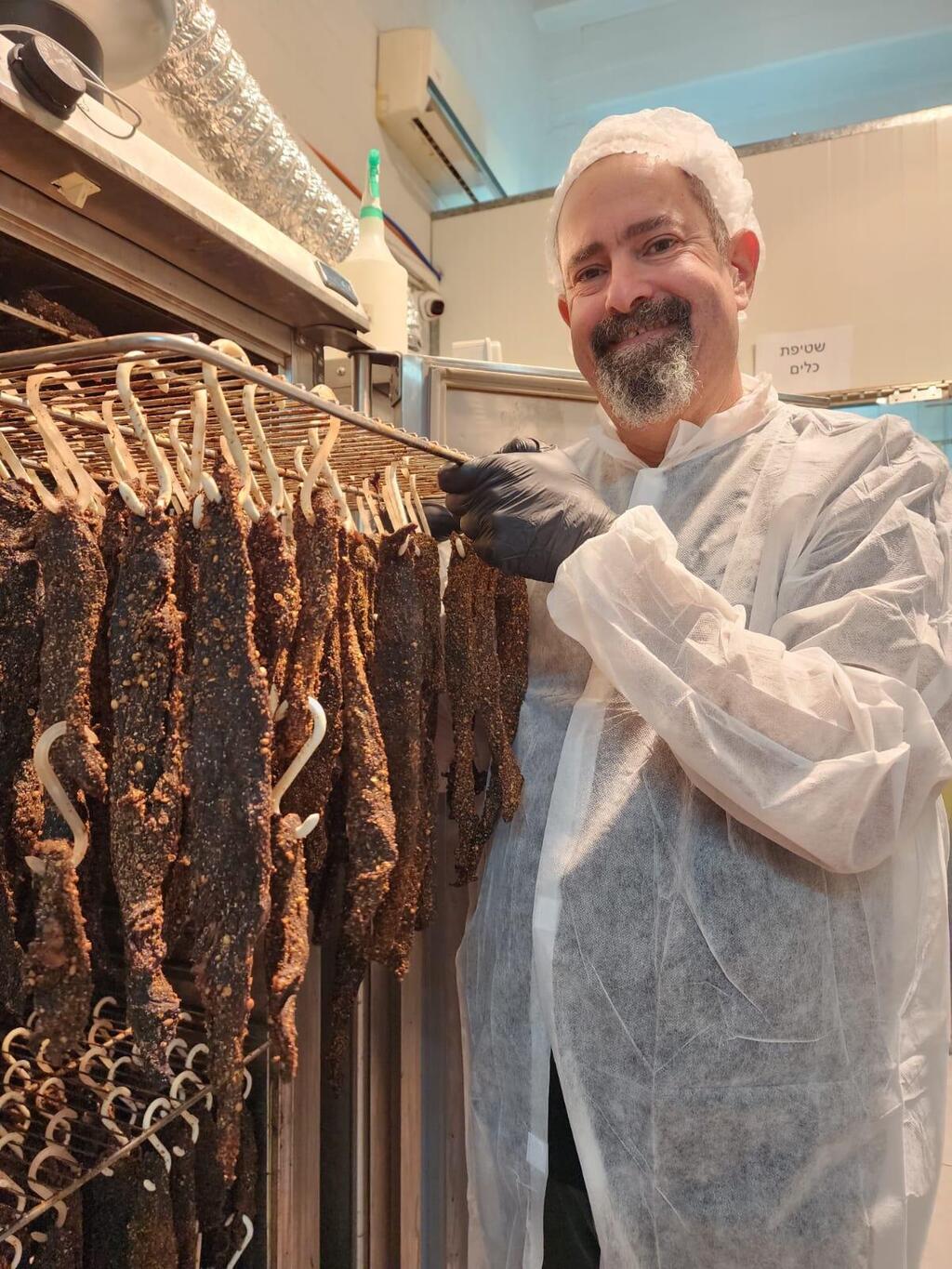
That has begun to change in recent years. During the long months of war, soldiers in the field were provided packages of dry, protein-rich meat strips that do not require refrigeration and do not spoil. Soldiers accustomed mainly to canned meat, kabanos and tuna discovered a very different, accessible and reliable source of protein. The dried meat packages started catching on, and canned meat’s standing began to weaken. Before long, beef jerky and biltong made their way to butcher shops and delis across the country.
“It all started because I’m South African, and one of my childhood snacks was biltong and dried sausage,” says Gadi Blau, 52, the entrepreneur behind Gadi’s, a brand of dried meat snacks sold in small bags that do not require refrigeration.
Together with his wife, Merav, 51, he runs the production of their dried meat delicacies: beef jerky, biltong and dried sausages. Gadi immigrated to Israel at age 3 and grew up on biltong and dried sausages. When he became a chef, he began trying to recreate at home the flavors he remembered from childhood.
“As a child, when we would travel abroad to visit family, we would bring it back in our suitcases,” Gadi says. “We waited so eagerly for it to arrive, and by the next day, it was already gone. Dried meat was hard to find in Israel, and only a few people made it at home. Since I couldn’t find it here, I decided to make it myself. I adjusted the seasoning until I recreated the flavor I remembered from childhood.”
“Our dried meat really took off during the war,” he says. “Before that, we mainly sold to South Africans and Americans who knew the product from their countries of origin. During the war, many of our products reached combat zones because they can be kept in a vest pocket, do not require refrigeration and provide a high-protein serving.
"We donated to military units we connected with directly, and at the same time various nonprofits bought from us and distributed the products to soldiers at staging areas or before they entered the field. After soldiers had grown accustomed to canned meat, our beef jerky was met with enthusiasm; they loved it, and when they came home from reserve duty, they started looking for where they could buy it.”
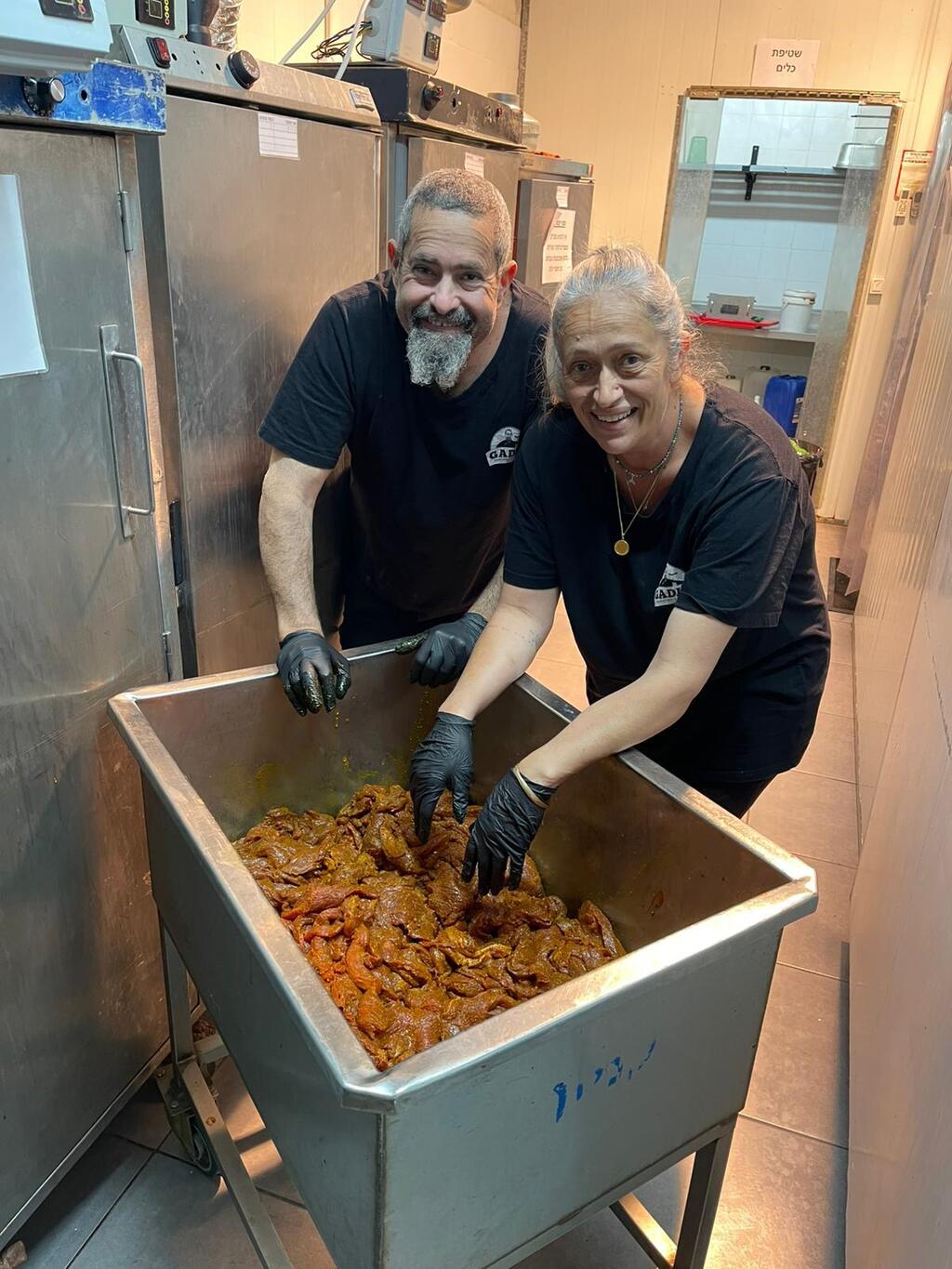
Family business
(Photo: PR)
The couple’s first breakthrough came during the COVID-19 pandemic, when buying groups and home deliveries flourished. Only after the pandemic did they decide to open their own factory in Kfar Saba. Today, two years after the factory was established, their products are sold at hundreds of locations, including delis and supermarket chains across Israel, distributed by Agat-d.
Why did you think Israelis would like this? The texture is tough for their palate.
Gadi: “I used to make South African sausages at home for grilling. That was also one of my childhood delicacies. I gave them to friends, and that’s how I started making sausages and selling them to friends and to anyone who heard about me. We grew from there.”
Merav: “Dried meat is still relatively new in Israel and many people don’t know it; it has an acquired taste that takes time to develop. It took us six months to prove to the Health Ministry that it was OK to dry the meat traditionally.
"We realized that American beef jerky did not quite suit the Israeli palate. It's too hard and requires a lot of chewing, so we cut it smaller to make it more chewable and less dry in the mouth. We also created one flavor for Israelis: shawarma beef jerky. Beyond that, there is a classic flavor, a smoked flavor and a barbecue flavor.
"The amount of protein in it, and the fact that it has no industrial ingredients and is just meat and spices, are important to many people. I feel we are among the pioneers of this product. Israelis simply need to be exposed to it and get used to it.”
Big hands, big heart
Then came Oct. 7. The Blaus had a food truck operating at the Nova music festival. Running it that day was a close friend of the couple, Doron Boldes, a large man with big hands who loved people, the land and meat. Boldes was murdered at Nova after saving many festivalgoers. Out of the deep grief over his death came one of Gadi’s products: a spicy dried sausage named after him — Doron’s Sausage.
“Doron was a big, heavyset redheaded farmer who loved meat and loved eating with his hands,” Merav says. “For a long time, he had asked us to dry a specific sausage, but we never got around to making it for him. During Doron’s shiva, we decided to dry the sausage he loved. The factory’s first oven had originally been in his storage shed.
Gadi’s also insists on serving as a platform for commemorating Doron. Soldiers and post-army travelers receive packages of “Doron’s Sausage” as gifts and are asked to take them on trips around the world, photograph them and send the pictures back. The photos began arriving from all over - India, South America and Singapore.
“Doron was murdered at 32. He did not get to do much in his life,” Merav says. “His parents have a goat farm, and he was a classic moshavnik. Doron never got to take the big post-army trip because his whole life revolved around the farm. He barely traveled the way young people do. So we said, at least his spicy sausage will travel the world.”

Doron Boldes
But beyond the story, how does it taste? Let's start with the texture: This is dried meat with a tough texture that requires serious chewing before it can be swallowed. The taste may not be entirely foreign to Israelis, but the texture can be challenging. The classic American beef jerky is cut smaller than the original, while the biltong remains true to its roots, arriving sliced and simply seasoned. There is also a traditional spicy version.
“It’s indeed an acquired taste,” Blau admits. “But once people get to know it, they keep coming back for more."
Their small factory employs four people: new immigrants from South Africa and the United States, along with an at-risk teenager. They also try to keep the entire production chain local, from the packaging design, created by a woman evacuated from Nir Oz, to the printing of the packaging at a print shop in Sderot.
There has been a lot of talk lately about meat, partly because of popular diets and changes to the food pyramid. Do you feel that?
“Israelis love meat, and demand for protein from meat is surging, not just among athletes,” Gadi says. “Two or three years ago, few people even thought about protein content in food, but today it is gaining traction worldwide. One of the first things I do every morning is taste the products in preparation, and during the day I snack on them too. Instead of a cookie or croissant, I snack on dried sausage.”
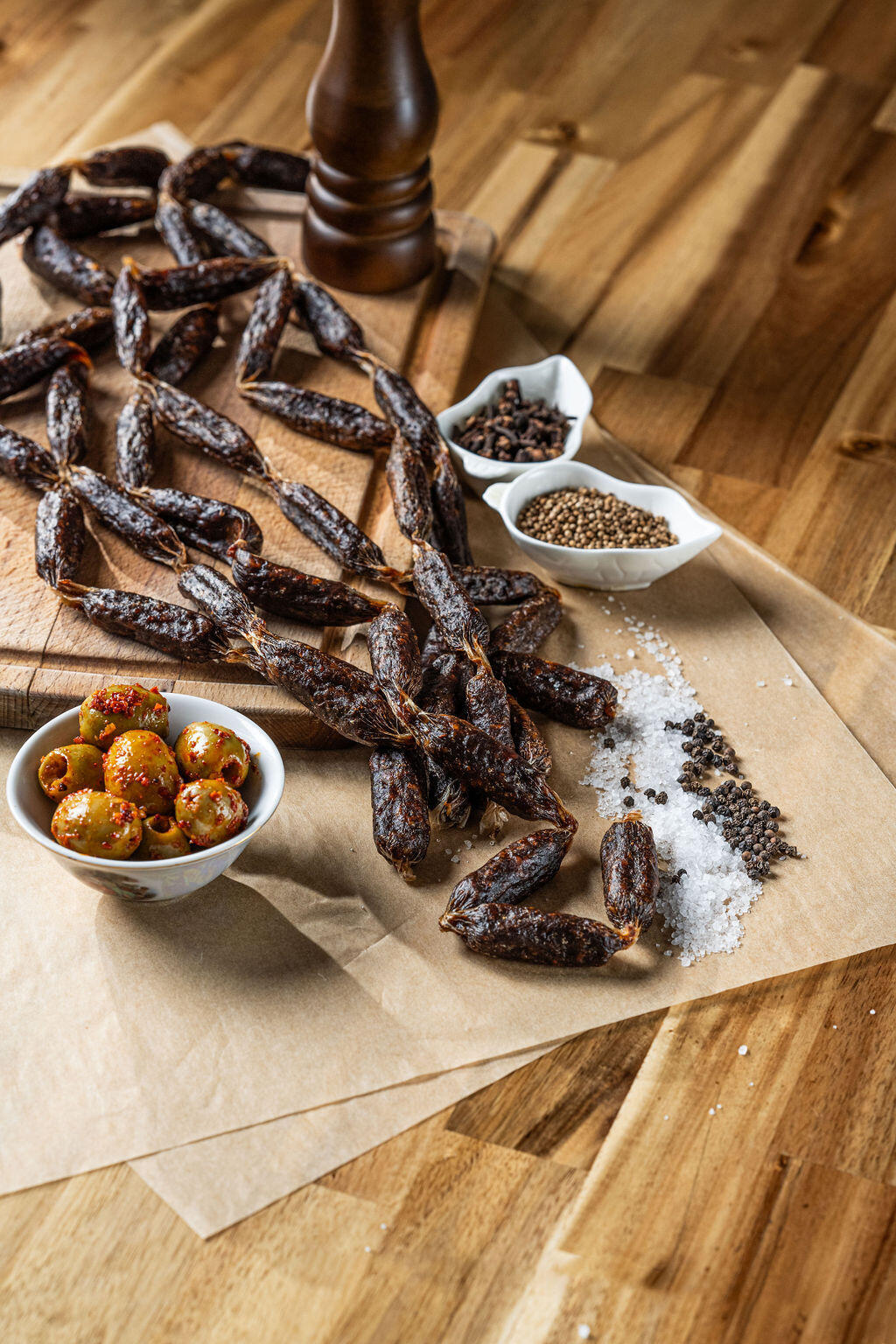
Gadi's dried meat
(Photo: PR)
“I Never Skip the Meatballs at Ikea”
Before he opened a dried meat factory, Blau spent 15 years in the industrial kitchen of Ikea, where he served as the chain’s chef in Israel. He started with the first branch in Netanya and later expanded to Ikea branches in Kiryat Ata and Rishon Lezion.
He did not just cook. He had to navigate strict international standards alongside the complex local reality of kosher requirements, ingredients that were not always available in Israel and the demanding Israeli palate. Ikea’s famous meatballs may look simple, but behind them, he says, is an entire culinary engineering process aimed at adapting a global recipe to the needs of a specific market.
At home, far from the rules and protocols, he began making his own sausages. That is where his passion to run his own business was born.
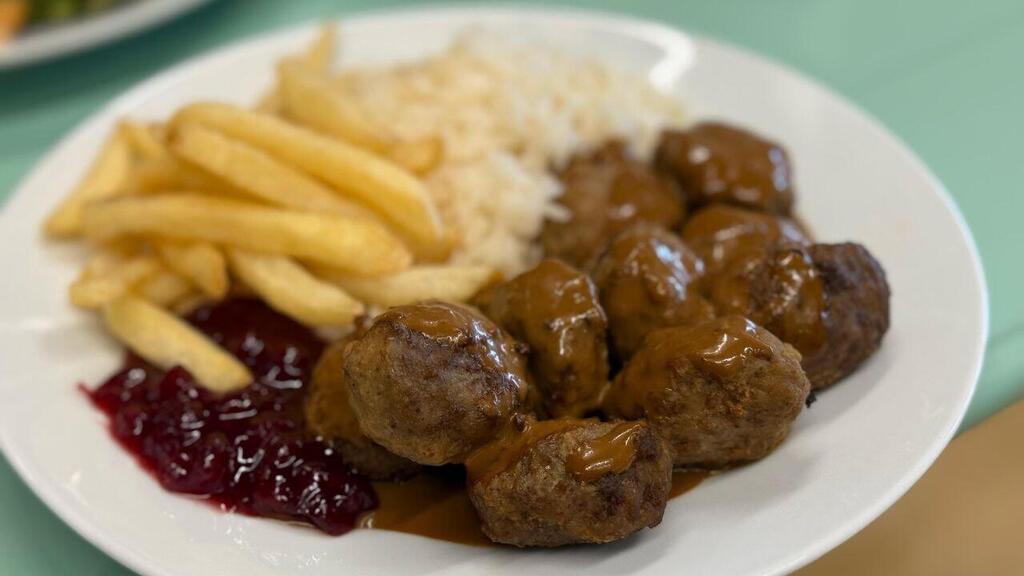
The food at Ikea
(Photo: Sapir Gordo)
What did your experience at Ikea teach you?
“When you feed tens of thousands of people a day, there is no room for mistakes,” he says. “Every gram, every spice, every minute of cooking, everything has to be precise. At Ikea, I learned to think about food as a product: not only how it tastes, but also the consumption experience, the price and production capacity.”
“The whole food operation at Ikea began as a challenge because we had to work under the chain’s international definitions, and because the menu included dishes that were Swedish at their core, such as the popular Swedish meatballs, which were not kosher, and we needed a kosher product. I worked a lot on developing parve (neither meat nor dairy) sauces, and I went through a lot with the food at Ikea. But to this day, when I go shopping there, I never skip the meatballs I turned kosher.”
What is it like to own a business in Israel?
“It’s not simple, but it is a great source of pride,” he says. “Being a business owner in Israel today is not easy, especially when salaried employees have a comfortable life. But the satisfaction is enormous because we enjoy what we do. It’s difficult to strike out on your own and open a factory at that age, but we have the spirit and the strength. In any case, we are together 24 hours a day, at work and at home, and we are still married and in love.”