

Dr. Michal Kreitler, 55, of Tel Aviv, is a researcher and novelist, married and a mother of two, aged 24 and 21.
She holds bachelor’s and master’s degrees from Tel Aviv University’s School of Psychological Sciences and recently completed a doctorate examining the psychological characteristics of women undergoing fertility treatment. She has also written three novels.
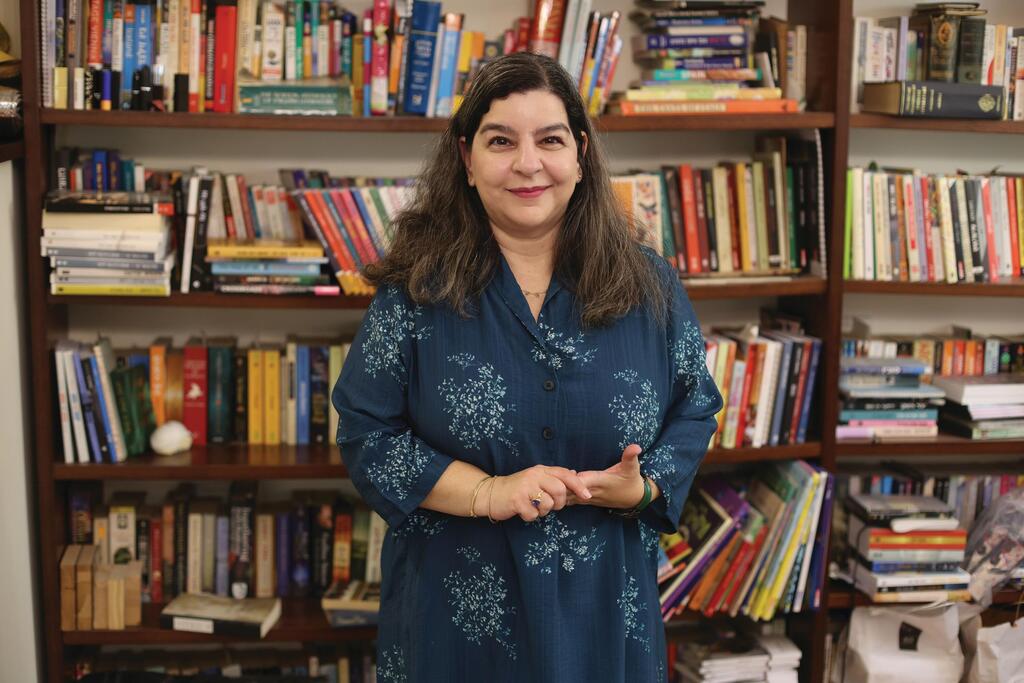
Dr. Kreitler, what did you study?
“I examined the psychological characteristics of women who successfully became pregnant following fertility treatment, according to the principles of cognitive orientation.”
What does that mean?
“It is a theory designed to predict and modify a broad range of behaviors, such as a tendency to be late, the chances of succeeding on a diet, persistence in physical exercise and even who will be good at chess.
“The theory was developed in the 1970s by Professors Hans Kreitler, who has since died, and Shulamith Kreitler, and has been successfully applied around the world.”
Kreitler, like your surname.
“It’s a long story. I worked with Prof. Shulamith Kreitler from 1993, when I was a second-year psychology student and she offered me a position as her research assistant. At the same time, completely separately, I met her son, Ron Kreitler. We met in a psychology class at university. When we married, she became my mother-in-law.
“After I finished my studies, I worked with her at Ichilov Hospital. My main job was coordinating research she conducted in different hospital departments, particularly oncology. We studied psychological profiles of patients with various illnesses. For each illness, we built a psychological profile of beliefs characterizing the patients, with the aim of developing psychological treatment that could support their recovery.
“At the same time, while studying for my master’s degree, I was trying unsuccessfully to become pregnant. After a year, I began fertility treatment at Ichilov. During treatment, I met other women undergoing fertility treatment and saw that some became pregnant after only a few cycles while others had a much longer journey, even though their medical conditions were similar.
“I asked myself why that happened, but at the time I didn’t have the tools, knowledge or authority to do anything with the question. I was also occupied with my own attempts to become pregnant.”

From the study’s findings: ‘Persevere and keep trying, even when the journey is complicated and frustrating’
(Photo: Shutterstock)
When did you return to the subject?
“After I was already a mother of two and had completed my master’s degree. But it took several more years before the idea matured and I knew exactly what I wanted to do and how.
“In 2016, I enrolled in a doctoral program at Tel Aviv University. My doctoral supervisor was Prof. Shoshana Shiloh of the School of Psychological Sciences, and I conducted the research in the IVF unit at Ichilov, then headed by Prof. Fuad Azem.”
What did you want to examine?
“My research consisted of two parts. In the first, I examined what characterized women who succeeded in treatment. I conducted in-depth interviews, based on the cognitive orientation approach, with patients from different fertility clinics. I wanted to understand what success and failure in treatment meant to them.
“From about 20 interviews, I created a list of beliefs relevant to becoming pregnant following fertility treatment. I then approached other patients in the waiting room of Ichilov’s IVF unit and asked them to complete questionnaires I had developed based on those beliefs. A total of 141 women completed them.
“A year later, I contacted each one and asked whether she had become pregnant following treatment. I filtered the beliefs reported by the women who had become pregnant and created a new, relevant questionnaire.
“In the second stage, I posted an advertisement in the IVF unit saying I was looking for women for a study examining psychological characteristics associated with success in fertility treatment. Many women applied, and ultimately 91 participated in this part.”
How did the study work in practice?
“The participants were randomly divided into three groups. In the first group, I reviewed each woman’s questionnaire with her, and based on the results she received individual treatment aimed at adding beliefs considered relevant to becoming pregnant. Women in the second group also received individual treatment, but it was ordinary supportive psychological treatment addressing issues such as family or work problems.
“The third group received no treatment. All of the participants completed the questionnaire before the intervention and again three months later so we could see whether, and how, their psychological profiles had changed.”
What did you find?
“The results surprised us so much that we sent them for an additional statistical review. In the group that received the cognitive orientation intervention, 25 of 26 women became pregnant, or 96%. In the other two groups, pregnancy rates ranged from 55% to 65%. I demonstrated a very substantial increase in the pregnancy rate when the only difference was several conversations with these women.
“There was no hocus-pocus involved. I told them we had identified certain beliefs associated with success in fertility treatment, went through each woman’s questionnaire with her and looked at which specific beliefs needed strengthening.”
The findings described by Kreitler show an association within her study between the intervention and pregnancy rates. They do not establish that psychological factors alone determine whether IVF succeeds, and Kreitler herself strongly rejects interpreting the research as assigning responsibility to women whose treatment is unsuccessful.
Which beliefs were associated with success in fertility treatment?
“For example, persevering and making an effort even when the process is complicated and frustrating; responding flexibly rather than becoming attached to one particular path; thinking ahead to life after treatment and seeing the bigger picture; and, most importantly in my view, letting go of control and going with what happens.”
Does that mean women who fail to become pregnant are somehow responsible?
“Absolutely not!!! All of our beliefs exist for a reason. The fact that certain beliefs may not necessarily support success in fertility treatment does not mean they do not serve us very successfully in other parts of our lives. There is no need to damage or eliminate existing beliefs, but rather to add specific beliefs that can support success during fertility treatment.”
You are a mother of two thanks to fertility treatment. Looking back, did you recognize in yourself the beliefs associated with success?
“I think so. What is interesting is that it took about two and a half years of treatment before I became pregnant with my eldest, Yonatan, but about six months with Tamara. Very often, treatment for a second child produces faster results because those beliefs are already more deeply rooted.”
You have previously spoken about an agreement with your husband under which he would not take part in raising the children, although that changed over the years. Could the study’s findings suggest a connection between that agreement and your difficulty becoming pregnant?
“There is no connection whatsoever. None of the themes we found to be associated with becoming pregnant were related to the couple’s relationship at all.”
Did your mother-in-law, Prof. Shulamith Kreitler, help you during the research?
“The entire study is mine, but she was there for me throughout the process and answered every question. When you conduct research based on a particular theory, you sometimes have to guess what the person who developed the theory meant. In my case, I had 100% access to the person who created the theory, and she was willing to explain anything that came up.”
How long did you work on your doctorate?
“About eight years, on and off. There was a two-year interruption during the COVID pandemic, when hospitals were closed to research. But I used the time to publish two books, Burned Edges and Year Seven. I wrote the third, Neta Is Not Dead, while finishing the research.”
Can you compare the excitement of publishing a book with having your doctorate approved?
“It’s a completely different story. The research involved a great deal of hard work, but the measures are objective. When you publish a book, you yourself are standing in the town square and people can have all sorts of feelings about it, and about you. There is nothing objective about that.”
So what now? Will you continue researching?
“I have made my contribution to science. Now I’m going to focus on writing books. I have four more on the way.”
What would you advise women undergoing fertility treatment who are struggling to become pregnant?
“Let go of control. Allow things to happen the way they need to happen, and remember that every step and every failure brings you closer to the moment when you succeed.”