

Ever since she could remember, Ghadir Saleh, 20, from the Druze city of Maghar, in Northern Israel, dreamed of becoming a violinist.
"I've been playing since I was nine years old. I represented Israel on several international delegations around the world, and I never imagined I would pursue anything other than music," she said.
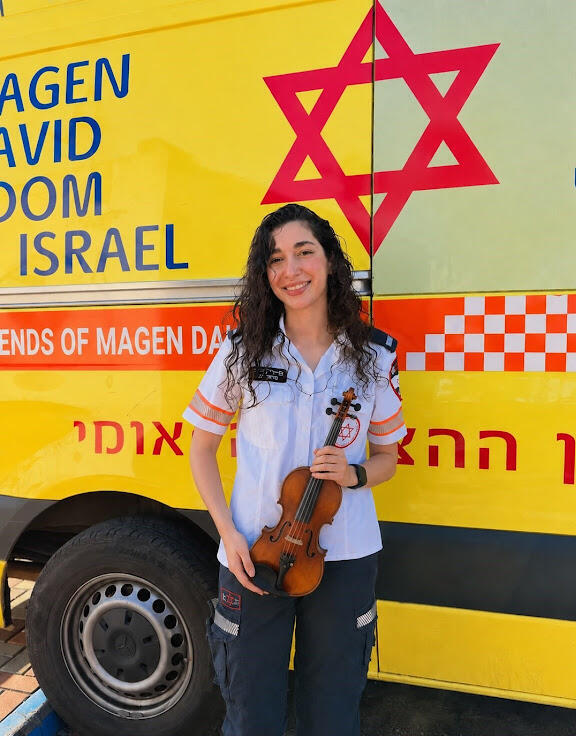
Ghadir Saleh, 20, from the Druze city of Maghar
(Photo: Magen David Adom)
After high school, she worked with the Ministry of Education, teaching violin to at-risk youth and children on the autism spectrum. But a medical recommendation to significantly reduce strain on her hands forced her to reconsider a future in professional music.
"The news devastated me. I went through a very difficult period and had no idea what I would do next," recalls Ghadir.
The uncertainty she felt led her to reflect on another pivotal moment in her life, a serious accident she experienced at age 16. "When I was injured in the accident, the people around me didn't know how to help. They didn't even know they should call 101, MDA's emergency hotline," she said. "Throughout my recovery, which involved countless hospital visits and medical examinations, I kept thinking about how important it is to know what to do in situations like that."
That experience, combined with the need to find a new path after stepping away from music as a full-time career, inspired Ghadir to pursue emergency medicine. "I felt completely lost after being told I wouldn't be able to pursue performance music as my primary career. Almost immediately, I began thinking about how I could help people and do something meaningful that I loved," she explained.
She enrolled in MDA’s paramedic training program as part of her national service, describing it as both demanding and formative.
“The course is intensive and demanding, but it’s designed to prepare us for the realities and challenges we’ll face as paramedics in the field,” she said. “As someone who grew up quite sheltered, it was difficult to live away from my parents and adjust to an independent lifestyle. At the same time, it pushed me out of my comfort zone, helped me grow as a person, and allowed me to build strong connections with my fellow trainees. We became like a family, and I left with friendships that will last a lifetime.”
Today, Saleh serves on MDA mobile intensive care units, responding to emergencies across Israel. She says she has received strong support from both her family and her Druze community, even as some initially questioned her choice of profession.
“I receive so much love and support from my community, especially when people see me in my MDA uniform,” she said. “When I first completed the paramedics course and came home, some people asked me, ‘Why do you need this? It’s dangerous.’ But I always say that this is what I want to do. I want to help people and save lives. The Druze community is known for being traditional, but in the end, it doesn’t matter what religion I am or what religion my patient is. It’s about one person helping another.”
While she has stepped back from professional violin performance, Saleh says music remains part of her life and that her new career has given her a different sense of purpose.
“Slowing down my violin playing opened the door to a new world that fascinates me just as much, and I fell in love with it,” she said. “I feel an incredible sense of fulfillment in serving my country and helping others. What means the most to me is the support I receive from my family.”
She added that her mother, in particular, takes pride in her work on the front lines of emergency care.
“Some of my relatives are very religious, and they are incredibly proud of me. My mother always jokes that her pampered little girl has been entrusted with such great responsibility. Every time she sees me in uniform, her face lights up with pride. Whenever I come home from a shift, she’s eager to hear about the people I helped and the lives I touched. Knowing that I was there for those people is what brings me the greatest satisfaction,” Saleh said.