

Ever since Albert Einstein formulated the theory of general relativity, black holes have remained among the most fascinating, extreme and mysterious phenomena in the universe. Now, a major mathematical and physical breakthrough has finally settled one of the field’s longest-running questions: Can several black holes exist together in a perfectly static equilibrium — fixed relative to one another, without moving closer, merging or changing their motion? The answer, now conclusively proven, is no.
To understand the significance of the discovery, it is necessary to go back to the 1970s. Leading physicists, including Stephen Hawking and David Robinson, established what are known as the “no-hair theorems,” a set of results in general relativity showing that a stable black hole can be described by a very small number of physical properties, chiefly its mass and angular momentum and, in more general cases, its electric charge.
Gallery
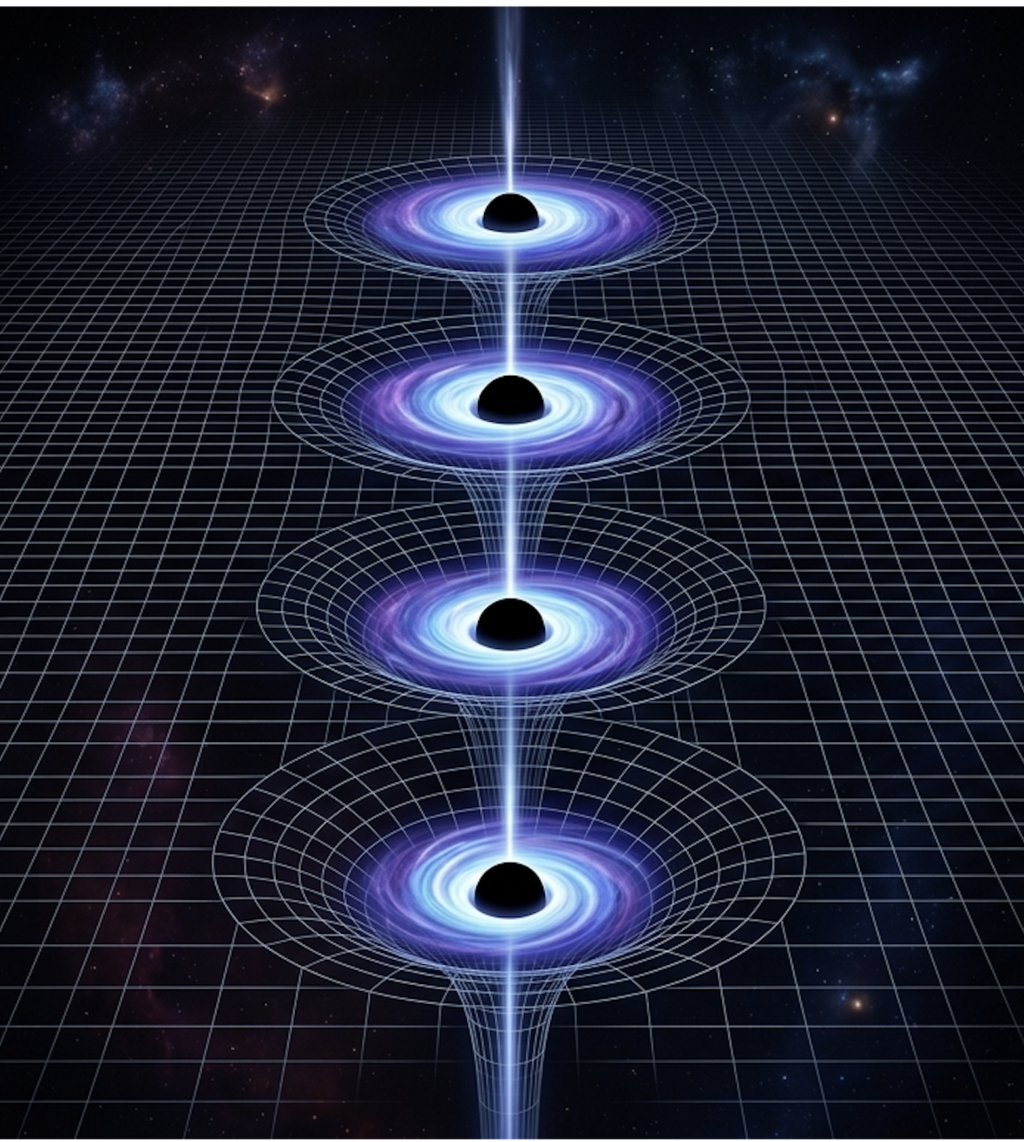
Several black holes rotating along a common axis
(Illustration: Generated using artificial intelligence)
These theorems established that an isolated, stable black hole is a relatively “simple” object, characterized essentially by its mass and rate of rotation, or angular momentum.
Such a black hole can be imagined as a perfect cosmic spinning top rotating undisturbed around its axis in a state of eternal equilibrium — what is known in physics as the Kerr solution, the mathematical solution to Einstein’s equations describing a rotating, electrically neutral black hole. It is one of the central solutions in general relativity.
That understanding worked well for a single black hole but gave rise to a question that occupied the scientific community for half a century: What happens when several black holes are placed one above another along the same axis of rotation?
Could two or more black holes rotate around exactly the same axis while maintaining a fixed distance from one another forever in a constant state of equilibrium, without being drawn together and colliding? For decades, scientists had no definitive mathematical proof answering that question.
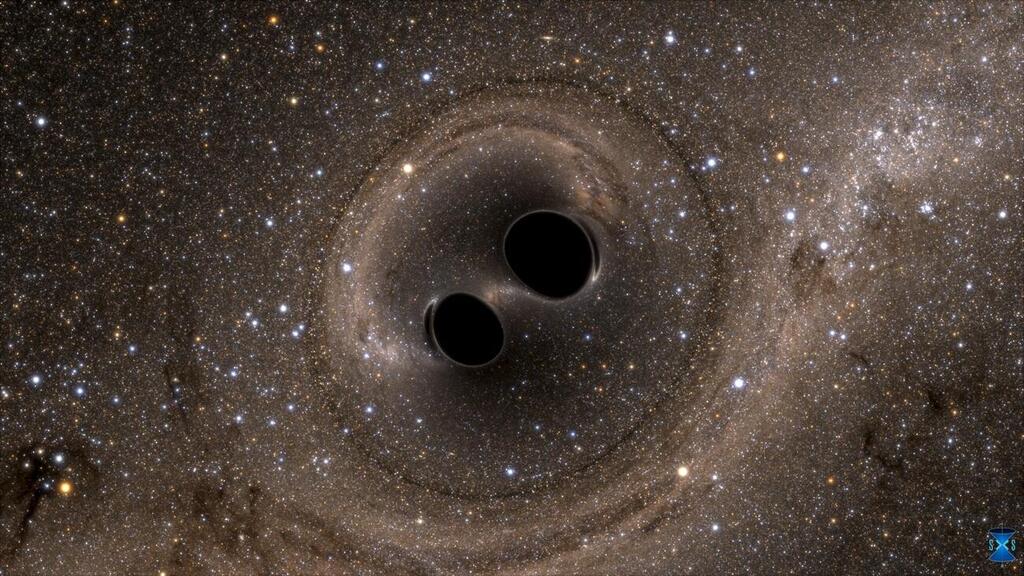
Simulation of a black hole merger
(Illustration: LIGO Laboratory/Reuters)

Albert Einstein, father of the theory of general relativity
(Photo: AP)
Now, an international team of researchers, including Prof. Gilbert Weinstein of the Department of Mathematics at Ariel University, has achieved a major breakthrough and solved the mystery.
“Through an in-depth mathematical analysis of Einstein’s vacuum equations — equations that describe the geometry of spacetime in regions where no matter is present — we proved the uniqueness conjecture: There is no stable, time-independent configuration of multiple black holes aligned along the same axis of rotation,” Weinstein said.
The researchers showed that once more than one black hole is present in such a system, the forces between them cannot cancel each other out.
“Along the common axis of rotation connecting them, there is always a net attractive force,” Weinstein said. “This means they cannot remain ‘suspended’ one above the other in a static state of equilibrium. The unbalanced gravitational force between them will inevitably cause the system to change and evolve dynamically, such as through mutual collapse and merger.”
The discovery is not merely the solution to a complex mathematical problem but a milestone in understanding the fundamental laws of the universe.
It provides definitive proof that such equilibrium states cannot exist in systems containing multiple black holes, closes a significant gap in the study of general relativity and deepens scientific understanding of the dynamics between some of the most powerful objects in space.
“The mystery was first presented to me by my doctoral adviser, Prof. Demetrios Christodoulou, about 40 years ago,” Weinstein said. “Now that it has been solved, it represents a meaningful closing of the circle for me.”