

If you had told the young child from the kibbutz, born in a tent and raised in tough conditions, that one day the minister of education would call him to announce that the State of Israel had chosen him for its highest honor, he would likely have burst out laughing.
That child grew up to become Prof. Reshef Tenne of the Weizmann Institute of Science, who was awarded the prestigious Israel Prize for Chemistry and Chemical Engineering this year's Independence Day.
Gallery
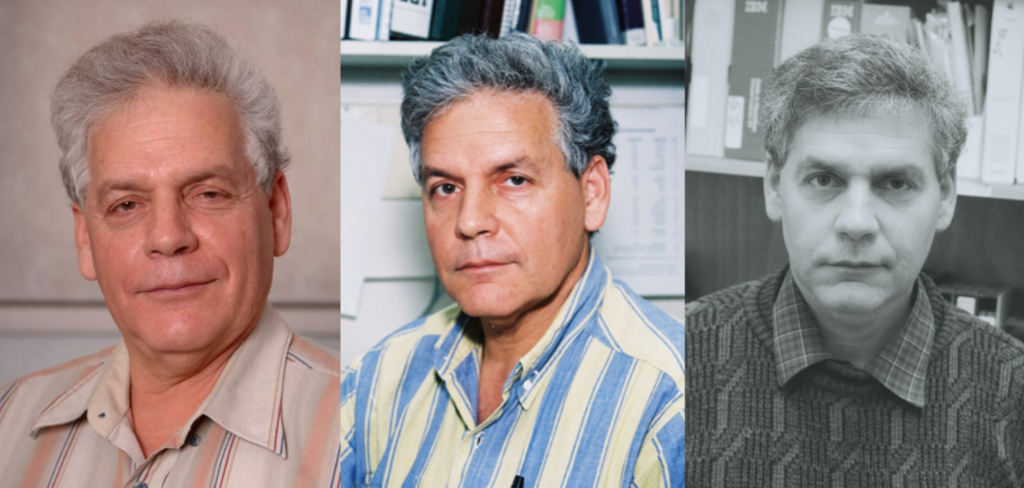
'Reshef Tenne is one of the most important and distinguished figures in Israeli science' — Tenne over the years
(Photo: Weizmann Institute Archive)
“Reshef Tenne is one of the most important and distinguished figures in Israeli science,” the prize committee wrote. “He has made an extraordinary contribution to materials research and to physical and inorganic chemistry, and over the course of decades, he has led a scientific revolution in the field of two-dimensional nanomaterials. His work has helped secure Israel’s place at the forefront of global scientific research.”
Tenne’s breakthrough came in the early 1990s, after more than a decade of work on solar cells, which absorb sunlight and convert it into electricity. Until then, scientists working at the nanoscale had focused on tiny closed carbon structures such as spheres and nanotubes. Drawing on an older idea, Tenne was the first to show that closed structures could also be created from two-dimensional sheets of inorganic materials—that is, materials containing no carbon at all. Here too, the structures most commonly take the form of spheres and nanotubes.
To appreciate the significance of these materials, imagine trying to drag a large wooden board across a rough sidewalk. It would be difficult and exhausting. But place thousands of tiny marbles or miniature rollers underneath it, and the board would glide forward almost effortlessly. That is how Tenne’s basic discovery became an applied technology: the nanospheres and nanotubes developed in his laboratory—molecular structures measured in billionths of a meter—gave rise to commercial lubrication technologies. Today, products based on this work are used in the oil and machinery industries and even in medical applications.
A family legacy
Tenne’s parents were both highly educated. His father, Daniel (Danche) Tenne, originally Tannenbaum, was born in Pinsk, Belarus. He attended the Hebrew Gymnasium and learned several languages. Later he moved to Warsaw, where he met Shoshana Hermelin, a young Jewish woman who was then nearing the end of her doctoral studies at the University of Warsaw. At the same time, Daniel was among the founders of the Zionist youth movement in Belarus and Poland.
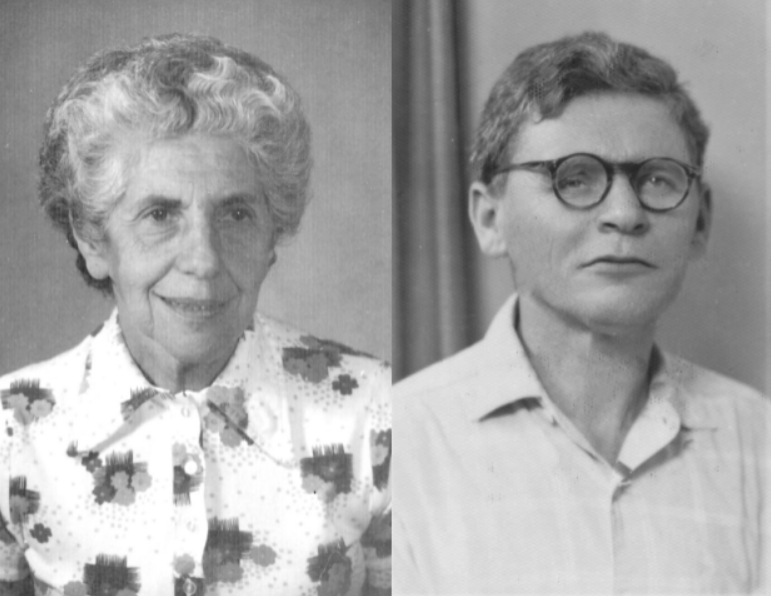
Both of Tenne’s parents were highly educated. His father, Daniel, studied at the Hebrew Gymnasium and learned several languages. Later he moved to Warsaw, where he met Shoshana Hermelin, who was then nearing the end of her doctoral studies. Daniel and Shoshana
(Photo: Usha Kibbutz website)
In 1934, they immigrated to Israel, married and settled in Magdiel—now part of the city of Hod HaSharon. Two years later, they were among the founders of Kibbutz Usha in the Zevulun region, near Haifa. It was the first kibbutz established by the Zionist youth movement, named after the ancient Jewish city of Usha, whose ruins lie not far from the site. Their three children, Ruthie, Reshef and Reuven, were born there.
Life in the young kibbutz was not easy. It involved grueling farm work and draining swamps. For a time, the Tenne family lived in a shack, but shortly before the birth of their second son in September 1944, they gave it up to make room for newly arrived immigrants. As a result, Reshef was born in a tent.
Economic hardship persisted in the years that followed, alongside a rich cultural and educational life. Reshef attended the kibbutz’s joint school and later the Zevulun regional high school, where he had the good fortune to study with outstanding teachers. Among them were the biology teacher Chaim Hadomi, who would later become a professor and head of Oranim Academic College, and the chemistry teacher Dr. Avraham Lipshitz. They, along with others, instilled in him a deep passion for science. Yet in keeping with the norms of kibbutz education at the time, he did not graduate from high school with a matriculation certificate.
After finishing school, Tenne spent a year of service at Kibbutz Gezer near Rehovot, and then enlisted in the paratroopers. In 1964, while he was still in uniform, his father died of a heart defect he had lived with all his life. Toward the end of his military service, Tenne began completing his matriculation exams and ultimately received his certificate at age 22. To earn some money, he worked as a tractor driver in the Sharon orchards.
Excellence under challenging conditions
With the high school diploma he earned through tremendous effort, Tenne enrolled in a chemistry bachelor’s degree program at the Hebrew University of Jerusalem. He later described the day he was accepted into the program as one of the happiest days of his life.
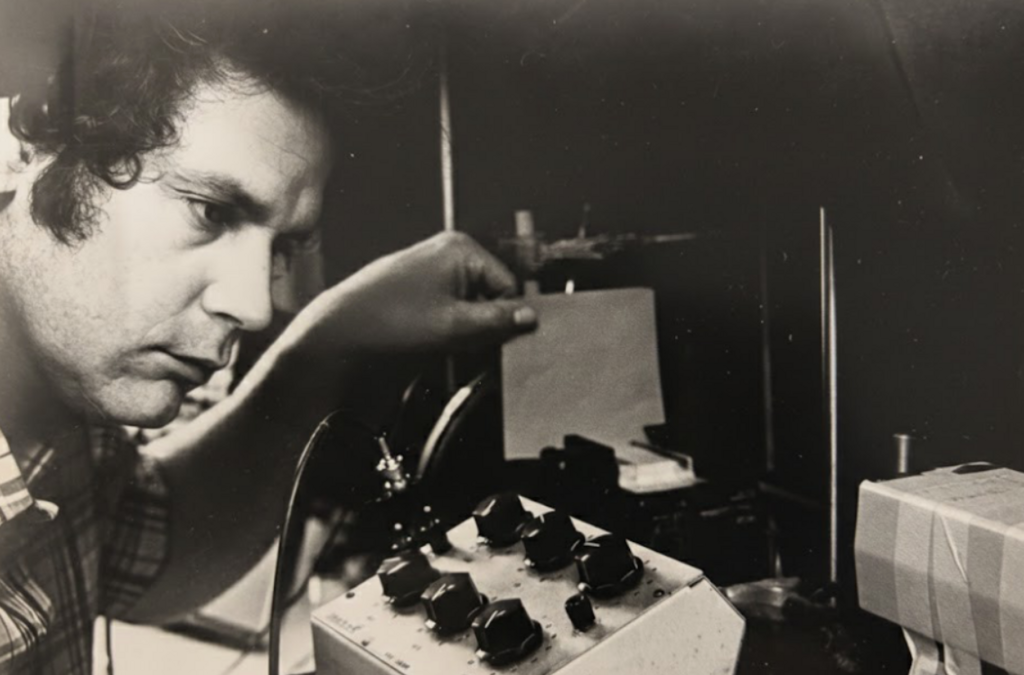
He later described the day he was accepted to the program as one of the happiest of his life. Tenne in the lab in the 1970s
(Photo: Courtesy of the family)
His studies were far from easy. Tenne had to overcome gaps in his formal education, particularly in his command of the English language, and worked hard to keep up in his first-year courses. To pay for his studies, he worked nights and gave private lessons during the day, and the exhaustion took its toll. Reserve duty during the Six-Day War made things even harder. Nevertheless, Tenne completed his bachelor’s degree with honors.
“I was very persistent. I can say that it’s a trait that has stayed with me throughout my life and still does to this day. I never cut myself any slack,” he said.
Remarkably, of the 120 students in Tenne’s class, seventy went on to pursue Ph.D.s. The most outstanding among them, including Tenne himself, later became professors: Amiram Goldblum at the Hebrew University, Rafi Lamed at Tel Aviv University and Avigdor Shafferman, who went on to serve for many years as director of the Israel Institute for Biological Research.
Upon completing his degree in 1969, Tenne consulted Prof. Gabriel (Gabi) Stein about his future career path. Stein suggested that Tenne pursue a master’s degree in physical chemistry under his supervision and that of his student Yehuda Haaz, focusing on the study of solar cells.
Although the field was still in its infancy and the research methods were fairly outdated and rudimentary, Tenne excelled. During his master’s studies, he published his first scientific paper in the journal of the Israeli Chemical Society. The research focused on europium, an element that emits electrons when exposed to ultraviolet light. In this case, instead of being used to generate an electric current, as in the photovoltaic cells found in household solar panels, the electrons reacted with nearby water molecules. The reaction released hydrogen gas, effectively turning the solar cell into a kind of fuel-producing reactor.
At the end of his master’s degree, Tenne once again found himself at a crossroads, wondering whether to continue in academia. He became increasingly interested in theoretical chemistry, perhaps in part because he felt the need to strengthen his mathematical skills. In the course of that search, he met, among others, Arieh Warshel and Michael Levitt, who were beginning to develop computational tools to understand how proteins fold. Tenne was less drawn to this field and continued to search for his direction. Warshel and Levitt later shared the Nobel Prize in Chemistry with Martin Karplus.
Ultimately, Tenne’s search led him back to the Hebrew University, where he began a Ph.D. under the supervision of Prof. Arieh Ben-Naim, who worked on the statistical mechanics of solutions. But his research soon ran into a serious obstacle when Ben-Naim went on an extended sabbatical. Tenne continued his studies under the guidance of Prof. Shalom Bar. His doctoral work was beset by difficulties, and only after three years did he achieve a breakthrough in his research, which focused on the theory of hydrophobic, or water-repelling, solutions.
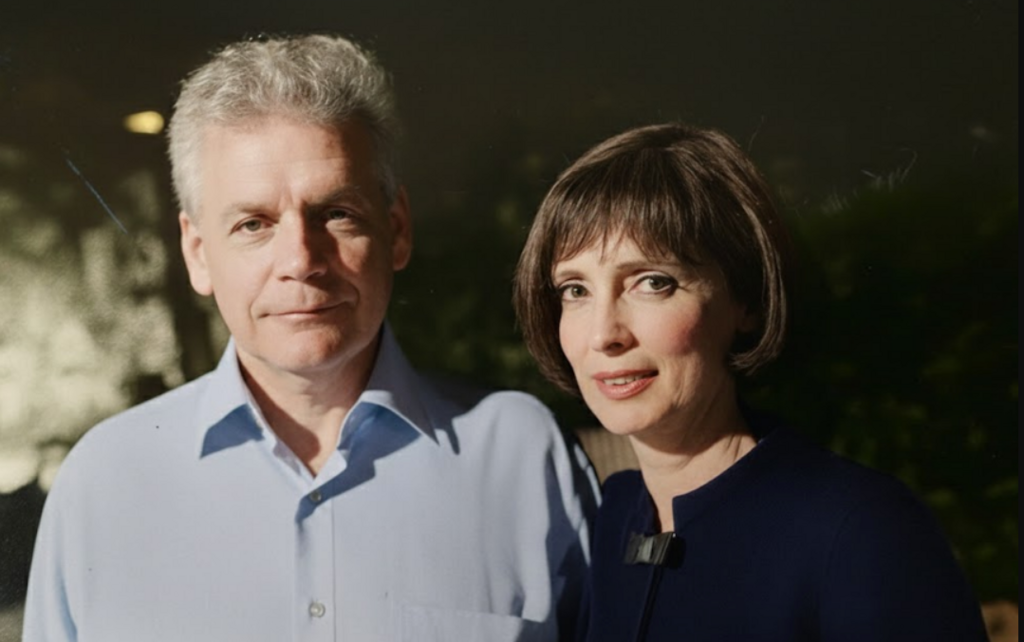
During his doctoral studies, Tenne married Leah Jonas, who studied and taught history at the Mount Scopus campus of the Hebrew University. Reshef and Leah
(Photo: Courtesy of the family)
During his doctoral studies, Tenne married Leah Jonas, who studied and taught history at the Mount Scopus campus of the Hebrew University in Jerusalem and later led the adult education program in Rehovot. The couple had three children: Dana, Tal and Ron.
Layers upon layers
The difficulties he faced during his Ph.D. left Tenne feeling that he had exhausted his path in theoretical chemistry and would be better off returning to the laboratory. He therefore accepted an invitation to work in the lab of Erich Bergmann at the Battelle Institute in Geneva. There he studied rechargeable batteries and models of lead-acid car batteries—nearly fifty years before today’s advanced electric vehicles. But once again, bad luck intervened: Battelle’s Swiss branch closed, Bergmann moved into the watchmaking industry, and Tenne found himself back at square one.
Once again, he had to search for a new path, but his inquiries to research institutions in Israel were all turned down. He decided to return to experimental work on solar energy and europium. A research proposal he sent to Joost Manassen, founder of the Department of Materials and Interfaces at the Weizmann Institute of Science, was eventually accepted.
Thus, in 1979, Tenne was invited to join Manassen’s lab, which was working on solar cells based on thin films of cadmium telluride and cadmium sulfide. Tenne and his colleagues developed a method for improving these layers, dramatically increasing the cells’ efficiency. At the time, they were considered the best thin-film solar cells in the world.
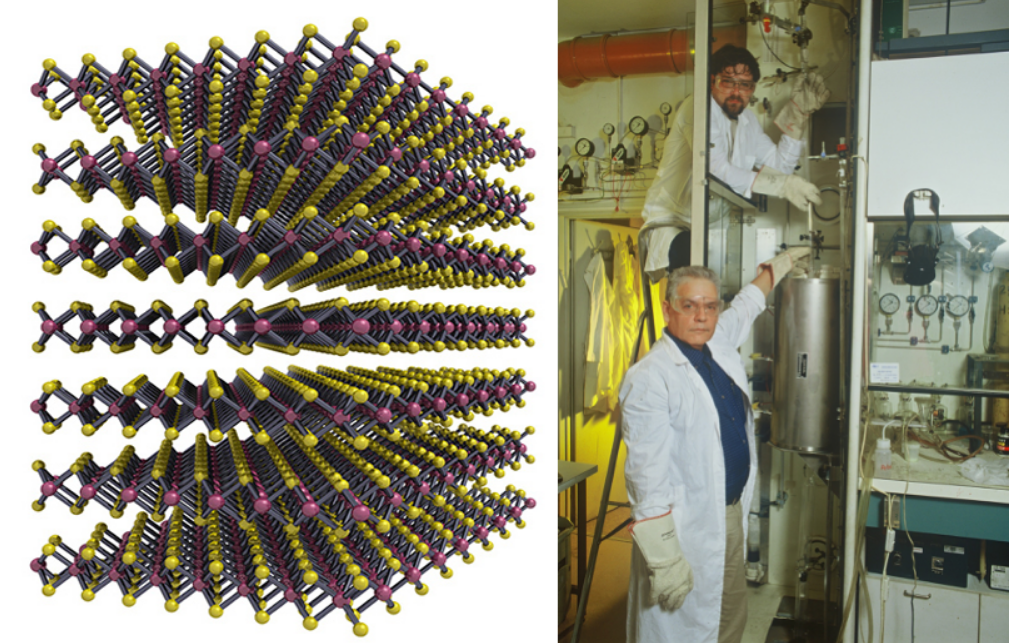
After joining the Weizmann Institute’s research staff, Tenne focused on layered materials. Illustration of molybdenum disulfide layers alongside an image of Tenne in the lab
(Photo: Weizmann Institute Archive, Shutterstock, ogwe)
After joining the Weizmann Institute’s research staff, Tenne focused on layered materials, also known as two-dimensional materials: substances with a periodic structure made up of layers that are only weakly bonded to one another. He initially explored the connection between these materials and solar cells. After being promoted to associate professor in 1985, he turned to creating new layered materials using chemical and electrochemical methods.
For this work, Tenne brought the first scanning electron microscope (SEM) to the Weizmann Institute at the enormous cost of $350,000. Because of the expense, it was decided that the microscope would be made available to other research departments as well, leading to the creation of the Faculty of Chemistry’s Department of Chemical Research Support, which remains in operation today.
A new calling
In 1991, during a sabbatical in Tokyo, Tenne came across a paper by Japanese scientist Sumio Iijima, who was studying carbon nanotubes—tiny structures made of one or more layers folded into a tube-like form. Rolled sheets of graphite, the black carbon material found in pencil lead, are one example.
“I told myself that if graphite, a two-dimensional material, closes up into nanotubes because it is unstable in a flat form at the nanoscale, then materials like molybdenum disulfide should close up as well,” Tenne said. “I told Joost Manassen, ‘I know what I’m going to do for the rest of my scientific career.’”
In doing so, Tenne revived an old idea first proposed by the chemist Linus Pauling in 1930, that mineral layers could bend into complex and useful three-dimensional structures. The first material synthesized in this way was indeed molybdenum disulfide, which formed nanotube structures. These came to be known as inorganic nanotubes, to distinguish them from carbon nanotubes.
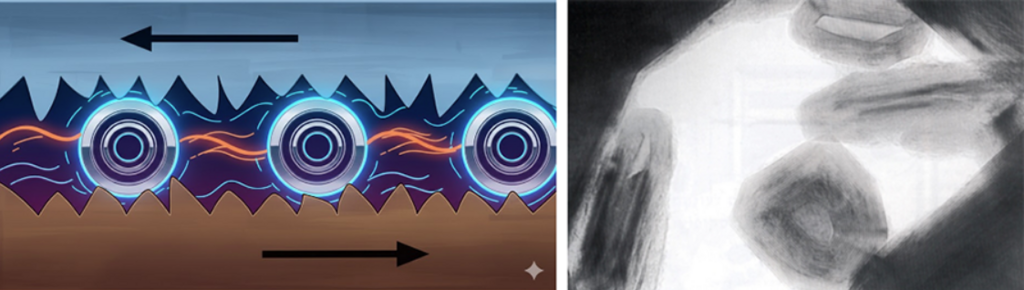
Tenne was interested not only in discovering and producing these new materials, but also in their practical potential. Right: fullerene-like tungsten disulfide. Left: an illustration of nanobearings made from this material, which prevent contact between surface protrusions and significantly reduce friction between moving machine parts
(Illustration: AI-processed image from the Weizmann Wonder Wander website)
Later, inorganic fullerenes joined the picture. A fullerene is a large molecule with a spherical shell, modeled on the geometric form known as a geodesic dome. Tenne’s main collaborator in the early stages of this research was Lev Margulis, then head of the transmission electron microscope (TEM) facility at the Weizmann Institute. After Margulis’s death, Ronit Popovitch-Biro took his place and has remained Tenne’s research partner ever since.
Tenne was not content merely to discover and produce these new materials; he also recognized the considerable practical potential of inorganic nanotubes and fullerenes. Inspired by the Romans, who used lead balls to help move heavy stones at construction sites, he proposed that tiny spheres made of molybdenum disulfide could serve as lubricants with an exceptionally low coefficient of friction. Today, three companies market innovative lubrication technologies based on this idea.
A rich legacy
Over the course of his long career, Tenne mentored many students who went on to hold senior positions in both industry and academia, among them Gitti Frey and Maya Bar-Sadan, as well as Alla Zak, dean of the Faculty of Sciences and head of the Laboratory for Synthesis and Investigation of Nanomaterials at the Holon Institute of Technology. After the death of his first wife, Leah, Tenne married Zak. Recently, the couple established a prize fund in Materials Research within the Israeli Vacuum Society.
Over the years, Tenne has earned growing recognition in his field, reflected both in major appointments and in numerous awards and honors. In 2000, he was appointed head of the Department of Materials and Interfaces at the Weizmann Institute and served in that role for seven years. Among the distinctions he has received are the EMET Prize, the Rothschild Prize, the Mifal HaPais Michael Landau Prize, the von Hippel Award—the highest scientific honor conferred by the Materials Research Society and the most prestigious international prize in materials science—and now the Israel Prize. He was also among the founding members of the Materials Research Society (MRS).
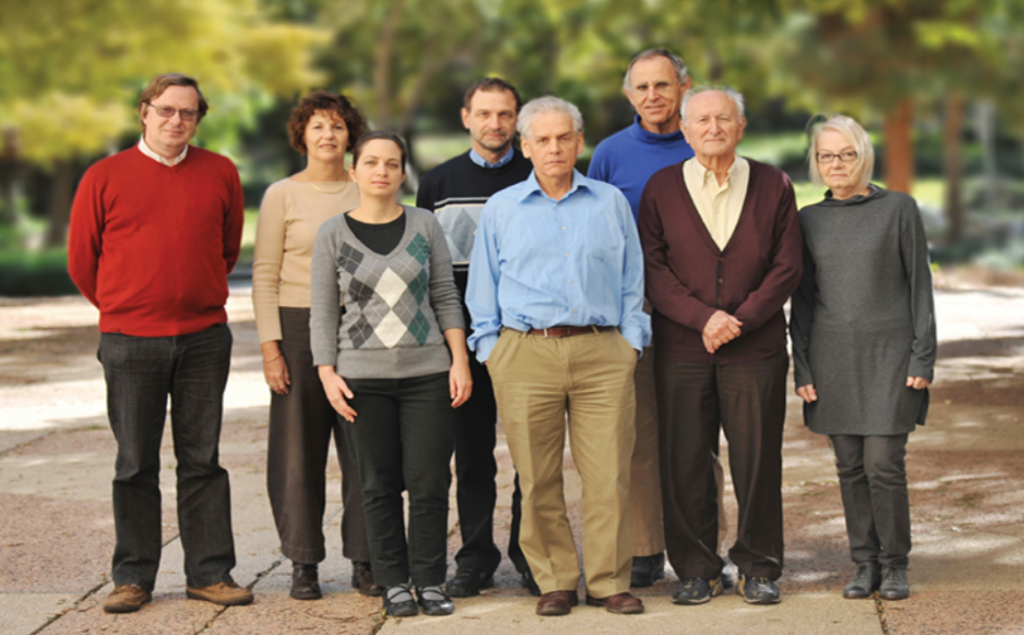
Over the course of his career, Tenne mentored many students who went on to prominent positions in both industry and academia. From right: Dr. Anna Albo-Yiron, Prof. Moshe Levy, Prof. Jeffrey Gordon, Prof. Reshef Tenne, Prof. Daniel Feuermann, Prof. Maya Bar-Sadan, Dr. Ronit Popovitch-Biro, and Dr. Eugene Katz
(Photo: Weizmann Wonder Wander website)
Over the past decade, he has been a member of the Israel Academy of Sciences and Humanities and has chaired the committee responsible for the Report of the State of the Sciences in Israel, which submits a detailed assessment every few years to the president of Israel on the state of the country’s research and academic enterprise.
In a message to the next generation and to those shaping science policy, Tenne said: “I try to instill in students dedication to their goals and the professional discipline to ask interesting questions. I also emphasize that there is plenty of room for high-level research in industry, and most of my graduates went into industry—and I am proud of that. […] Research costs money, and it is becoming more expensive, but if we want to be an enlightened and advanced country, there is no alternative but to strengthen research and give young people the tools to move forward.” One of those young people is his son Ron, a researcher in the Faculty of Chemistry at the Technion.
We extend our warmest congratulations to Reshef Tenne on receiving the prize and wish him many more years of fruitful work, curiosity and creativity.