

Researchers at the Hebrew University of Jerusalem say they have overcome one of ice’s biggest weaknesses, creating a new composite material that is 10 times stronger under compression than ordinary ice and capable of absorbing 70 times more energy before breaking.
The material, called BioPykrete, combines ice with plant-derived cellulose nanocrystals and an engineered protein that acts as a molecular glue. The researchers say the approach could eventually provide a basis for greener construction and durable infrastructure in some of the coldest regions on Earth.
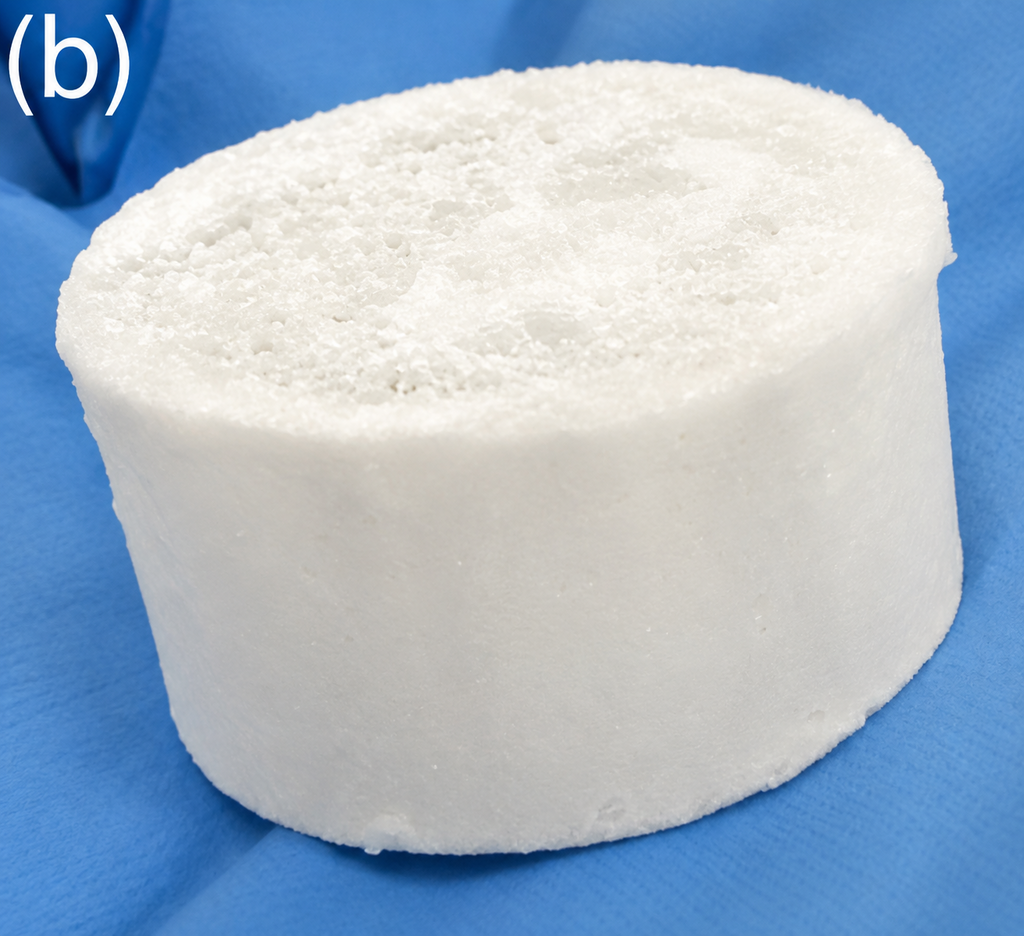
Ice is cheap, abundant and surprisingly strong, but it has a major drawback: cracks can spread rapidly through it, causing it to fracture suddenly and without warning. The new study, led by Prof. Ido Braslavsky of the Hebrew University’s Faculty of Agriculture, Food and Environment, set out to change the way ice fails.
Published in the scientific journal Colloids and Surfaces B: Biointerfaces, the study found that BioPykrete was about 10 times stronger under compression than ordinary ice, bringing its strength close to that of standard concrete. It was also able to absorb around 70 times more energy before breaking.
The concept builds on an idea dating back to World War II, when researchers experimented with Pykrete, a mixture of ice and wood pulp that was stronger than ordinary ice and melted more slowly. The Hebrew University team took that principle down to the molecular level.
The researchers added cellulose nanocrystals, tiny rigid particles derived from plants, to the ice. During freezing, the particles formed a three-dimensional network around microscopic ice crystals. The team also engineered a protein whose one end binds to ice while the other attaches to cellulose, effectively serving as a molecular bridge between the two materials.

Prof. Ido Braslavsky during an earlier study
(Photo: Prof. Ido Braslavsky)
According to the researchers, when a crack forms in ordinary ice, it can spread quickly through the material. In BioPykrete, however, the cellulose network and molecular bonds create physical obstacles that slow the crack, redirect its path and prevent it from expanding as easily.
Adding the engineered protein doubled both the material’s strength and the amount of energy it could absorb compared with a mixture of ice and cellulose without the protein.
“We wanted to go beyond simply mixing fibers into ice and control how the different materials connect at the molecular level,” Braslavsky said. “The result changes not only the strength of the ice, but also the way it breaks. Instead of shattering suddenly, the material can absorb a large amount of energy and deform gradually.”
The researchers say the material could eventually have applications in infrastructure and construction in Arctic and Antarctic regions, where transporting conventional materials such as concrete and steel is expensive, logistically difficult and associated with a high carbon footprint.
Because BioPykrete is composed mainly of ice and plant-based materials, the team says it could offer a biodegradable and more environmentally friendly alternative for construction in extreme cold.
The researchers caution, however, that the work remains an initial proof of concept. Future studies will examine how the material performs over long periods, how it responds to repeated freezing and thawing cycles, and whether its strength can be improved further through new freezing techniques and additional engineered proteins.