

Pride for Israeli academia. The iGEM teams from TAU and the Technion received gold medals this month at the prestigious international competition held in Paris, which this year included over 400 teams from around the world.
The TAU team earned its medal for a breakthrough strategy aimed at developing a treatment for lung cancer patients who currently have no effective therapeutic options. The project reached the finals in both oncological research and model categories.
TAU project that won gold at iGem
(Video: TAU)


iGEM is a global competition in synthetic biology where teams conceptualize innovative ideas to address challenges in the field. These ideas are then realized through a combination of engineering, biological and computational tools, akin to a startup development process.
The judging panel consists of researchers and scientists with expertise in the field, many of whom are past iGEM participants or mentors. This year, over 400 teams from around the world competed.
This year, TAU’s iGEM team, as in previous years, included outstanding students from diverse disciplines such as engineering, life sciences, medicine and exact sciences. Working together, they conducted advanced research in synthetic biology.
Guided by Professor Tamir Tuller of the Faculty of Engineering, this year’s team developed a strategy addressing five major challenges involved in treating metastatic lung cancer in particular and cancer in general.
1. Targeted drug delivery: One of the main challenges in the pharmaceutical world is how to deliver a drug precisely to the intended tissue.
2. Incomplete eradication of cancer cells: Most advanced-stage cancer treatments rarely eliminate all cancer cells. Even a few remaining cells can proliferate and return in a more aggressive form.
3. Identifying cancer cells: Many current biological treatments identify cancer cells based on mutated proteins typically located on the cell membrane. However, some mutations do not alter membrane proteins or affect only non-membrane proteins.
4. Trial and error in drug development: Unlike in engineering disciplines, drug development today still relies heavily on trial and error.
5. Genetic variability between patients: Standard strategies struggle to address the high variability in cancer-related mutations among different patients, making it difficult to find one-size-fits-all solutions.
To illustrate their approach, the team likened the battle against cancer to a game of chess. Their proposed solution involves a DNA sequence designed to silence a cancerous gene, attached to an antibody capable of penetrating cancer cells. The components were developed using a variety of computational strategies and innovative algorithms.
Following their success in the competition, the team filed a patent application through Ramot, Tel Aviv University’s technology transfer company, and will soon publish a scientific paper describing their development.
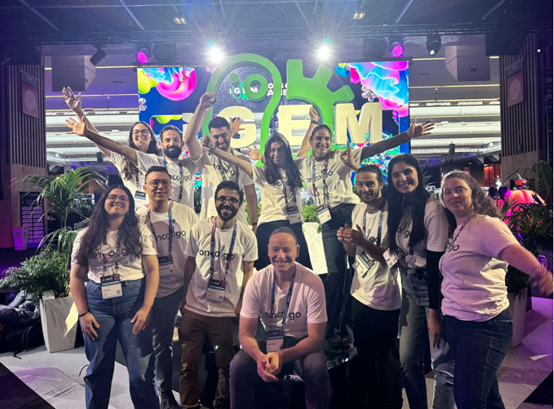
The team also drafted a detailed business plan to bring the product to market. Lonza, an international pharma and biotech firm impressed by the project, contributed to the team.
In addition to their scientific work, the team organized a nationwide synthetic biology competition for high school students in collaboration with the ORT high school network, drawing participation from hundreds of students.
The full team members for 2025: Shir Shance (co-captain, Biotechnology), Idan Eyni Galanti (co-captain, Biomedical Engineering), Michael Kovaliov (model team lead, M.Sc. applied mathematics), Ester Buderovsky (biology team lead, Medical Sciences), Ariella Nouman (Biomedical Engineering), Roni Zarakhovsky (Biomedical Engineering + Biology) Gal Aziel (Medical Sciences), Niv David (Biomedical Engineering + Biology), May Lieber (Biomedical Engineering), Din Saadon (Biomedical Engineering) and Hillel Charbit (Biomedical Engineering), Dr. Daniel Dovrat (team instructor, Engineering faculty).
The iGEM steering committee included Yair Sakov from TAU's Entrepreneurship Center, the team from Startup Nation Central, and Professors Martin Kupiec, Avigdor Eldar, Uri Gophna and Itai Benhar.
Professor Tamir Tuller summarized: “This year’s team was outstanding by every measure. I believe their innovations, including models and software, will have an impact not only in the field of lung cancer, but also for other cancer types, genetic diseases and foundational research in molecular biology and medicine. I would especially like to thank the team at Startup Nation Central for their expert guidance in entrepreneurship."
Gold for the Technion team as well
The Technion’s iGEM team also earned a gold medal and took second place in the Inclusivity Award category. Their innovative project developed a biotechnological system for producing stem bromelain, an enzyme vital to medicine, agriculture, cosmetics, food and textiles.
The Technion team presented a project focused on the synthetic production of stem bromelain, the main component in a complex enzyme mixture extracted from pineapple stems. Current extraction methods are costly, inefficient and dependent on plant availability and climate conditions.
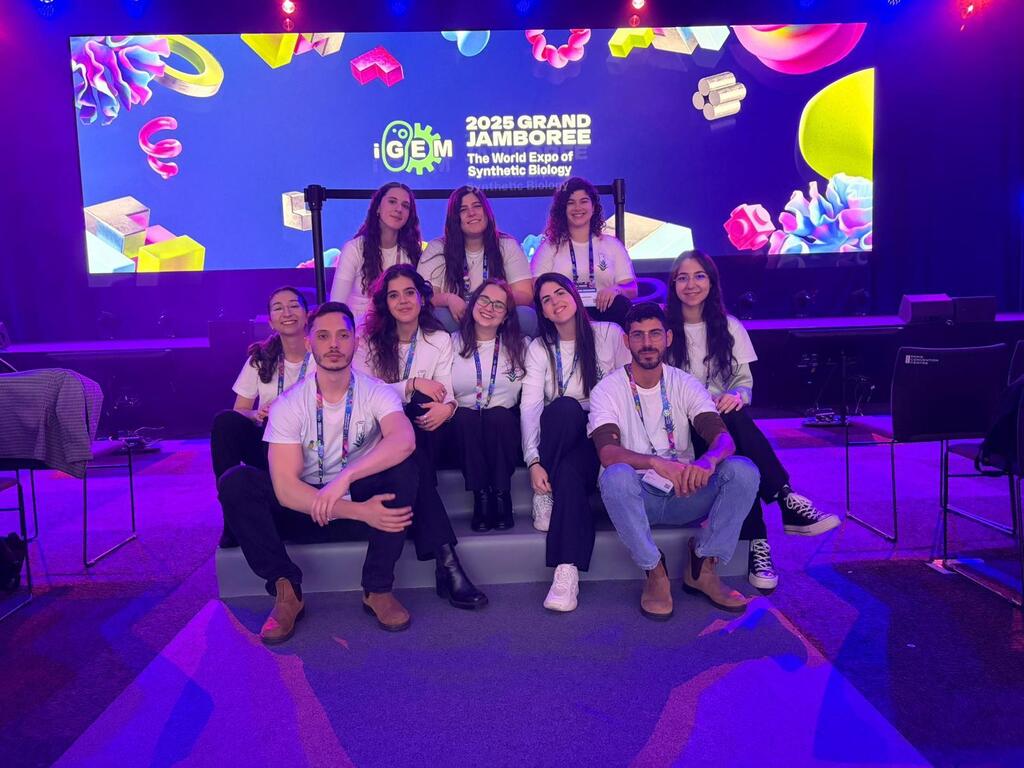
Technion team winning gold
(Photo: Technion)
To overcome these challenges, the team developed a system for producing stem bromelain using genetically engineered cells, supported by computational modeling and artificial intelligence. The result: streamlined production and purification processes, and potentially increased availability of bromelain for commercial use.
The iGEM competition was founded in 2004 at MIT to give students, primarily undergraduates, hands-on experience in scientific and applied research in synthetic biology. The first Israeli iGEM team was established at the Technion in 2012 under the mentorship of Professor Roee Amit from the Faculty of Biotechnology and Food Engineering, who continues to lead the team today. This latest achievement adds to a series of previous wins by Technion teams at iGEM.
Mai Ofek (team leader), Elinor Mor, Dekel Gibor, Noam Almog, Lihi Lavidor, Ofry Nothmann, Matilda Kuliminsky, Roni Vaizer (all from the Faculty of Biotechnology and Food Engineering), Leeyam Bat-El (dual degree in Biomedical engineering and Physics) and Ofri Leifer (Taub Faculty of Computer Science)