

The Iron Age in Britain, which began around 750 BCE and lasted until the Roman conquest in 43 CE, was marked by a surprising social structure: according to a new genetic study, men tended to leave their parental homes, while women remained close to their families of origin. Researchers analyzed DNA from 57 skeletons found in a burial chamber belonging to the Celtic Durotriges tribe in southwest England, as well as from additional skeletal remains from other sites. The findings reveal a surprising social pattern of matrilocality, where women stayed in their childhood communities while men arrived from other regions. This is the most comprehensive study to date for understanding the structure of Celtic society based on DNA samples, and it also draws on samples from previous studies.
To trace population movements, researchers sequenced genetic material from Iron Age remains at archaeological sites across Britain, comparing them with genetic data from both ancient and modern European populations. They found significant genetic overlap with populations from northwestern Europe, including France, Belgium, and the Netherlands — evidence of repeated migrations from the continent to the British Isles during this period.
Gallery
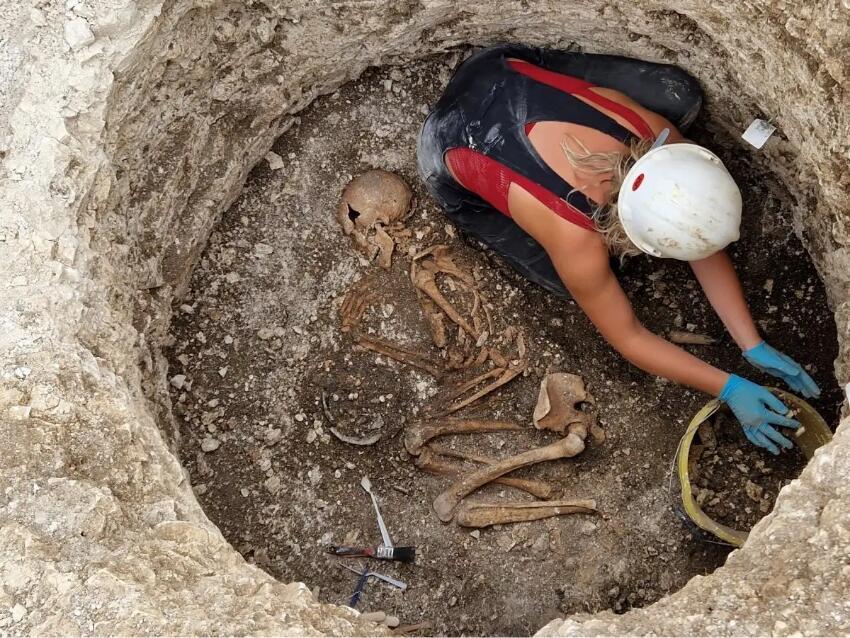
Researchers analyzed DNA from skeletons discovered in a burial chamber of the Celtic Durotriges tribe in southwest England and from additional skeletal remains at other sites. An archaeologist uncovers a skeleton at the site
(Photo: Bournemouth University)
For years, historians and archaeologists believed that during the Iron Age, there was limited population movement in Britain. This new study challenges that view, pointing to much broader genetic ties to continental Europe — suggesting that migration was an integral part of life in the region.
Rooted women, migrating men
One of the study’s key discoveries is the presence of a matrilocal pattern — a system in which men joined their wives’ communities while women remained in their place of birth. To identify this, researchers analyzed the Y chromosome, which is passed from father to son, and mitochondrial DNA, which is passed from mother to child. They found that Y-chromosome diversity was high, indicating that men had come from various regions, whereas diversity levels in mitochondrial DNA were relatively low — suggesting that women tended to stay in their communities.
This pattern implies that women played a central role in maintaining local traditions and cultural continuity. It is possible that the migrating men integrated into local communities through marriage or other social mechanisms, adapting to local customs and values. A previous study on Neolithic populations (circa 4850–4500 BCE) showed the opposite trend: women moved to their husbands’ homes. The new research suggests that a social shift occurred after this earlier period.
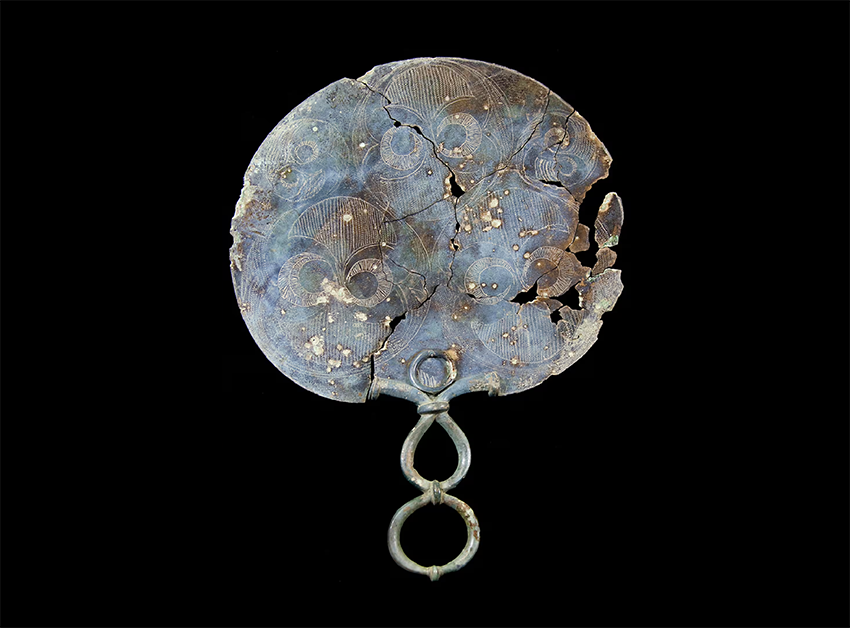
The study’s findings suggest that women were central to preserving local traditions and culture. A decorated bronze mirror uncovered at the excavation site
(Photo: Chris Moody/Bournemouth University)
“This is quite exciting,” said archaeologist Rachel Pope of the University of Liverpool in an interview with Science. “There are moments in time in which societies seem to have a lot of high female status.”
The matrilocal structure may also have shaped political dynamics. If women were the stable members of the community, they may have held important roles in family leadership, community management, and even political decision-making. Similar models have been observed in other cultures, such as early Balkan Greeks and the Basques until relatively recently, suggesting that this model was both widespread and sustainable in ancient Europe.
Women leading the way
The study’s conclusions challenge conventional perceptions, revealing that the British Isles were connected to Europe not only culturally but genetically. DNA analysis indicates that southern Britain, especially along the English Channel, was a major hub of cultural and genetic exchange. In contrast to the northern regions, such as Wales and Scotland, which remained relatively isolated, the south became a melting pot of external influences — a pattern reflected in the archaeological record. Researchers also identified significant migration streams dating back to the Bronze Age (2500–800 BCE) through the Late Iron Age (800 BCE–45 CE), including evidence of previously undocumented settlements.
Get the Ynetnews app on your smartphone: Google Play: https://bit.ly/4eJ37pE | Apple App Store: https://bit.ly/3ZL7iNv
It’s possible that matrilocal traditions played a central role in maintaining social ties and even in managing land ownership, calling into question long-held assumptions that prehistoric societies were universally patrilocal.
The use of advanced genetic methods has revealed a new and compelling portrait of Iron Age Britain: a society closely connected to the continent, open to change, and likely structured so that women held central roles in community life, while men integrated into established groups. The integration of archaeological and genetic evidence expands our understanding of human history — and reminds us that history is an ongoing process of change, with much still to learn about the complexity of past societies and humanity as a whole.