

More than 130 physicians considering aliyah gathered at MedEx UK in north London on October 25, seeking answers to questions that could reshape their careers and lives. Would their medical licenses be recognized in Israel? Where could they find work? How much Hebrew would they need? And what would it mean to leave behind the lives they had built in Britain?
MedEx | London 2026
(Video: Yael Feldman Shavit)


For some, moving to Israel had been a long-held aspiration. For others, rising antisemitism and the changing atmosphere surrounding Jewish life in Britain had given the question new urgency. The medical event took place alongside a broader aliyah fair attended by more than 1,200 people.
Gallery
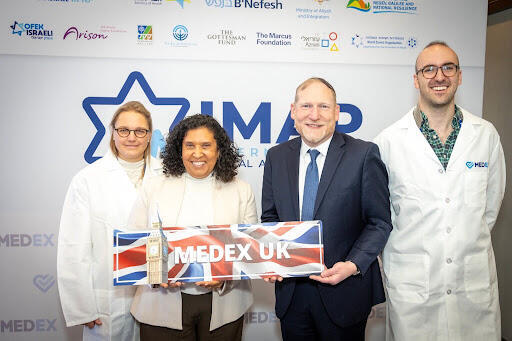
More than 130 physicians considering aliyah gathered at MedEx UK
(Photo: Meron Persey Photography)
For Dr. R, who has long dreamed of living in Israel, those concerns have made the possibility of aliyah feel increasingly relevant. "I've always had a secret yearning to make aliyah," he told ynet Global. "But that also has to be tempered with what is going on in Europe and concerns that I have for the future for Jewish people in the UK."
He has not personally experienced antisemitic harassment. His unease stems from what he has observed around him: anti-Israel demonstrations, public reactions to marches calling for the release of Israeli hostages and a growing discomfort with expressing his Jewish and Zionist identity openly.
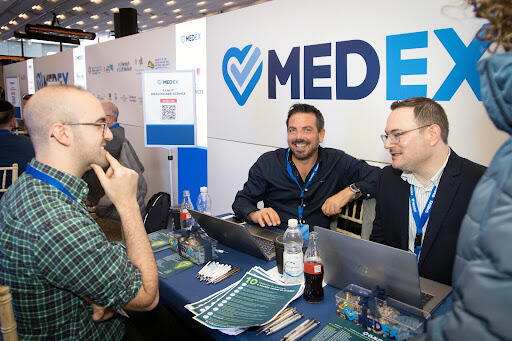
The physicians shared the personal hopes, professional challenges and decisions behind a potential move
(Photo: Meron Persey Photography)
"The writing's on the wall, and I don't see anything getting better," he said. "For me personally, with my underlying Zionist feelings, it's not cool to be a Zionist in the United Kingdom."
Yet for R and many other physicians attending MedEx, the decision involves more than identity and belonging. It also means navigating an unfamiliar medical system and rebuilding professional connections in another country.
Turning an aliyah dream into a medical career
MedEx UK is organized by Nefesh B'Nefesh in partnership with Israel's Ministry of Aliyah and Integration, Ministry of Health, Ministry of the Negev, Galilee and National Resilience, and the Jewish Agency for Israel. The event is part of the International Medical Aliyah Program (IMAP), launched in 2024 to recruit qualified physicians from abroad and help integrate them into Israel's health care system.
The initiative brings together government agencies responsible for medical licensing and immigration, hospitals and health funds seeking medical professionals, and organizations providing assistance before and after arrival. Nefesh B'Nefesh leads the recruitment and professional guidance effort, while the Ministry of Aliyah and Integration coordinates broader support for physicians and their families, including employment, Hebrew studies, education and community integration.
For Rabbi Yehoshua Fass, co-founder of Nefesh B'Nefesh, MedEx is about turning interest into action. "The last time we were in England for MedEx was two years ago, and it's a profoundly bigger event," he said. "It's a daunting process to move from one country to the next and to transplant your profession."
At MedEx, doctors can have their qualifications reviewed, discuss licensing requirements, take Hebrew proficiency tests and meet potential employers. Representatives from Hadassah, Shaare Zedek, Soroka, Laniado, ALYN and Tel Aviv Sourasky medical centers attended, alongside Israel's four health funds: Clalit, Maccabi, Meuhedet and Leumit.

(Photo: Yael Feldman Shavit)
"A person could come here in the morning with a concept, with this vision, with this dream of moving to Israel, and leave MedEx with actual practical steps," Rabbi Fass said. Some participants may even advance their licensing applications or receive job offers.
The effort addresses a pressing national need. Israel has approximately 3.5 practicing physicians per 1,000 residents, compared with an OECD average of 3.9, according to organizers. Shortages are particularly pronounced in the north and south, affecting specialties including family medicine, emergency care, psychiatry, oncology and rehabilitation.
IMAP aims to bring 2,000 doctors to Israel by 2029. Organizers say more than 1,300 physicians have already made aliyah through the initiative, supported by philanthropic partners including the Marcus Foundation, the Gottesman Fund, Jewish Federations of North America, the Azrieli Foundation and the Arison Foundation.
Jewish Agency Chairman Maj. Gen. (res.) Doron Almog described the recruitment effort as part of a broader national mission. "Aliyah is the driving force behind Israel's growth, and every new oleh who chooses to build their life here is a beacon of hope," Almog said. "Doctors who choose to make aliyah not only strengthen Israel's healthcare system, but also help build a better future for the country as a whole."
He emphasized the responsibility of the organizations involved to help immigrants establish homes, develop careers and contribute to Israeli society. For Fass, the message is simple: "Israel wants you. Israel needs you."
From uncertainty to opportunity
Among the participants was Dr. Charles Lever, a young British physician specializing in allergy and immunology, with one year remaining before qualifying as a consultant. He has been considering aliyah for several years, a desire that intensified after the October 7 attacks and the changes he has observed in Britain.
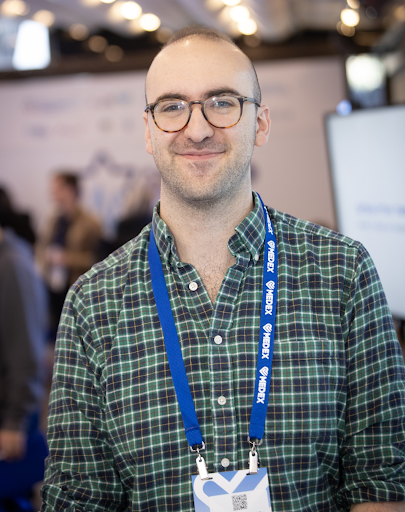
Dr. Charles Lever
(Photo: Meron Persey Photography)
"This is my second MedEx event," Lever said. "I've had the Israel bug, the drive to think about going back to Israel, for a couple of years."
After making valuable connections at MedEx in 2024, he returned this year to explore how his professional future might unfold in Israel. With his training nearing completion, Lever wanted to better understand the opportunities available in his specialized field.
He met doctors who had already made aliyah, reconnected with colleagues from Britain and spoke with Israeli health fund representatives.
"I think the whole Israeli healthcare system, as a UK-trained doctor, is extremely complicated," Lever said. The conversations helped him understand the system, the potential career paths and the realities of practicing medicine in another country.
He particularly valued meeting people who combined encouragement with practical experience. "You need someone who tells you you're doing the right thing and then also someone who sits you down and tells you what it's really going to be like."
For now, Lever plans to complete his training before deciding on his next steps.
Dr. Goenna Frauke Rehkamp, a radiologist based in Germany, was already further along in her preparations. She had begun investigating whether her German medical qualifications would be recognized in Israel and traveled to London specifically to meet the relevant representatives.
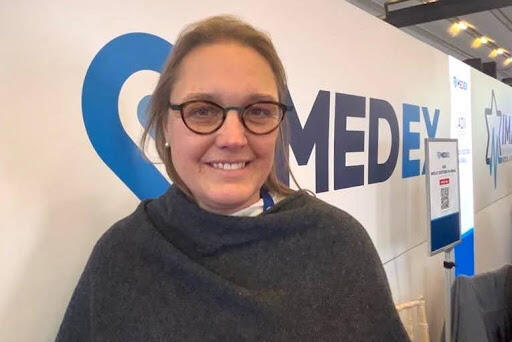
Dr. Goenna Frauke Rehkamp
(Photo: Yael Feldman Shavit)
"I think the most crucial part is if my license will be accepted so that I can work," Rehkamp said. "And of course, the language."
She has been studying Hebrew through Citizen Café Tel Aviv and knows that becoming fluent enough to practice medicine will require further effort. At MedEx, she was able to review her German documents, clarify translation requirements and meet physicians from Israeli medical institutions. One representative offered to help arrange document translations, removing a bureaucratic obstacle she would otherwise have faced in Germany.
Unlike some of the British participants, Rehkamp does not feel an immediate need to leave her country. She lives in a peaceful area but is watching Germany's changing political situation and wants to be prepared.
"If it will change, I want to be prepared that I can work and give something back."
Her moving date remains uncertain, depending largely on licensing approval, but the practical groundwork is underway.
‘It's an earthquake’
The growing interest among physicians reflects a wider shift in aliyah from Britain. According to figures released by the Jewish Agency, 890 people made aliyah from the UK in 2025, a 26% increase from 704 in 2024 and more than double the 377 recorded in 2023. Another 445 immigrated between January and July 2026, with those aged 18 to 35 representing the largest group.
Deganit Sanker-Lange, director-general of Israel's Ministry of Aliyah and Integration, said the atmosphere at MedEx reflected a profound change.
"Basically, it's an earthquake," she told ynet Global. Having worked in aliyah for many years, she said she had rarely encountered such urgency among prospective immigrants.
Antisemitism, she believes, is one factor, but the professional opportunities and integration programs Israel now offers are also encouraging people to consider moving.
"What we see here is this sense of urgency," she said, describing people asking what support Israel can offer and how quickly they could begin building their lives there.
The challenge of starting over
For R, one of MedEx's greatest advantages was the opportunity to meet Israeli medical professionals face to face. "While you can do things online, there is nothing to beat a bit of human contact," he said.
He hopes to settle near Netanya and combine clinical work with teaching or lecturing at an academic medical institution. Drawing on his experience in dermatology and allergy medicine, he wants to pass on his knowledge to younger Israeli specialists. "It would be nice to be able to contribute something back to Israel rather than just being in the diaspora as a Zionist," he said.
But moving also means adapting to a new professional environment, particularly the language. Although he has always managed to communicate during visits to Israel, practicing medicine requires a far more precise understanding of Hebrew. "You've got to fully understand all the nuances of what someone is telling you."
Much of medicine, he explained, depends on a patient's medical history and the details of their symptoms. For R, the challenge is not simply receiving permission to practice in Israel, but ensuring he can provide the same standard of care and professional judgment he has developed throughout his career.
What happens after aliyah?
Some of the most valuable advice at MedEx came from physicians who had already made the move.
Dr. Rivka Lebrett, a family physician who immigrated from Manchester approximately five years ago, represented Anglo Doctors in Israel (ADI), a professional community she established after experiencing the challenges of integration herself.
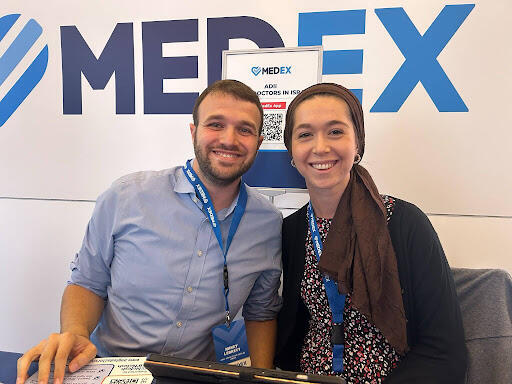
Dr. Rivka Lebrett with her husband, Mikey Lebrett
(Photo: Yael Feldman Shavit)
When she arrived, she lacked the professional network she had relied on in Britain.
"It's all about who you know," Lebrett said, explaining that foreign-trained doctors often struggle to navigate the Israeli medical system without local contacts.
She founded ADI as a small support group for English-speaking physicians. It has since grown into a network connecting doctors across hospitals and specialties, offering professional advice, educational sessions, events and WhatsApp groups. Together with her husband, Mikey Lebrett, she also developed a directory connecting English-speaking patients with physicians who speak their language.
The organization's work has revealed a less visible challenge: Israel's shortage of doctors does not automatically translate into employment for every physician who arrives.
Lebrett described a family doctor who moved to northern Israel after being told physicians were needed there, only to struggle to find a position. Another doctor encountered similar difficulties in Netanya.
Sometimes the obstacles are surprisingly basic. Newly arrived physicians may not know whom to contact at hospitals or health funds, and information is not always readily available. Emails go unanswered, leaving qualified doctors struggling to navigate a system actively seeking their expertise.
ADI helps bridge those gaps by connecting new arrivals with experienced colleagues who understand how the system works.
For Lebrett, the difficulties of her own first year remain a vivid memory.
"It was hard, but it's been so worth it," she said. Learning Hebrew, finding employment, making friends and adjusting to daily life all took time. Her experience convinced her that professional integration depends not only on official support, but also on a community willing to help newcomers establish themselves.
Bringing doctors home
Israel's efforts to strengthen its medical workforce extend beyond attracting new immigrants. At MedEx, Sanker-Lange acknowledged concerns about growing emigration from Israel, saying the trend worries officials responsible for aliyah and integration.
Her ministry also assists returning Israeli residents, including doctors seeking to resume their careers after working or training abroad. Through its Israeli Houses initiative, it helps returning citizens navigate taxation, housing, education and the practical requirements of relocating.
Financial incentives are also being used to encourage physicians to settle in regions facing significant shortages. Sanker-Lange described a doctor returning after several years of advanced training in Boston who plans to live and work in northern Israel. According to Sanker-Lange, the physician is eligible for a grant of 400,000 shekels linked to living and working in the region, an incentive that contributed to the decision to return.
The example highlights a broader challenge facing Israel's health care system: recruiting physicians is one task; ensuring they can establish careers, support their families and remain in the country is another.
From interest to integration
For the doctors attending MedEx, the event represented different stages of a journey still unfolding. Charles Lever intended to complete his training before deciding whether to make aliyah. Rehkamp had advanced her licensing preparations, while R was exploring opportunities to continue his career near Netanya and share his experience with Israeli medical students.
Each faced a different set of circumstances, but all were weighing professional ambitions, family considerations and the prospect of building a life in Israel.
For MedEx organizers, the goal is to turn that interest into practical opportunities, connecting prospective immigrants with the people and institutions that can help them take the next step. Yet the conversations in London also illustrated that medical licensing and recruitment are only the beginning. Successful integration depends on what happens afterward, when doctors must establish themselves professionally and personally in a new country.
For Israel, which is seeking to address its physician shortage, the ultimate measure of success will not be how many doctors attend recruitment fairs, but how many are able to build lasting careers and contribute to the communities that need them.
For R, that possibility remains closely connected to his professional identity. He wants to continue practicing medicine, share his knowledge and help train future physicians in Israel.
And perhaps that is MedEx's most meaningful promise: not simply helping doctors move to Israel, but enabling them to bring their experience, skills and ambitions with them, and put them to work in a country that needs them.
Disclosure: The reporter attended the event as a guest of MedEx
First published: 11:33, 11.03.26